Outstanding Currency Issuance Reaches 197 Trillion Won at End of Q1
Net Issuance Trend Continues Since Q4 2023
Falling Market Interest Rates Drive Demand for 50,000 Won Notes for Reserve Purposes
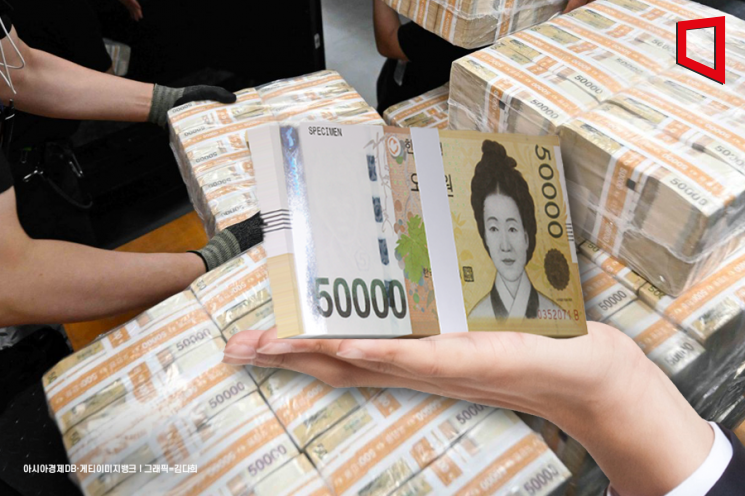
Despite the ongoing decline in cash usage, the trend of net issuance of currency continues. This is primarily due to the steady increase in demand for 50,000 won banknotes for reserve purposes, driven by falling market interest rates.
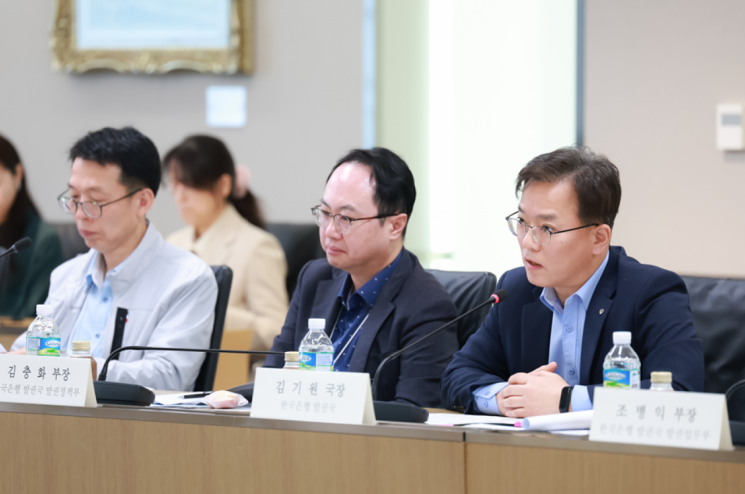 Kiwon Kim, Director of the Banknote Issuance Department at the Bank of Korea (right in the photo), is speaking at the first half regular meeting of the 'Currency Circulation System Related Agencies Council' held at the Bank of Korea headquarters on the 14th. Bank of Korea Photo by Kiwon Kim
According to the Bank of Korea on May 18, the outstanding balance of currency issued as of the end of the first quarter of this year stood at approximately 197 trillion won. Since the fourth quarter of 2023, net issuance has been centered on the 50,000 won note. The Bank of Korea explained that the recent decline in market interest rates has led to increased demand for 50,000 won notes for reserve and value storage purposes. In contrast, demand for lower-denomination notes, which are mainly used for transactions, remained largely unchanged. As for coins, circulation has been increasing since 2020. While the 10 won coin continues to see net issuance, the scale is rapidly decreasing.
On May 14, the Bank of Korea held the first half regular meeting of the 'Currency Circulation System Related Agencies Council' at its headquarters, where participants shared information and exchanged opinions on recent trends in currency supply and demand and key characteristics.
At the meeting, attendees examined the causes of differences in cash usage among major countries and used these findings to assess the level of cash usage in Korea. Korea has a high ATM penetration rate and a strong risk-averse tendency among its population. Since the factors influencing cash usage are similar to those in high-cash-use countries such as Japan, Spain, Germany, and Italy, participants concluded that, rather than experiencing a sharp decline like low-cash-use countries such as Australia, New Zealand, Canada, Finland, Sweden, and Norway, Korea is more likely to see a gradual decrease in cash usage that stabilizes at a certain level.
Cash transport companies and non-financial ATM operators expressed that a decline in cash usage inevitably leads to deteriorating profitability. They stated that they have no choice but to respond through organizational efficiency measures such as diversifying into non-cash handling businesses or reducing staff. They appealed for policy support to sustain cash handling operations. Furthermore, they emphasized that, since there are limits to ATM operation through their own efficiency efforts alone, institutional support such as adjusting long-frozen ATM fees to realistic levels is necessary.
There was also discussion on how to address the deterioration of cash accessibility in remote areas such as rural and fishing villages, resulting from the reduction in the number of bank branches and ATMs. Participants suggested that ATM reductions should be approached cautiously to maintain cash accessibility in rural areas, and that convenience store ATMs should be actively utilized as new access channels rather than relying solely on traditional bank branches. They agreed that expanding joint ATMs among financial institutions and promoting convenience store cashback services are effective means to maintain public access to cash, and that related agencies should closely cooperate to activate these measures.
Kiwon Kim, Director of the Banknote Issuance Department at the Bank of Korea and chair of the council, stated, "The recent decline in cash usage is reducing public access to cash and worsening business conditions for institutions participating in the currency circulation system, which is gradually increasing concerns about the stability of the currency circulation system. As the issuing authority, the Bank of Korea is making continuous efforts to systematically respond to the side effects of declining cash usage. As part of these efforts, we established a Currency Circulation Team within the Banknote Issuance Department in February."
He added, "Going forward, we will strengthen close information sharing and cooperation among participating institutions to ensure that effective policy alternatives can be developed for maintaining a sustainable currency circulation infrastructure."
© The Asia Business Daily(www.asiae.co.kr). All rights reserved.
![Clutching a Stolen Dior Bag, Saying "I Hate Being Poor but Real"... The Grotesque Con of a "Human Knockoff" [Slate]](https://cwcontent.asiae.co.kr/asiaresize/183/2026021902243444107_1771435474.jpg)
















