Bloomberg Expert Survey Results
"30% Tariff Could Cut 70% of Chinese Exports to the U.S."
Experts have found that the tariffs imposed by the Donald Trump administration on Chinese imports are likely to remain at around 30% until the end of this year.
On May 15 (local time), Bloomberg News reported these findings after surveying 22 experts, including analysts, economists, and investors.
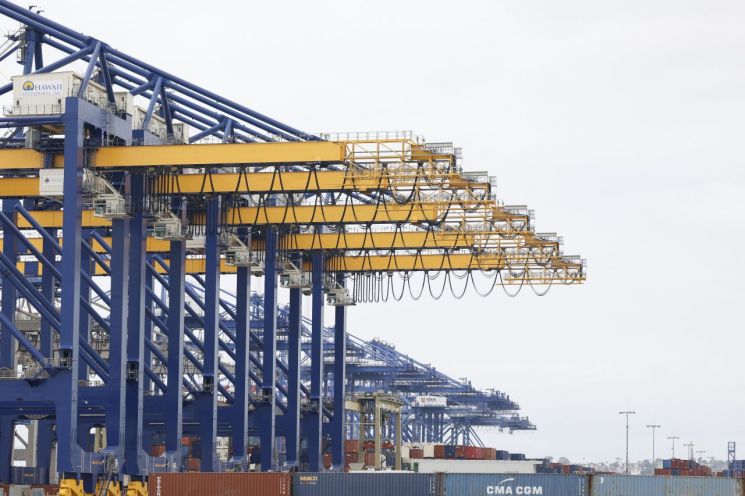
The United States and China, which had continued their tariff war by imposing high tariffs, held high-level talks in Geneva, Switzerland, on May 10-11. After these talks, both sides agreed to lower their respective tariff rates by 115 percentage points each for a period of 90 days. As a result, the U.S. tariff rate on Chinese goods became 30%, and the Chinese tariff rate on U.S. goods became 10%. Bloomberg Economics explained that the current U.S. tariff rate on Chinese imports is high enough to eliminate 70% of China's exports to the United States in the medium term.
Respondents noted that although the U.S. and China have reached a truce in their tariff war, it is highly likely that the Trump administration will maintain tariffs at a level that severely restricts Chinese exports to the U.S. even after the 90-day period ends.
The survey found that the median expectation for the U.S. tariff rate on Chinese goods six months from now is 30%. After a trade agreement is reached, the median expected final tariff rate is 20%.
Kelly Chen, an economist at DNB Bank, said, "I expect the trade negotiations will result in only a superficial agreement," adding, "There is not enough time for the positions of the U.S. and China to change significantly before the 2026 U.S. midterm elections. This election could serve as a potential deadline for an agreement."
Uncertainty is casting a shadow over the resolution of the U.S.-China trade conflict, and expectations for the future are divided. Among the survey respondents, seven expect the U.S. tariff rate on Chinese goods to fall below 30% within six months, while six expect tariffs to exceed 30%.
Bloomberg also reported that there was an overwhelming response that the tariffs imposed on Chinese goods during Trump’s first term would remain in place. This is because removing them could affect President Trump’s support base. According to estimates by Bloomberg Economics, these tariffs average about 12%.
Some respondents warned that President Trump’s tariff policy is unpredictable and advised against trying to forecast it from the outset. Sam Jokim, an economist at EFG Asset Management, said, "The first term of President Trump should serve as a warning that we cannot yet be assured, and there is no guarantee that any agreement will be maintained," adding, "Risks stemming from the high uncertainty of U.S. trade policy remain significant."
© The Asia Business Daily(www.asiae.co.kr). All rights reserved.

















