Demanding Solutions for Medical Student Issues from Three Presidential Candidates
"System Reform Needed, But Must Be Discussed with the Medical Community"
The Korean Medical Association (KMA) has announced plans to file a petition for a national audit regarding the unilateral increase in medical school admissions by the Yoon Suk Yeol administration. Regarding the healthcare pledges put forth by each major party’s candidate ahead of the 21st presidential election, the KMA emphasized that "discussions with medical professionals who possess expertise should come first."
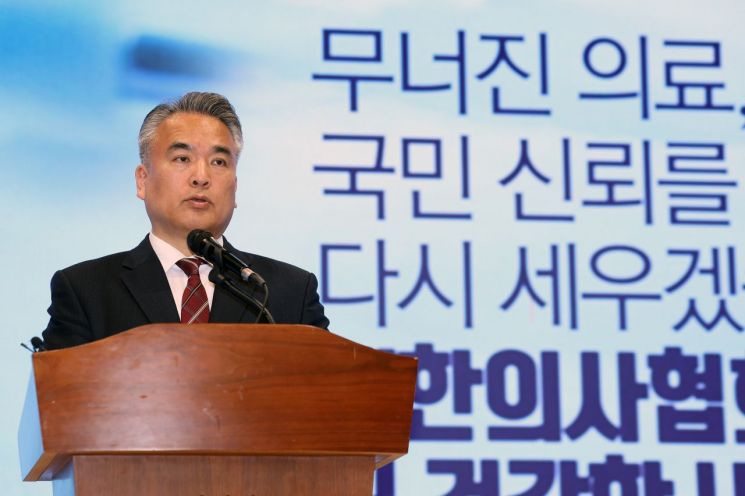
On the 16th, at a regular briefing held at the KMA headquarters in Yongsan-gu, Seoul, KMA spokesperson Sungkeun Kim stated, "In relation to the government’s unilateral push for an increase in medical school admissions, we intend to request an audit by the Board of Audit and Inspection through the national audit petition system, in order to hold those responsible for illegality, abuse of administrative authority, and losses to the national treasury and health insurance finances accountable." He added that the purpose of the audit is to correct hastily implemented healthcare policies and to demand accountability from those who devised misguided policies.
He also called on each party’s presidential candidates, saying, "Do you believe it is right for the current administration, which forcibly pushed through the increase of 2,000 medical school admissions, to now expel medical students without justifiable reason?" He urged them not to ignore the suffering of students and to make this issue a top priority for the new administration.
On this day, the KMA reiterated its position regarding the healthcare pledges of the presidential candidates, stating that while it recognizes the need to reform the healthcare system, any such reform must ensure expertise through discussions with the medical community.
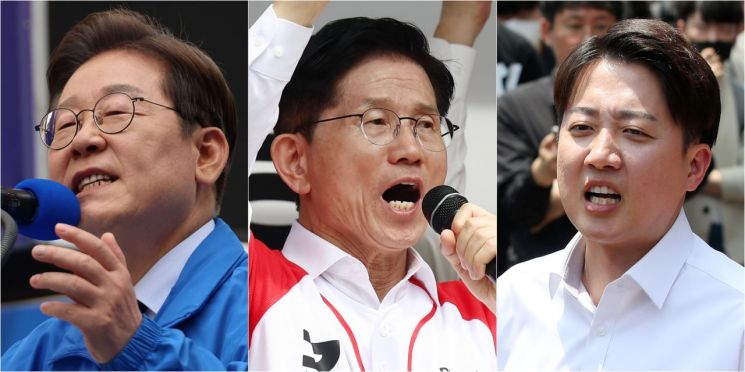 Lee Jae Myung, the Democratic Party presidential candidate (from the left in the photo), Kim Moon Soo, the People Power Party presidential candidate, and Lee Jun Seok, the Reform New Party presidential candidate. Yonhap News Agency
Opposition to Lee Jae Myung’s 'Public Healthcare' Pledge
The KMA acknowledged the problems in healthcare policy pointed out by Lee Jae Myung, the Democratic Party’s presidential candidate, through his pledges, but argued that fundamental solutions must be discussed.
First, while Lee’s pledge to "strengthen essential, regional, and public healthcare" is an issue the KMA has consistently advocated for, the association drew a clear line regarding Lee’s proposals to introduce a "regional doctor system" and to establish new "regional medical schools and public medical academies." The KMA stated that these measures do not fundamentally resolve workforce supply issues in regional and public healthcare sectors. The KMA urged for policies that can improve acceptance in the medical field by ensuring sufficient communication and consultation with the medical community.
The KMA also expressed a negative view toward the proposal to establish a "public deliberation committee for healthcare reform with citizen participation." The association’s position is that a decision-making system centered on experts and based on scientific evidence must be established. The KMA argued that pledges such as "alleviating the burden of rare and intractable diseases," "strengthening national responsibility for childhood obesity and pediatric diabetes," "resolving essential drug supply instability," and "building infrastructure for infectious disease crisis response" can only be effective if they undergo substantive consultation and opinion gathering with the medical community, which possesses the necessary expertise.
Regarding pledges to "establish a primary care system centered on personal physicians and tailored care," "expand home and visiting care," and "institutionalize telemedicine," the KMA stated that building a cooperative system among primary care institutions centered on local communities should also be considered. On pledges to "expand integrated nursing and care services," "apply health insurance to nursing care costs in long-term care hospitals," and "build a community-integrated care system," the KMA stressed the need for care policies centered on primary care institutions, which are the first point of contact for patients in the community.
The KMA responded positively to pledges to "resolve the issue of patients being bounced between emergency rooms" and "establish a 24-hour specialist response system for severe emergencies." However, the association believes that, in order to address these issues, structural improvements to the overall emergency medical system and substantial reforms to the medical delivery system are necessary, and that additional support such as expansion of emergency medical personnel and facilities and improvement of emergency medical fees should come first.
On Kim Moon Soo’s 'Complete Reassessment' Pledge: "Need for Concrete Implementation Plans"
Regarding Kim Moon Soo, the People Power Party’s presidential candidate, and his pledges to "rebuild the medical system within six months" and "establish a presidential committee on future healthcare," the KMA evaluated positively the intention to completely reassess the current administration’s healthcare reforms. However, the association emphasized that the committee must include increased participation of medical experts, and that discussions and decision-making must be regular and transparent.
The KMA also requested discussions with the medical community to build an efficient system for pledges such as "expanding national support for major disease vaccinations" and "strengthening the national responsibility system for dementia." Regarding the pledge to "strengthen the care and self-reliance balance system for the elderly," the KMA called for an in-depth review of realistic funding measures that take into account the financial burden. For the pledge to "strengthen support for people with disabilities," the association said that concrete measures are needed.
Regarding Lee Jun Seok, the Reform New Party candidate, and his sole healthcare-related pledge to "establish a separate Ministry of Health," the KMA expressed initial approval. However, the association demanded that the new ministry be tasked with formulating professional healthcare policies and be equipped with a decision-making structure that ensures medical expertise.
© The Asia Business Daily(www.asiae.co.kr). All rights reserved.
![Clutching a Stolen Dior Bag, Saying "I Hate Being Poor but Real"... The Grotesque Con of a "Human Knockoff" [Slate]](https://cwcontent.asiae.co.kr/asiaresize/183/2026021902243444107_1771435474.jpg)
















