"Completion of Six Metropolitan Ring Expressways"
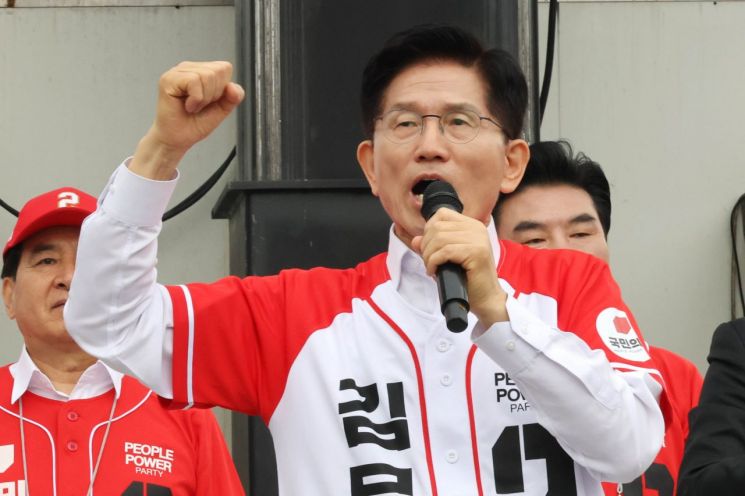
Kim Moonsoo Begins Campaign Tour in Gyeonggi and Chungcheong Regions
On May 16, Kim Moonsoo, the presidential candidate of the People Power Party, pledged to expand the Metropolitan Express Railway (GTX), which is currently limited to the Seoul metropolitan area, to a nationwide network.
That morning, after visiting Pangyo and Suwon in Gyeonggi Province, Kim announced his pledge for a "nation connected by GTX" in front of Dongtan Station in Hwaseong. Previously, in his list of ten major campaign pledges, Kim had already proposed a plan to connect Dongtan and Cheongju Airport as part of the nationwide expansion of the GTX.
First, he plans to complete six metropolitan ring expressways in the Seoul metropolitan area to reorganize the transportation system. This plan includes the undergrounding of the northern section of the Seoul Metropolitan Area Circular Road, undergrounding Gangbyeonbuk-ro and connecting it to the First Metropolitan Ring Expressway, and establishing a new connection between the Gangnam Circular Road and the First Metropolitan Ring Expressway. The People Power Party's Policy Headquarters explained in a press release that "traffic congestion is worsening due to the rapid population increase in the metropolitan area and the construction of the first, second, and third phases of new towns," and that "there is a growing need to underground and enhance the functions of existing ring roads and to establish new axes."
The plan is to complete and begin construction on all metropolitan GTX lines within his term, and to expand the GTX to other regions such as Chungcheong, Daegu-Gyeongbuk, Busan-Ulsan-Gyeongnam, and Honam. By expanding transportation infrastructure such as GTX and urban railways, the aim is to achieve a "30-minute commute revolution."
He also announced measures to reduce transportation costs for young people and seniors. The current transportation card policies, which are divided by local governments such as Seoul, Gyeonggi, and Incheon, will be integrated, and a nationwide integrated public transportation card (K-One Pass) will be introduced at a monthly cost of 60,000 won. In particular, young people will be able to purchase the K-One Pass for 50,000 won per month. For seniors aged 65 and older, free rides will be allowed on weekdays from 9 a.m. to 6 p.m.
In addition, he outlined plans to introduce a "rural Uber" to improve mobility for rural residents and to increase the number of call taxis for people with severe disabilities.
The People Power Party's Policy Committee stated, "We will closely expand transportation infrastructure and reduce the financial burden," adding, "We are committed to creating a society where everyone can travel comfortably anywhere in Korea by improving convenience for transportation-vulnerable groups."
That afternoon, Kim plans to meet with citizens in Cheonan, Cheongju, and Daejeon, visit the relocation site of the National Assembly in Sejong, and announce his pledge regarding the administrative capital.
© The Asia Business Daily(www.asiae.co.kr). All rights reserved.
![Clutching a Stolen Dior Bag, Saying "I Hate Being Poor but Real"... The Grotesque Con of a "Human Knockoff" [Slate]](https://cwcontent.asiae.co.kr/asiaresize/183/2026021902243444107_1771435474.jpg)















