Composed of 20 Members Including Business Leaders, Academia, and Researchers
The Korea Federation of SMEs announced on May 16 that it had launched the "2025 Corporate Succession Promotion Committee" at the federation's building in Yeouido, Seoul.

The Corporate Succession Promotion Committee was established to enhance the field applicability and expertise of policy initiatives aimed at promoting corporate succession. The committee, formed this year, consists of a total of 20 members, including first- and second-generation SME owners, as well as experts from academia, research, law, and tax sectors. Kim Dongwoo, President of the Korea Concrete Industry Cooperative Federation, and Jung Jaeyeon, President of Kangwon National University, were appointed as co-chairs.
In addition, a joint forum was held with the Family Business Association under the theme "Tasks for Centennial Enterprises: Shifting Policy from Family Business Succession to Corporate Succession."
Choi Sujeong, a research fellow at the Korea Small Business Institute, delivered a keynote presentation titled "Legislative Directions for a Paradigm Shift in Corporate Succession." Choi pointed out that, although the proportion of SME manufacturing owners aged 60 or older increased from 15.9% in 2013 to 36.8% in 2023, indicating rapid aging, the current system still focuses on inheritance and family-based succession, lacking institutional foundations for diverse succession methods.
Choi further emphasized the need to establish a legal framework supporting corporate succession by integrating various policy tools, such as expanding the scope of support to include employee succession and M&A-based succession, as seen in Japan's Business Succession Facilitation Act, as well as incorporating financial support and M&A assistance.
Chu Moongap, head of the Economic Policy Division at the Korea Federation of SMEs, also participated as a panelist and presented the results of a survey on SME corporate succession. According to the survey, 27.5% of SMEs had not established a succession plan for their children. Excluding respondents who said they were too young to consider succession, the main reasons cited were "not wanting to impose a heavy responsibility on their children" (42.8%) and "their children not wanting to take over" (24.7%).
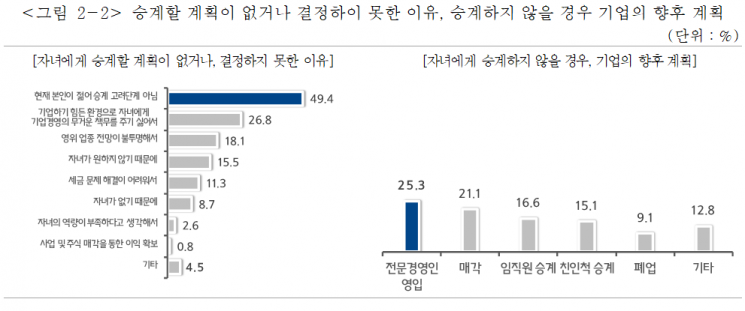
Notably, 30.2% of SMEs that did not plan to pass on their business to their children responded that they were considering selling or closing the business in the future, highlighting the need to prepare alternatives such as third-party succession to address succession gaps. In addition, 87.7% of SMEs agreed on the necessity of enacting a separate law to promote corporate succession, and 64.5% supported the introduction of third-party succession and M&A support systems.
When asked about the support needed for third-party succession, respondents cited "tax relief" (70.8%), "simplification of succession procedures such as M&A requirements" (39.3%), "expert consulting" (25.3%), and "financial support for succession" (18.6%).
Chu stated, "The results of this survey show that SME succession can no longer be resolved solely through family succession, and that it is urgent to establish a system that institutionally supports various succession routes. Corporate succession for SMEs should be recognized as a social issue aimed at building centennial enterprises, not merely as an asset transfer. Through the enactment of a special law on SME corporate succession, a comprehensive and systematic policy foundation should be established to include various forms of succession."
© The Asia Business Daily(www.asiae.co.kr). All rights reserved.
![Clutching a Stolen Dior Bag, Saying "I Hate Being Poor but Real"... The Grotesque Con of a "Human Knockoff" [Slate]](https://cwcontent.asiae.co.kr/asiaresize/183/2026021902243444107_1771435474.jpg)
















