EU Trade Chief Holds Talks with US
Pledges to Deepen Technical-Level Negotiations
Substantive Detailed Discussions Begin
Conflicts Over VAT and Appropriate Tariff Rates
Optimistic Tone Accelerates Agreement
"If Negotiations Fail, Retaliatory Tariffs Will Follow"
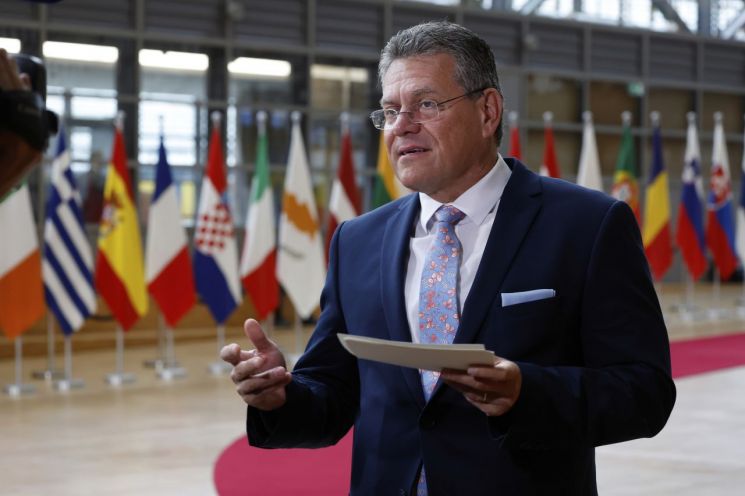 Marosi Chefchovich, European Union (EU) Commissioner for Trade and Economic Security, explained the progress of trade negotiations with the United States to reporters at the EU Trade Ministers' Meeting held in Brussels, Belgium, on the 15th (local time). Photo by AP
The European Union's (EU) top trade official, who is currently negotiating tariffs with the United States, officially announced on the 15th (local time) that the two sides have agreed to accelerate the pace of their negotiations. Europe and the United States continue to play a "ping-pong game" over contentious trade issues, including the EU's tax regulations and appropriate tariff rates, which reflect the sharp interests of both sides. However, as the United States has recently achieved trade agreements in succession with the United Kingdom and China, expectations for the negotiations with the US have grown within the EU.
"Spoke with US Commerce Secretary Rutnick... Deepening technical-level talks"
Marosi Chefchovich, EU Commissioner for Trade and Economic Security, told reporters at the EU Trade Ministers' Meeting held in Brussels, Belgium, that "yesterday (the 14th), I once again had a constructive phone call with US Commerce Secretary Howard Rutnick, and we agreed to deepen negotiations at the technical levels." This indicates that substantive detailed discussions have begun.
He added, "I also exchanged text messages with Jamison Greer, the US Trade Representative, just a short while ago, and I expect we will meet again soon, either in Brussels or at an OECD meeting."
The European Commission is reportedly continuing its dialogue with the US while revising its negotiation proposals. According to reports from US media outlets such as Bloomberg, the EU is considering concessions including expanding European investment in the US, increasing purchases of US liquefied natural gas (LNG) and artificial intelligence (AI) semiconductors, and even the possibility of mutual tariff elimination.
Some of the US demands remain difficult for the EU to accept. For example, there is the EU's value-added tax (VAT), which US President Donald Trump has cited as a representative non-tariff barrier. This week, President Trump continued his criticism of the EU, saying it is "in some ways even more vicious than China." In response, the EU has maintained that tax and regulatory issues are matters of sovereignty that cannot be compromised.
The two sides have sharply different views on appropriate tariff rates. For instance, the EU has stated that it will not accept an agreement at a level below that achieved by the United Kingdom, which reached its first trade deal with the US on the 8th. This means the EU wants an agreement at a zero-tariff level, lower than the 10% basic (universal) tariff accepted by the UK. In an interview with the Financial Times (FT) on the 1st, Commissioner Chefchovich also suggested that the 10% tariff rate is "very high" and indicated that it is unacceptable.
Rising expectations within the EU for negotiations with the US
How much the two sides can narrow these gaps depends on the sincerity with which they approach the negotiations. Fortunately, as the US has reached trade agreements with the UK (on the 8th) and China (on the 12th) in succession, expectations for negotiations with the US have grown within the EU. Michal Baranowski, Deputy Minister of Economic Development and Technology of Poland, which holds the EU presidency for the first half of the year, said, "There are some optimistic signs as the US side is showing elements of de-escalation," adding, "Negotiations with the EU are gaining momentum."
There are also signs that the US, which had previously maintained an ambiguous stance without specific demands, is now showing a more sincere approach to the negotiations. The US administration reportedly sent a letter to the European Commission this week containing its response to the 'tariff compromise proposal.' The letter is also said to include the US's own demands. According to Politico Europe, this is the first time during the Trump administration's negotiations with the EU that such a positive and concrete response has been provided.
The EU has once again confirmed its policy of imposing retaliatory tariffs if the negotiations fail. Previously, the EU had warned that it planned to implement economic retaliatory measures within 90 days. These measures would target approximately 21 billion euros (about 33 trillion won) worth of US products. Separately, the EU is also planning additional retaliatory measures targeting US big tech companies such as Google and Meta, which generate significant profits from service trade with Europe.
© The Asia Business Daily(www.asiae.co.kr). All rights reserved.
![Clutching a Stolen Dior Bag, Saying "I Hate Being Poor but Real"... The Grotesque Con of a "Human Knockoff" [Slate]](https://cwcontent.asiae.co.kr/asiaresize/183/2026021902243444107_1771435474.jpg)















