Gwangyang City, Yeosu Coast Guard, POSCO E&C, and World Vision
Aim to Create a Sustainable Marine Environment
Gwangyang City in South Jeolla Province has begun public-private cooperation to expand blue carbon, a marine carbon sink.
The city announced that on May 15, it signed a business agreement with the Yeosu Coast Guard, POSCO E&C, and World Vision at the meeting room of City Hall to establish "Gwangyang Bay Blue Carbon."
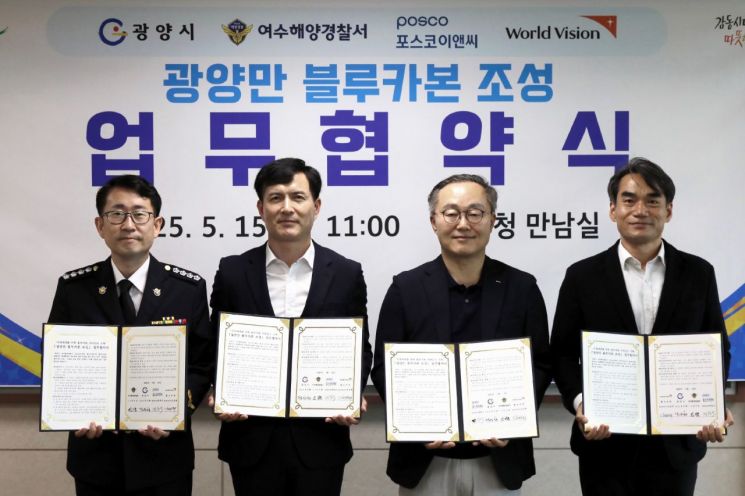 On the 15th, at the meeting room of Gwangyang City Hall, a business agreement was signed with Yeosu Coast Guard, POSCO E&C, and World Vision to establish the "Gwangyang Bay Blue Carbon." Photo by Gwangyang City
Blue carbon refers to carbon absorbed and stored by marine and coastal ecosystems such as tidal flats, seagrasses, and halophytes. It is gaining attention as a nature-based solution to address the climate crisis.
The purpose of this agreement is to establish a foundation for joint action to restore the coastal ecosystem of Gwangyang Bay and reduce carbon emissions. Under the agreement, the participating organizations will collaborate in various fields, including administrative and technical cooperation for blue carbon creation, restoration and management of coastal ecosystems, and promotion and education to increase citizen participation.
Previously, in March, the city sowed 70 kilograms of halophytes in the Seonsori area of Jinwol-myeon at the mouth of the Seomjin River. With this agreement, the city plans to expand the blue carbon creation area to the entire Gwangyang coast.
Cho Sangjin, head of the Resource Circulation Division, said, "This agreement is a practical starting point for conserving coastal ecosystems and expanding blue carbon," adding, "We will build a sustainable environmental foundation through cooperation among institutions."
© The Asia Business Daily(www.asiae.co.kr). All rights reserved.
![Clutching a Stolen Dior Bag, Saying "I Hate Being Poor but Real"... The Grotesque Con of a "Human Knockoff" [Slate]](https://cwcontent.asiae.co.kr/asiaresize/183/2026021902243444107_1771435474.jpg)















