Emergence of Healthy and Educated "Young Old"
More People Willing to Work, but Demand Remains Low
"Need to Address the Aging of Work Practices"
Pursuing Both Wage Flexibility and Employment Stability
Continued Employment Needed... Gradual Discussion on Extending Retirement Age
"Success in Responding to Aging Depends on Monitoring Youth Employment"
There is an assessment that the seniority-based wage system and rigid employment protection are constraining the demand for older workers in South Korea. Some experts have also argued that the probability of retirement among older workers who benefit from seniority increases when the economy worsens. To address these issues, it has been advised that policies should be developed to enhance wage flexibility for middle-aged and older workers while ensuring employment stability. Additionally, it was suggested that the Japanese-style continued employment (rehiring) system should be promoted, while discussions on extending the retirement age should proceed gradually.
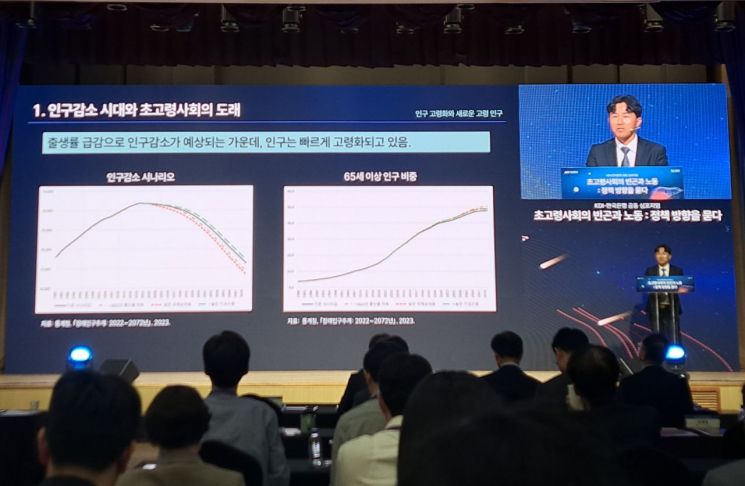 Joseph Han, Research Fellow at the Fiscal and Social Policy Research Department of the Korea Development Institute (KDI), is presenting at a session during the KDI-Bank of Korea Joint Symposium held at the KDI Conference Hall in Sejong City on the 15th. Photo by Kim Pyeonghwa
Joseph Han, Research Fellow at the Fiscal and Social Policy Research Department of the Korea Development Institute (KDI), gave a session presentation on "The New Elderly Population and Changes in the Labor Market in Response" at the KDI-Bank of Korea Joint Symposium held at the KDI Conference Hall in Sejong City on the 15th. The event was organized to diagnose elderly poverty and the current state of the labor market for older adults as South Korea enters a super-aged society, and to seek effective policy responses.
During the session, Han pointed out that, unlike in the past, the emergence of the "young old" means that this generation lives longer and has a higher level of education than previous generations. He also explained that there have been clear changes, such as the economic activity of older adults being more focused on wage employment and a rising proportion of white-collar jobs. He particularly emphasized that these changes are more pronounced among older women.
Han explained, "Population aging due to increased life expectancy can actually be seen as providing new opportunities." He further noted, "The emergence of generations who live longer and healthier lives has a positive effect, as it increases the supply of skilled labor in the economy." He also mentioned, "The negative impact of a declining working-age population can be largely offset by increased productivity among those aged 50 to 60 and above."
However, he pointed out, "To productively utilize the young old, fundamental changes are needed in the labor market." This is because a high proportion of workers retire from their long-term jobs before reaching the official retirement age, and despite strong willingness to work, many retire early due to insufficient labor demand or deteriorating health. At the reemployment stage, about 40% of older workers end up at workplaces with fewer than 10 employees or in jobs unrelated to their previous work.
Han cited the seniority-based wage system and rigid employment protection as reasons for the low demand for older workers in South Korea. He said, "While seniority can protect older workers,it can also act as a double-edged sword when the economy worsens." He explained, "When companies face difficulties, they implement voluntary or honorary retirements, and those who benefit from seniority are often the first to be targeted for retirement."
He continued, "Overseas, it is common to conduct layoffs in reverse order of hiring," and explained, "In Korea, given the seniority-based wage system, the Supreme Court has ruled that prioritizing long-term employees for dismissal can be considered a fair and reasonable standard for layoffs." He added, "In fact, we found that when the local economy worsened, the probability of older workers retiring increased."
Han also noted, "Another important reason for the low demand for older workers is the lack of regular (permanent) job openings." He explained, "In Korea, employment protection is applied differently to regular and non-regular workers. From the employer's perspective, even if they want to hire older workers, hiring them as regular employees imposes various burdens."
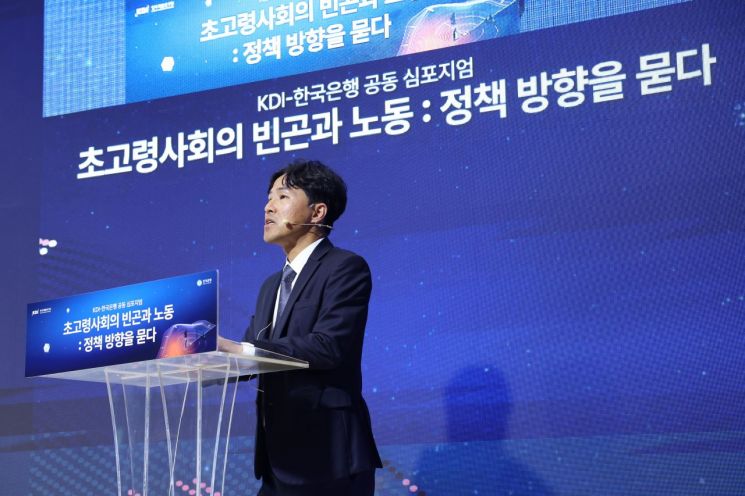 Joseph Han, Research Fellow at the Fiscal and Social Policy Research Department of the Korea Development Institute (KDI), is giving a session presentation at the KDI-Bank of Korea joint symposium held at the KDI conference room in Sejong City on the 15th. Photo by KDI
The statutory retirement age is also a limiting factor. Han said, "The retirement age functions as a ceiling for employment protection," and compared extending the retirement age in Korea to "lifting a very heavy barbell." He also explained, "In small and medium-sized enterprises or blue-collar jobs where there is a labor shortage, the retirement age is meaningless, but in large corporations or white-collar jobs, where the retirement age matters, the real problem is a shortage of jobs, not a shortage of workers."
Han noted, "When the retirement age of 60 or older was introduced in 2016 and made mandatory for workplaces with 300 or more employees, three out of five beneficiaries actually saw their employment extended, and it was estimated that about one youth job was lost as a result." He added, "There was no decrease in youth jobs at workplaces with fewer than 100 employees, but the impact grew significantly at companies with 1,000 or more employees."
As a short-term policy task to address these limitations, Han stated, "It is necessary to move toward enhancing wage flexibility for middle-aged and older workers while ensuring employment stability." The idea is that wage flexibility can minimize layoffs for managerial reasons, and employment stability can be strengthened for occupations or workers who accept wage flexibility.
He also suggested, "When employing older non-regular workers, market-friendly protection can be provided by paying a contract termination allowance." He explained, "This allowance can be waived if the contract is renewed, thus encouraging continued employment." He also proposed that, to ensure employment stability after the retirement age, it is necessary to promote the Japanese-style continued employment (rehiring) system.
Han emphasized, "The mid- to long-term challenge is not the issue of population aging itself, but the aging of work practices," and stated, "It is necessary to invest in innovations that transform the way we work." He also suggested, "Extending the retirement age should be pursued gradually in connection with reforms to the dual structure of the labor market."
Regarding concerns about conflicts with youth employment, he stated, "Although the population is declining, the unfavorable environment for youth employment may persist for some time," and emphasized, "We must maintain continuous attention to avoid failure in responding to population aging."
© The Asia Business Daily(www.asiae.co.kr). All rights reserved.


















