Seoul's School-Age Population Continues to Decline
Over 1,000 Classes Disappear Across All School Levels
Kindergarten Closures and Fewer Elementary School Classes Highlight Demographic Shift
This year, more than 1,000 classes have disappeared from kindergartens, elementary, middle, and high schools in Seoul. This is due to a decline in the school-age population, with the decrease in the number of elementary school classes being particularly pronounced among the different school levels.
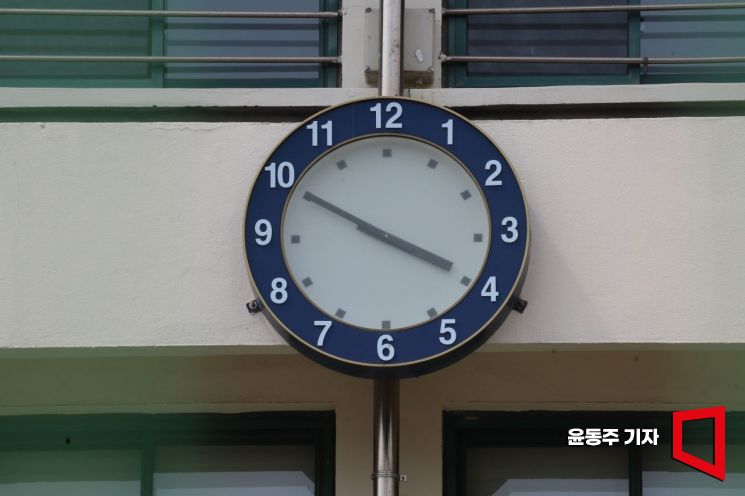 The clock at Huayang Elementary School, which was closed in 2023, has stopped. 2025.04.16 Photo by Dongju Yoon
According to the 2025 class organization results announced by the Seoul Metropolitan Office of Education on May 16, the total number of students in kindergartens, elementary, middle, high, special, and various other schools in Seoul this year is 812,207, a decrease of 22,863 students (2.7%) from last year's 835,070. Compared to four years ago in 2021 (902,940 students), this represents a decrease of 90,733 students (10%).
As the number of students decreased, the number of schools also dropped by four this year. While the number of elementary, middle, and high schools remained unchanged, the number of kindergartens decreased by five (with eight public kindergartens closing and three new public kindergartens opening), and the number of various other schools increased by one, bringing the total number of schools to 2,115.
Over the past five years, the total number of schools has decreased by 36. Except for two high schools, all closures or shutdowns occurred at kindergartens. The number of kindergartens fell from 787 in 2021 to 788 in 2022, 769 in 2023, 754 in 2024, and 749 this year, meaning a total of 38 kindergartens have closed. As the low birth rate accelerates, schools serving younger age groups are more heavily affected by the declining birth rate. During the same period, the number of elementary schools increased by two and the number of middle schools increased by one.
The closure of kindergartens was mainly driven by private kindergartens. Since private kindergartens, operated by individuals or corporations, receive limited financial support, a decrease in enrollment often leads directly to closure due to reduced income. Over the past five years, the number of private kindergartens dropped from 513 to 448, a decrease of 65 (12.7%), while public kindergartens increased from 274 to 301, a rise of 9.9%. The Seoul Metropolitan Office of Education attributed the increase in public kindergartens to the success of policies aimed at expanding public kindergarten services.
For elementary, middle, and high schools, apart from kindergartens, the impact of the declining school-age population has appeared as a reduction in the number of classes rather than school closures.
The total number of classes in all schools in Seoul is 38,063, a decrease of 2.6% from last year's 39,079. By school level, the number of elementary school classes (16,927) decreased by 508 classes (2.9%), marking the largest drop, while middle schools (8,060 classes) saw a decrease of 173 classes (2.1%), and high schools (8,527 classes) decreased by 237 classes (2.7%). Kindergartens (3,478 classes) saw a decrease of 98 classes (2.7%), while the number of classes in special and various other schools remained unchanged.
The decrease in the number of elementary school classes is largely attributable to the decline in student numbers. The number of elementary school students is 342,249, a decrease of 5.8% from the previous year, which is the largest drop among elementary, middle, and high schools. During the same period, the number of high school students decreased by 1.9%, while the number of middle school students increased by 2.2%. The temporary increase in middle school students is believed to be due to population spikes among those born in the Year of the White Tiger (2010, currently third-year middle school students) and the Year of the Black Dragon (2012, currently first-year middle school students).
The average number of students per class in elementary, middle, and high schools was 23.3, the same as the previous year.
The Seoul Metropolitan Office of Education plans to improve educational conditions by comprehensively considering trends in student numbers, regional and school-specific circumstances, and by managing an appropriate number of classes, reducing the number of students per class, and fostering appropriately sized schools.
© The Asia Business Daily(www.asiae.co.kr). All rights reserved.

















