Investment and Production Reconsidered
Bloomberg: "Impact Expected to Last for Years"
Bloomberg News reported on May 14 (local time) that major Japanese automakers are expected to suffer losses exceeding $19 billion (approximately 26.6437 trillion won) due to U.S. President Donald Trump's tariff policy.
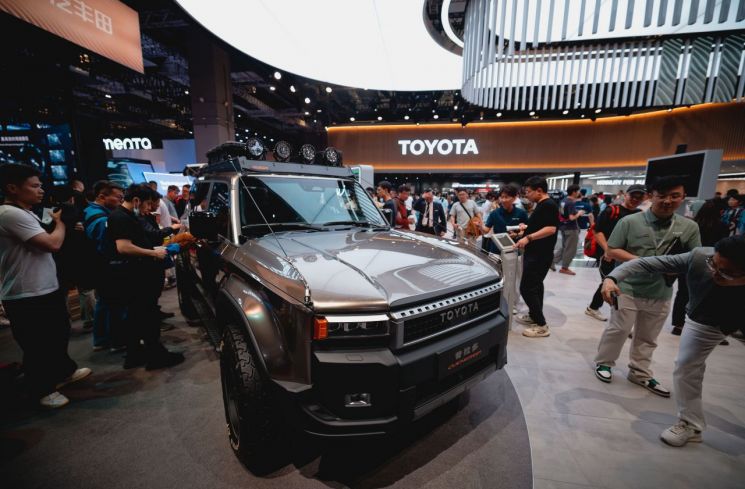
Toyota Motor is expected to be hit the hardest. Toyota announced that it expects the policy to impact its operating profit by as much as 180 billion yen (about 1.7256 trillion won) just in April and May. Bloomberg Intelligence estimated that, for the entire fiscal year, the tariff policy could result in annual losses of up to $10.7 billion (about 15 trillion won). Julie Booth Pelham Smithers, an analyst, projected losses between $5.4 billion and $6.8 billion.
Nissan and Honda each anticipated losses of about $3 billion. Subaru, which imports about half of its vehicles sold in the U.S., projected losses of $2.5 billion and did not provide an annual earnings outlook. Mazda Motor also did not present an annual forecast.
Bloomberg Intelligence estimated that, due to the U.S. tariff policy, Honda would face losses of $4.5 billion, Nissan $3 billion, Subaru $2.6 billion, and Mazda $2.3 billion.
The United States is the largest market for major Japanese automakers. Most vehicles imported into the U.S. have been subject to a 25% tariff since the 3rd of last month. Auto parts have also been subject to a 25% tariff since the 3rd. Bloomberg projected that, as a result of these policies, car prices in the U.S. would rise by several thousand dollars.
As U.S.-Japan trade negotiations are expected to intensify at the end of this month, whether to abolish auto tariffs has become a key issue. Japanese automakers are hoping for a suspension of the tariffs. On May 12, Japanese Prime Minister Shigeru Ishiba drew a clear line, stating that, given the importance of the auto industry to the Japanese economy, Japan would not agree to tariff negotiations unless automobiles are excluded.
With uncertainty over tariffs increasing, the Japanese auto industry is reconsidering investment and production in North America. Bloomberg projected that the repercussions would continue for years.
Honda announced that it has postponed by two years its plan to invest 15 billion Canadian dollars in building an electric vehicle supply chain in Canada, including factory construction. Honda is also shifting production of the Civic Hybrid model from Japan to the United States. Subaru is reviewing all investments, including those related to electric vehicle development, and Nissan has halted U.S. orders for sport utility vehicles (SUVs) produced in Mexico.
© The Asia Business Daily(www.asiae.co.kr). All rights reserved.
![Clutching a Stolen Dior Bag, Saying "I Hate Being Poor but Real"... The Grotesque Con of a "Human Knockoff" [Slate]](https://cwcontent.asiae.co.kr/asiaresize/183/2026021902243444107_1771435474.jpg)















