Technical Challenges in Navigation Payload System Design... Additional Time Required for Design, Development, and Verification
Space Aviation Agency Approves Plan at the 5th Space Development Promotion Working Committee
The first satellite launch of the Korean Positioning System (KPS), originally scheduled for December 2027, has been postponed by 20 months to September 2029.
On May 15, the Space Aviation Agency held the 5th Space Development Promotion Working Committee, presided over by Commissioner Yoon Youngbin, and deliberated and approved a proposal to adjust the development plan for the first satellite of the Korean Positioning System (KPS), jointly submitted by relevant ministries.
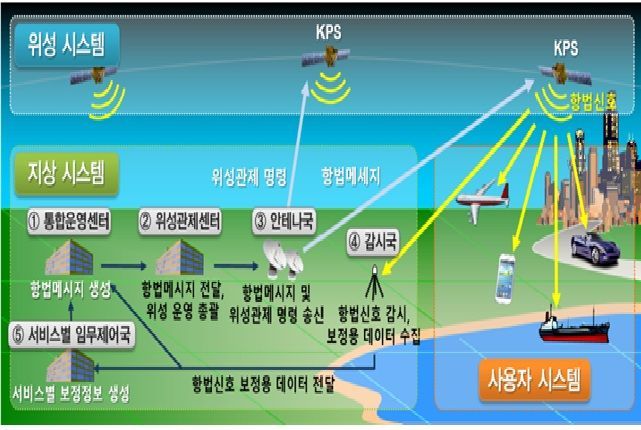
The KPS development project aims to create a satellite navigation system that provides ultra-precise positioning, navigation, and timing information in the vicinity of the Korean Peninsula. Currently, only six countries?recognized as traditional space powers?possess their own satellite navigation systems: the United States, Russia, the European Union, China, India, and Japan.
Based on its steadily accumulated capabilities in satellite development and navigation technology, South Korea launched the KPS development project in 2022 through a joint effort among relevant ministries, aiming to become the seventh country in the world to possess its own satellite navigation system.
Prior to the preliminary design review of the KPS system and the first satellite, the Space Aviation Agency conducted a thorough assessment of research and development progress, technology maturity, and risk factors through an inspection and evaluation team from September to December last year, and a separate review committee from December last year to April this year. As a result, technical difficulties were identified in the system design of the navigation payload. The navigation payload is a core component of navigation performance, responsible for generating and broadcasting navigation and correction signals from the satellite.
Considering the development complexity of the navigation payload system, which is being developed domestically for the first time, and to ensure the reliability of navigation performance, the Space Aviation Agency determined that additional time is required for the specification design, development, and verification of the navigation payload.
Based on these findings, the Space Development Promotion Working Committee confirmed a plan to extend the development period for the first satellite by 20 months.
Accordingly, the first satellite is now scheduled to launch in September 2029, followed by an initial operation and technology verification phase until August 2030. However, to achieve the final project goal of deploying eight satellites by 2035, the agency will revisit the detailed development plans for subsequent satellites after the upcoming "system preliminary design review" next quarter, in order to minimize the impact on the overall schedule.
Support for the project organization, which had been identified as needing reinforcement, will also be strengthened. The KPS Development Project Headquarters, initially established as an independent organization within the Korea Aerospace Research Institute (KARI) at the start of the project, will be incorporated as a department directly under the KARI president. This change is expected to enable more professional project management and technology development through active administrative and financial resource allocation at the KARI level and more efficient personnel placement.
Commissioner Yoon Youngbin stated, "With the growing economic and strategic importance of positioning, navigation, and timing information, developing a satellite navigation system tailored to Korea's needs has become more crucial than ever." He emphasized, "The Space Aviation Agency will continue to provide unwavering support to ensure that KPS is developed without delay as a key infrastructure for revitalizing the space economy and realizing Korea's ambitions as a space power."
© The Asia Business Daily(www.asiae.co.kr). All rights reserved.
![Clutching a Stolen Dior Bag, Saying "I Hate Being Poor but Real"... The Grotesque Con of a "Human Knockoff" [Slate]](https://cwcontent.asiae.co.kr/asiaresize/183/2026021902243444107_1771435474.jpg)















