Recently, the popularity of officetel monthly rentals has declined. As prices have soared, demand has failed to keep up. However, experts predict that this phenomenon will not persist. They cite the ongoing impact of jeonse fraud and changing perceptions regarding monthly rentals as the reasons.
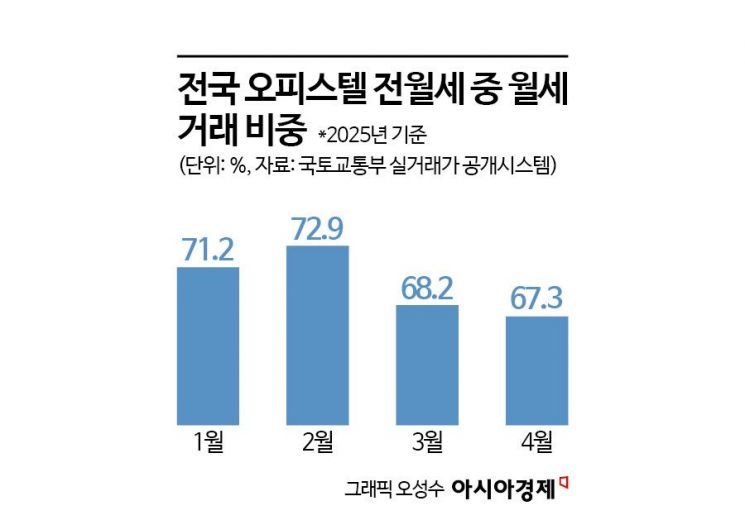
According to the Ministry of Land, Infrastructure and Transport's real transaction price disclosure system on May 15, the proportion of monthly rental transactions among all officetel lease transactions nationwide last month was 67.3%. This is a decrease of 5.6 percentage points compared to February, when it reached the highest level of the year at 72.9%. In March, the figure was 68.2%.
This trend has also been observed in Seoul, which accounts for about one-third of all officetel lease transactions nationwide. In February, the proportion rose to 73.8%, establishing monthly rentals as the dominant trend in the officetel lease market. However, last month the proportion fell to 69.4%, dropping below the 70% mark.
It is unusual for the proportion of monthly rental transactions to decrease during the busy spring moving season, when demand is typically high. Experts believe that landlords raising rents has contributed to the decline in transactions. This suggests that the price increase has reached its limit. According to the Korea Real Estate Board, the average monthly rent for officetels in March was 786,000 won, up 14,000 won from 772,000 won a year earlier. This also represents an increase compared to 784,000 won in January. In contrast, the average jeonse price fell from 177.07 million won in January to 176.94 million won in March.
As monthly rental prices have risen, the rental yield for officetels has also increased. In March, the nationwide yield for officetels was 5.51%, up 0.21 percentage points from 5.3% in the same period last year. The yield refers to the ratio of monthly rent to the sale price.
Experts predict that although the proportion of officetel monthly rental transactions has declined, tenant demand will continue. They emphasize that this is only a temporary decrease in proportion and does not signal a shift in the overall trend of the lease market.
Kwon Youngsun, team leader at Shinhan Bank's Real Estate Investment Advisory Center, said, "Tenants are increasingly shifting their perception, preferring to pay monthly rent and invest their money elsewhere rather than locking it up in a jeonse contract. Although higher monthly rents may be burdensome, it is unlikely to cause a shock significant enough to completely overturn the trends in the officetel lease market." Yoon Sumin, a senior advisor at NH Nonghyup Bank, also stated, "The aftereffects of jeonse fraud still persist, and this continues to drive demand for monthly rentals in the officetel market."
Meanwhile, due to the trauma caused by jeonse fraud, the proportion of monthly rentals in the overall lease market has increased.
© The Asia Business Daily(www.asiae.co.kr). All rights reserved.
![Clutching a Stolen Dior Bag, Saying "I Hate Being Poor but Real"... The Grotesque Con of a "Human Knockoff" [Slate]](https://cwcontent.asiae.co.kr/asiaresize/183/2026021902243444107_1771435474.jpg)
















