Metropolitan Index Surpasses 100 for the First Time in Seven Months
"Increase in Seoul Housing Transactions and Market Recovery Have a Positive Impact"
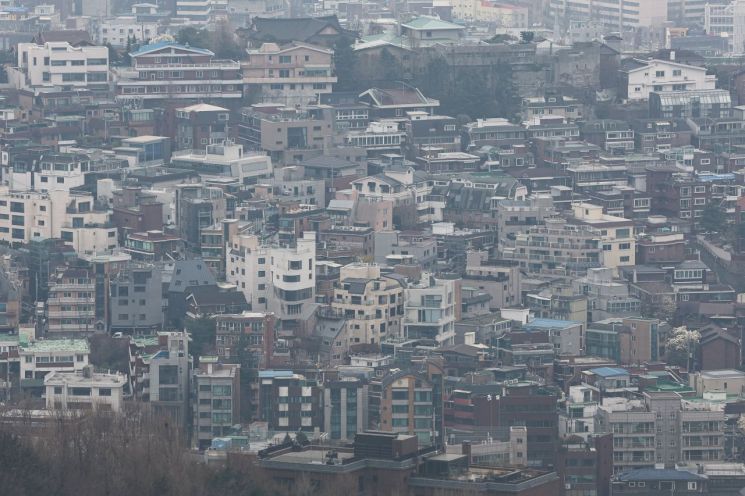
Expectations that buying demand will spread, particularly among genuine homebuyers, have led to a fourth consecutive monthly rise in the nationwide housing market outlook.
According to the Housing Industry Research Institute (HIRI) on May 15, the Housing Business Sentiment Index for May, based on a survey of housing business operators, was recorded at 89.6, up 4.1 points from the previous month. The index had dropped to 61.6 in January this year before reversing course and has now risen for four consecutive months.
The Housing Business Sentiment Index indicates that when it exceeds the baseline of 100, a greater proportion of businesses expect the housing market to improve.
In the Seoul metropolitan area, the index was projected to reach 104.4, up 20.2 points. Incheon saw the largest increase, rising 21.6 points to 96.6. Gyeonggi Province rose 20.0 points to 100.0, while Seoul itself increased by 19.0 points to 116.6. Seoul surpassed the baseline of 100.0 and was identified as the main driver of the recovery in the metropolitan area.
HIRI stated, "In the metropolitan area, the index surpassed 100.0 for the first time in seven months since it reached 107.4 in October last year," and added, "The freeze in the base interest rate, mortgage rates entering the 3% range, and the expansion of buying demand centered on genuine homebuyers have driven the recovery in key areas of Seoul and the metropolitan region, contributing to the index's rise."
HIRI further explained, "In particular, the number of housing transactions in Seoul in March increased significantly to about 15,000, compared to 10,338 in February," and added, "Housing permits in the metropolitan area also rose by 45.3% year-on-year, and this overall market strength has had a positive impact on business sentiment."
In non-metropolitan areas, the index was projected to rise by 0.6 points to 86.4. Gwangju recorded the largest increase, up 23.6 points to 94.1. Sejong rose by 18.7 points, Daegu by 6.1 points, and Busan by 4.5 points. In contrast, North Gyeongsang Province saw the largest decline, falling 22.4 points to 69.2. Metropolitan cities were projected to rise by 4.6 points to 90.9, while provincial areas were expected to fall by 2.4 points to 83.1.
HIRI commented, "Driven by the rise in metropolitan cities among non-metropolitan regions, the overall index reached its highest level since November last year," and added, "Supplementary tax and financial measures for local housing markets, as well as factors such as the relocation of the presidential office and the National Assembly in Sejong, have contributed to continued price increases, especially in Sejong."
However, HIRI also noted, "Since 76% of unsold housing inventory nationwide is located in non-metropolitan areas, the index for these regions remains below the baseline of 100.0, indicating that it is difficult to consider the market as booming. In addition, political uncertainty ahead of the presidential election early next month is delaying legislative discussions on housing supply-related bills, and the direction of the real estate market could change depending on the new administration's policy, so ongoing monitoring is necessary."
Meanwhile, this month’s nationwide funding index was projected to fall by 1.3 points from the previous month to 79.3, while the materials supply index was forecast to rise by 3.3 points to 96.2.
© The Asia Business Daily(www.asiae.co.kr). All rights reserved.
![Clutching a Stolen Dior Bag, Saying "I Hate Being Poor but Real"... The Grotesque Con of a "Human Knockoff" [Slate]](https://cwcontent.asiae.co.kr/asiaresize/183/2026021902243444107_1771435474.jpg)















