Japanese Restaurants Impose Entry Restrictions Based on Nationality
SCMP: "Believed to Benefit from People Influenced by Certain Nationalist Sentiments"
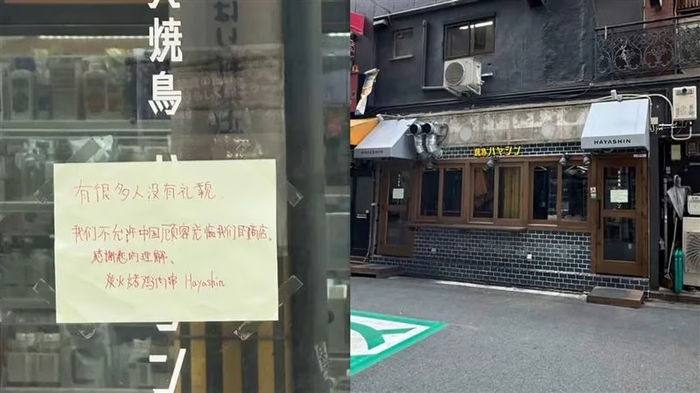 A restaurant in Osaka, Japan posted a notice at its entrance banning Chinese customers for being "rude." Photo by SCMP
Foreign media have reported that an increasing number of restaurants in Japan, which are most frequently visited by Koreans and Chinese, are openly refusing entry to Korean and Chinese customers.
On May 13 (local time), the South China Morning Post (SCMP) reported that a restaurant in Osaka, Japan posted a notice at its entrance banning Chinese customers for being "rude."
This restaurant, named "Hayashin,"posted a photo on its social media account on May 10 showing a note attached to the entrance stating that Chinese customers are not allowed. The note, written in Chinese, said, "Because many Chinese people are rude, we do not accept Chinese customers."
SCMP reported that incidents of Japanese restaurants refusing Chinese customers have been occurring one after another recently. In fact, in 2023, a Chinese influencer visited a restaurant in Tokyo and posted a photo on social media of a notice banning entry in both Chinese and Korean, which sparked controversy. The memo stated in Japanese that it was "designed to prevent the Chinese virus." The influencer entered the restaurant to ask the staff for an explanation but was kicked out without receiving an answer.
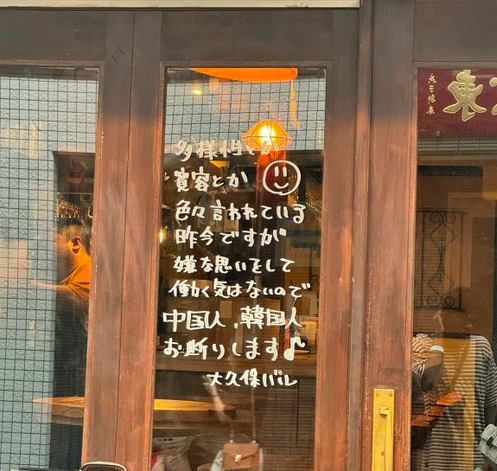 An Italian restaurant in Shinjuku had a sign on the window saying, "Koreans and Chinese are refused." X
The outlet pointed out that Japanese restaurants are not only turning away Chinese customers but also Koreans. It also reported that in July of last year, a restaurant in Tokyo refused both Korean and Chinese customers. At the time, an Italian restaurant in Okubo, Shinjuku, wrote on its entrance window in white marker, "Although this is an era of diversity and tolerance, I do not want to work while harboring unpleasant feelings. For this reason, Koreans and Chinese are refused."
SCMP analyzed that Japanese restaurants are taking such actions because they benefit from people influenced by certain nationalist sentiments. The outlet also pointed out that these actions are "illegal." According to the Japanese constitution, it is legal for a restaurant to accept only customers who speak Japanese for linguistic reasons, but it is against the constitution to discriminate against customers based on race or nationality.
Meanwhile, a famous shrine in Tsushima, Nagasaki Prefecture, Japan, recently sparked controversy by completely banning Korean tourists from entering its grounds. In March, the Sankei Shimbun reported that Watatsumi Shrine in Tsushima was prohibiting anyone other than Shinto priests and worshippers from entering the premises. According to the outlet, some Korean tourists had engaged in acts such as smoking, littering, and throwing stones inside the shrine, and on March 22, a shrine employee was reportedly assaulted.
© The Asia Business Daily(www.asiae.co.kr). All rights reserved.
![Clutching a Stolen Dior Bag, Saying "I Hate Being Poor but Real"... The Grotesque Con of a "Human Knockoff" [Slate]](https://cwcontent.asiae.co.kr/asiaresize/183/2026021902243444107_1771435474.jpg)

















