The Hidden Flaws of AEBS in Automobiles
Korea Transportation Safety Authority Releases AEBS Test Results
A recent test has revealed that the Autonomous Emergency Braking System (AEBS), considered one of the key advanced safety features in automobiles, fails to properly detect children.
According to AEBS operation tests released by the Korea Transportation Safety Authority on May 14, when child dummies were placed at the edge of the road, none of the six tested vehicles detected the dummies and all passed by without stopping. AEBS is designed to automatically apply the brakes to prevent or mitigate collisions if it detects a risk of crash and the driver fails to respond appropriately. In theory, the system should detect the dummy and slow down or stop.
The Authority conducted the tests on six domestic and imported vehicles equipped with advanced safety systems currently sold in Korea. The tested models included the BMW 320i, BMW iX3, Tesla Model Y, Polestar Polestar 4, Kia EV6, and Renault Grand Koleos. In tests simulating a stationary vehicle ahead, all vehicles successfully stopped as required.
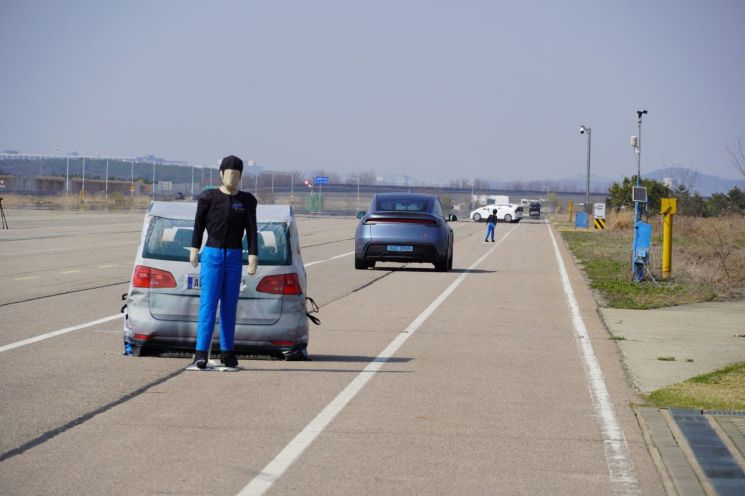 The Korea Transportation Safety Authority Automobile Safety Research Institute is conducting tests on Advanced Driver Assistance Systems (ADAS). Provided by the Authority
When simulating a scenario where a person is standing behind a broken-down, stationary vehicle, three models stopped while the other three collided. The 320i, Polestar 4, and iX3 collided. The remaining vehicles either detected only the stationary vehicle and stopped after hitting the human dummy, or failed to detect the dummy altogether and collided.
In tests simulating a frontal traffic accident, three models recognized the vehicle and stopped, while the other three collided. The Polestar 4, EV6, and iX3 were the ones that crashed. For this test, a vehicle was positioned at a 45-degree angle in the driving lane to mimic an accident scenario.
These results indicate that relying solely on advanced safety systems could still result in accidents. The Authority explained, "The detection range and activation conditions for advanced safety systems vary by vehicle model," adding, "We have confirmed that there are differences between vehicles, and with current technology, there are limitations to vehicles responding autonomously to all traffic situations."
Jung Yongsik, President of the Korea Transportation Safety Authority, emphasized, "Advanced safety systems are designed to support drivers and enhance safety while the driver is still in control, so it is essential not to neglect watching the road ahead." He added, "We will work to strengthen safety standards for advanced systems and apply them to vehicle safety assessments, in order to create a safer driving environment."
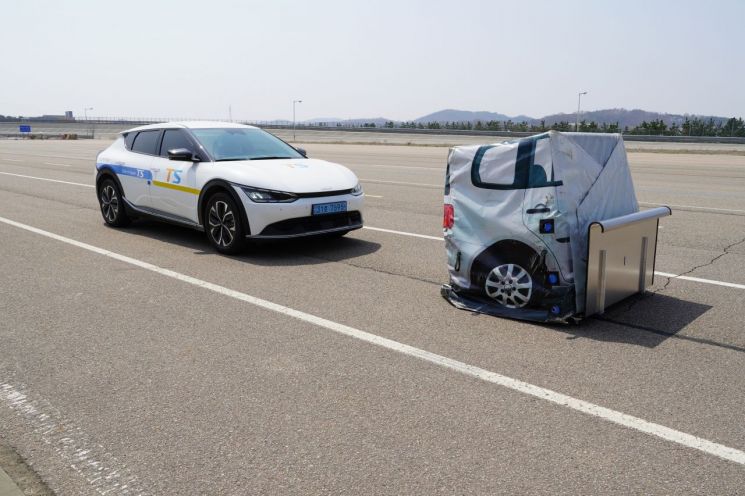 An advanced driver-assistance system (ADAS) responded and stopped at a stationary vehicle (dummy). Provided by Korea Transportation Safety Authority
© The Asia Business Daily(www.asiae.co.kr). All rights reserved.
![Clutching a Stolen Dior Bag, Saying "I Hate Being Poor but Real"... The Grotesque Con of a "Human Knockoff" [Slate]](https://cwcontent.asiae.co.kr/asiaresize/183/2026021902243444107_1771435474.jpg)
















