KDCA to Begin Operation Five Days Earlier Than Last Year Starting May 15
Protecting High-Risk Groups Through Proactive Response by Local Governments and Medical Institutions
Due to the early onset of summer heat this year, the government's heat-related illness surveillance system will begin five days earlier than usual.
The Korea Disease Control and Prevention Agency (KDCA) announced on May 14 that it will operate the "Emergency Room Surveillance System for Heat-Related Illnesses" from May 15 to September 30 in order to quickly share information on the occurrence of heat-related illnesses during the summer and to minimize harm to public health.
Heat-related illnesses are acute conditions caused by heat, with heatstroke and heat exhaustion being the most common examples. Prolonged exposure to hot environments can cause symptoms such as headache, dizziness, muscle cramps, fatigue, and decreased consciousness. If left untreated, these conditions can become life-threatening.
The Emergency Room Surveillance System for Heat-Related Illnesses is operated to identify and monitor patients suffering from heat-related illnesses due to heat waves on a daily basis, through cooperation among approximately 500 medical institutions with emergency rooms nationwide, local health centers, provincial and municipal governments, and the KDCA.
This year, the surveillance system will begin five days earlier than last year, in line with the "Comprehensive Government Heat Wave Response Period" that starts on May 15. As it is starting earlier than ever before, the system will be in operation for the longest period to date.
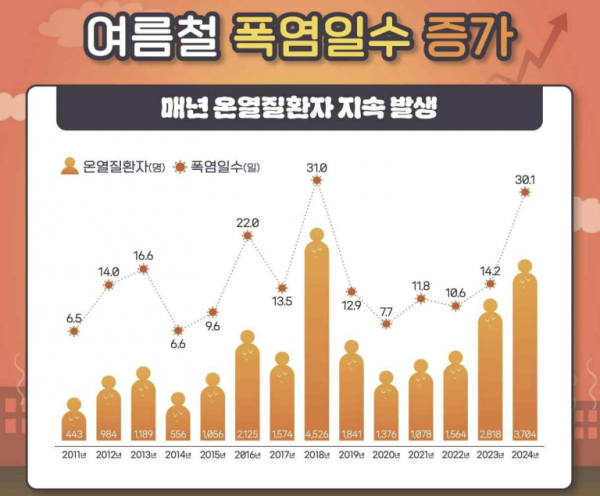
With the prolonged heat, the number of victims of heat-related illnesses is also increasing. Last year, a total of 3,704 cases of heat-related illnesses were identified through the surveillance system, representing a 31.4% increase compared to 2023 (2,818 cases). This is the second highest number ever recorded, following 2018 (4,526 cases), which was noted for its "worst heat wave." The estimated number of deaths was also 34, the second highest since 2018 (48 deaths), and the main presumed cause of death was heatstroke (94.1%).
Last year, 78.5% of heat-related illness patients were male, and by age group, those aged 65 and older accounted for 30.4% of all patients. The number of patients per 100,000 population was highest among those aged 80 and older (15.4 people).
By type of illness, heat exhaustion accounted for the largest share at 55.6% (2,060 cases). By region, the number of patients was highest in Gyeonggi (767 cases), followed by Jeonnam (407 cases), Gyeongnam (377 cases), and Gyeongbuk (290 cases). In terms of location, 78.7% (2,914 cases) occurred outdoors, which is 3.7 times higher than indoors (21.3%, 790 cases). The most common outdoor locations were worksites (31.7%), rice paddies and fields (14.3%), and roadsides (9.8%), while indoor worksites accounted for 9.2%. By occupation, 25.6% (947 cases) were simple laborers, followed by the unemployed (13.0%) and skilled workers in agriculture, forestry, and fisheries (10.0%).
Information on patient occurrences collected during the operation of the Emergency Room Surveillance System for Heat-Related Illnesses will be published daily on the KDCA website. Notably, starting this year, predictive information on the occurrence of heat-related illnesses will be provided on a trial basis to participating institutions such as emergency medical centers, provincial and municipal governments, and health centers. This service, developed in cooperation with the Korea Meteorological Administration, will provide four levels of risk prediction for all 17 provinces and metropolitan cities nationwide, covering the current day and the following three days. The KDCA expects that this will allow medical institutions to proactively establish response systems for patients, and enable local governments to develop heat wave countermeasures.
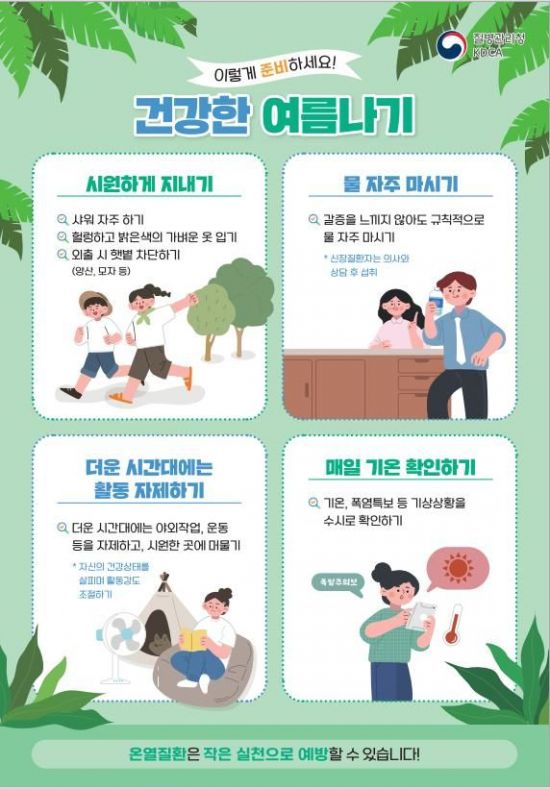
The KDCA urged the public to strictly follow health guidelines during the summer, such as refraining from going outdoors during heat waves, drinking water frequently, and taking sufficient rest. The agency especially emphasized that children, the elderly, and those with chronic illnesses are more vulnerable to heat-related illnesses, and warned against leaving them alone in enclosed spaces such as homes or cars with the windows closed.
© The Asia Business Daily(www.asiae.co.kr). All rights reserved.


















