Samsung Enters Central Air Conditioning with Flakt Acquisition
Global Air Conditioning Market Reshaped Around AI Cooling
Chairman Lee Jae-yong's Strategic M&A... Samsung Accelerates Structural Transformation
Samsung Electronics' decisive acquisition of Flakt, a German air conditioning company with a 100-year history, for 2.4 trillion won is more than just a business expansion; it is a signal that the company intends to join the race for dominance in cooling solutions, now referred to as the "air of the AI era." Data centers, which house high-temperature, high-density server equipment, cannot operate without advanced cooling technologies, and demand for these solutions is surging explosively with the spread of generative AI.
Flakt is a leading European central air conditioning company equipped with technologies such as liquid cooling units (CDUs) using chilled water circulation, building integrated control systems, high-efficiency fans, and heat exchangers. The company supplies systems to more than 65 countries and has completed numerous projects requiring strict environmental standards. Having established a presence in public and industrial facilities where precision and reliability are essential, Flakt is recognized for its strength in high-efficiency and eco-friendly solutions.
Samsung Electronics has now expanded its portfolio from its existing focus on individual air conditioning (residential and commercial system air conditioners) to include industrial central air conditioning. This acquisition marks the starting point for Samsung's full-scale entry into the infrastructure competition of the AI era, where cooling technology, data processing, and energy savings converge. At the same time, it is part of a structural transformation aimed at combining Samsung’s digital platform and global procurement and manufacturing capabilities with the traditional "heating, ventilation, and air conditioning (HVAC) market."
This deal was not a decision that could be made in a short period of time. There is an assessment that Chairman Lee Jae-yong made a direct decision on this core merger and acquisition (M&A) strategy, as Samsung Electronics accelerates its efforts to secure future technologies in areas such as AI, bio, automotive electronics, and robotics. While the air conditioning business may appear to be a relatively limited industry from the outside, in reality, it is being re-evaluated as a foundational technology that brings together energy, environment, and data, and as infrastructure that simultaneously addresses both decarbonization and the AI era.
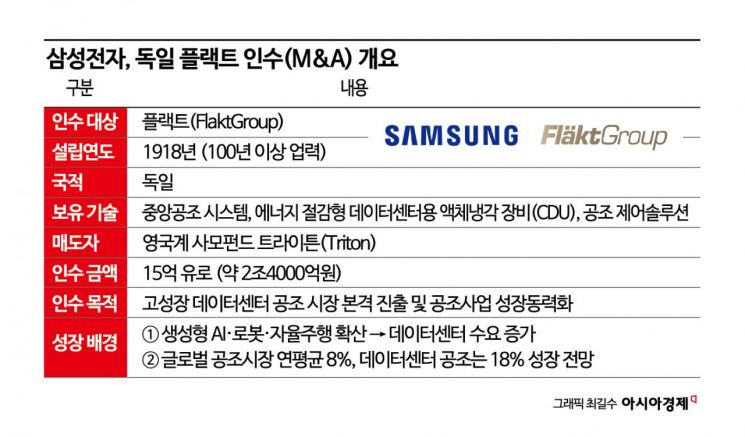
Chairman Lee has shifted away from the previous internalization strategy, boldly acquiring the necessary core competencies instead. Recent acquisitions, such as Harman’s Massimo audio division, Oxford Semantic Technologies in the UK, and the French AI medical company Sonio, are part of a strategy to simultaneously enhance technological expertise and market dominance.
In particular, the air conditioning industry, centered on cooling technology, has emerged as a core pillar of AI infrastructure rather than a peripheral sector. This market, which demands power efficiency, temperature control, and eco-friendly design, is now recognized by global technology companies as a "strategic industry" rather than a "supporting industry," intensifying the competition.
An industry insider commented, "Since air conditioning has not been a front-line business for Samsung Electronics, this acquisition would have been difficult to decide without a direct order from the chairman," adding, "It reflects an intention to proactively secure areas directly linked to future infrastructure, such as data center cooling."
With Samsung Electronics declaring its intention to strengthen its position in the air conditioning market, competition is expected to intensify further. The global air conditioning market, where demands for smart buildings, eco-friendliness, and decarbonization interact in complex ways, is projected to grow to 140 trillion won by 2030. HVAC is no longer just about air conditioners; it is a survival requirement in the AI era. LG Electronics has also designated the air conditioning business as a future core business, simultaneously reorganizing its structure and market approach.
In particular, LG Electronics has restructured its organizational framework to focus on expanding its air conditioning business. At the end of last year, the company separated the HVAC business from the existing H&A Business Division and established the ES Business Division, presenting a plan to grow air conditioning sales to 20 trillion won by 2030. This aligns with its plan to increase the B2B proportion to 45%.
LG Electronics has invested 400 billion won to begin construction of a new air conditioning production facility in Alabama, USA, and is accelerating its expansion in Southeast Asia and Europe. The company has established an Air Solution Research Center in Frankfurt, Germany, and a heat pump technology consortium in Oslo, Norway. In particular, its inverter compressor and oil-free magnetic bearing chiller technologies are regarded as unique in the commercial and industrial cooling markets. Cooling solutions targeting AI data centers and semiconductor fabs are also included in its portfolio, and collaboration with Microsoft (MS) is gradually becoming a reality.
© The Asia Business Daily(www.asiae.co.kr). All rights reserved.
![Clutching a Stolen Dior Bag, Saying "I Hate Being Poor but Real"... The Grotesque Con of a "Human Knockoff" [Slate]](https://cwcontent.asiae.co.kr/asiaresize/183/2026021902243444107_1771435474.jpg)
















