Inha University announced on May 13 that a research team led by Professor Eungsu Kim from the Department of Advanced Biopharmaceuticals and the Department of Biotechnology has published a comprehensive review article in collaboration with Dr. Jaegyu Lim's team at the Jeju Marine Bio-Resource Research Center of the Korea Institute of Ocean Science and Technology (KIOST). The article summarizes the latest research strategies for effectively discovering natural product drug candidates from microorganisms symbiotic with marine sponges.
The research team comprehensively addressed the isolation and structural elucidation of bioactive natural products derived from sponge-associated bacteria, gene-based biosynthetic cluster analysis, cultivation and isolation technologies, cutting-edge genome-based research, and compound screening techniques.
In particular, the team reviewed recently reported sponge-derived natural products with various bioactivities, including antibacterial, anticancer, anti-inflammatory, antiviral, and neuro-targeting effects. They highlighted the potential for future drug development by discussing the structural features and physiological activities of these compounds.
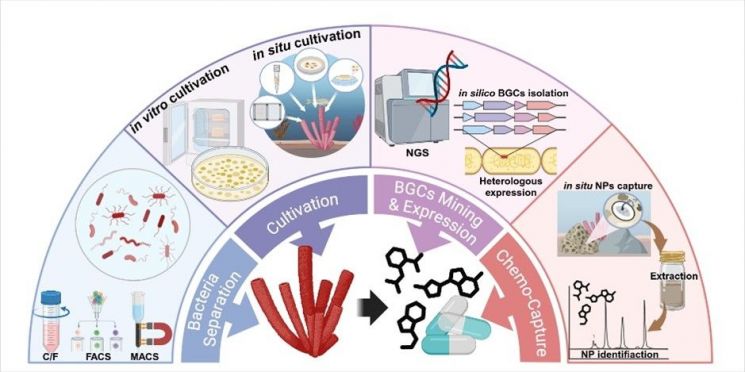 'Opening the Door to Marine Treasures: Strategies for Discovering Natural Products from Sponge Symbiotic Bacteria' Graphic. Inha University
The researchers emphasized that microorganisms symbiotic with sponges have evolved in unique marine environments, acquiring the ability to produce bioactive substances such as antibiotics, immunomodulators, and anticancer agents.
They also provided specific explanations of how various advanced technologies can be utilized to cultivate sponge-associated bacteria that were previously difficult to culture, including cultivation methods using fine filters, in situ marine cultivation systems, and techniques that grow bacteria encapsulated in small capsules.
The findings were published under the title "Unlocking Marine Treasures: Isolation and Mining Strategies of Natural Products from Sponge-Associated Bacteria" in the world-renowned scientific journal Natural Product Reports (impact factor 10.2, top 1% in the field).
Professor Eungsu Kim, the corresponding author of this study, stated, "Among marine biological resources, sponge-associated bacteria represent a vast, unexplored treasure trove of natural products. By combining sophisticated genome-based approaches with cultivation technologies, there is limitless potential for new drug development and the discovery of bio-based materials."
This achievement was supported by the Korea Institute of Ocean Science and Technology's future-leading project, "Research on the Production of Protein Biosimilars Using Marine Signal Peptides," and by the National Research Foundation of Korea's bio-medical technology development program, "Development of Foundational Retro-Biosynthetic Technology for the Design and Implementation of Next-Generation Therapeutic Candidates."
 (Photo from left) Dr. Jeonga Kim, Korea Institute of Ocean Science and Technology, Dr. Siseon Choi, Inha University, Dr. Jaegyu Lim, Korea Institute of Ocean Science and Technology, Professor Eungsu Kim, Inha University
© The Asia Business Daily(www.asiae.co.kr). All rights reserved.
![Clutching a Stolen Dior Bag, Saying "I Hate Being Poor but Real"... The Grotesque Con of a "Human Knockoff" [Slate]](https://cwcontent.asiae.co.kr/asiaresize/183/2026021902243444107_1771435474.jpg)
















