Countries around the world are struggling with large-scale wildfires. Major wildfires are not limited to a specific time or country. From 2013 to 2024, there have been nine record-breaking large wildfires globally. As the frequency of wildfires increases and the scale of damage grows, countries are developing wildfire response strategies that utilize forest roads. These countries are recognizing forest roads as an effective means of wildfire response and are seeking ways to utilize them. This is also why there are growing calls in Korea to strengthen wildfire response capabilities by expanding forest road networks.
According to the Korea Forest Service and the National Institute of Forest Science on May 14, a major wildfire broke out in Los Angeles, United States, earlier this year (January 7?31), burning more than 23,200 hectares of forest. The fire resulted in over 28 deaths, more than 22 injuries, and at least 31 people reported missing. The estimated economic loss from the wildfire is 237 trillion won. Locally, the LA wildfire is being described as the worst wildfire in U.S. history.
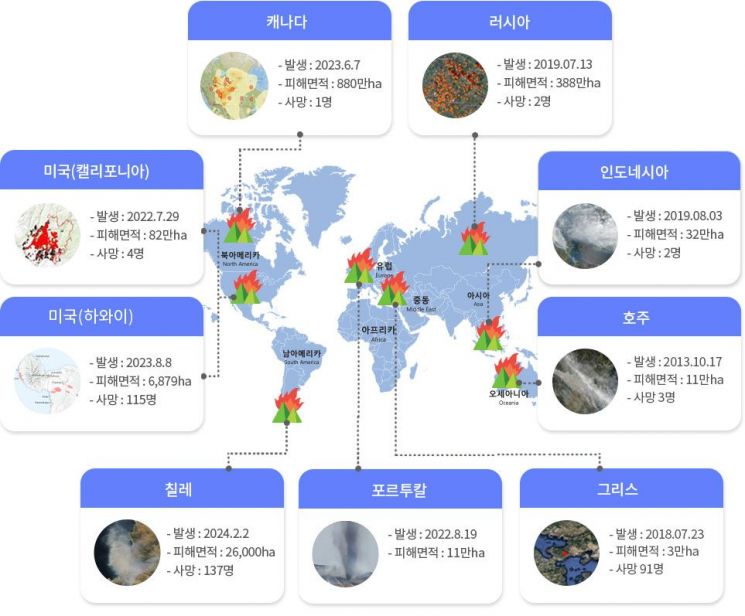
Large-scale wildfires have continued to occur in various parts of the world. In October 2013, a major wildfire in Australia destroyed 110,000 hectares of forest and resulted in three deaths. In July 2018, a wildfire in Greece burned 30,000 hectares of forest and killed 91 people. In July 2019, Russia experienced a wildfire that burned 3.88 million hectares and killed two people, while in August 2019, Indonesia lost 320,000 hectares of forest and two people died. In August 2022, Portugal lost 110,000 hectares of forest, and California, United States, lost 820,000 hectares and four people died due to wildfires.
In 2023, major wildfires also occurred in June in Canada (8.8 million hectares burned, one death) and Hawaii, United States (6,879 hectares burned, 115 deaths). Just before the LA wildfire this year, a major wildfire in Chile in February 2024 destroyed 26,000 hectares of forest and claimed 137 lives.
As the damage from large-scale wildfires increases around the world, there is growing interest in strengthening wildfire response capabilities. Notably, 'forest roads' are consistently at the center of efforts to improve wildfire response capacity.
For example, in the United States, there is a persuasive argument that "if forest roads are properly designed, maintained, and managed, they can reduce wildfire damage. Efficient management of forest road networks enables rapid deployment of suppression resources, thereby enhancing wildfire response capabilities." Reflecting this, local wildfire response strategies focus on selecting fuel management areas and deploying suppression resources efficiently based on forest roads. Research is also underway on installing and maintaining forest road facilities to improve wildfire monitoring, prevention, and access.
After experiencing a major wildfire in 2023, Canada has been using forest roads as strategic firebreaks and access routes. To this end, Canada is reevaluating the function of forest roads at each stage?before a wildfire occurs, during short-term and emergency response, and post-fire recovery. The country is also identifying sections that require priority maintenance and establishing plans for facility upgrades and ongoing maintenance.
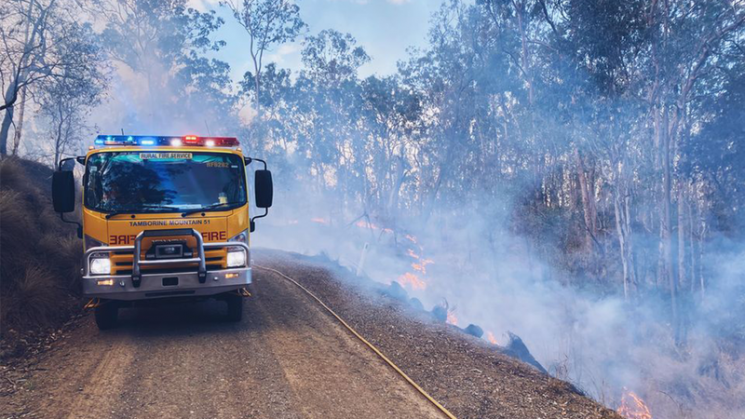 In 2023, a wildfire suppression vehicle is conducting wildfire control activities on a forest road in Queensland, Australia. Provided by the National Institute of Forest Science.
Australia classifies forest roads by their importance for wildfire response and mandates that sufficient space be secured for vehicles to pass safely or turn around. The country also requires that forest roads be designed to minimize environmental impact and has strengthened standards for maintenance and management.
Japan, which is geographically close to Korea, is also carrying out projects to improve firebreak forest roads, taking into account the location of residential areas, past wildfire occurrences, recent wildfire frequency, and the scale of recent fires. In addition, Japan has established a forest road location information system based on Geographic Information Systems (GIS) to strengthen wildfire prevention and initial response capabilities.
The wildfire that started in Uiseong, North Gyeongsang Province in March (the Uiseong wildfire) served as a reminder that Korea is not immune to major wildfires. Observing that countries around the world that have experienced large-scale wildfires are using forest roads as a primary means to strengthen wildfire response, there are increasing calls in Korea for appropriate utilization of forest roads for wildfire response.
Hwang Jinseong, a researcher at the Forest Technology and Management Research Institute of the National Institute of Forest Science, stated, "Many countries that have experienced large-scale wildfires, such as the United States, Greece, Canada, and Australia, already recognize forest roads as a means of strengthening wildfire response capabilities and are developing comprehensive wildfire response strategies. In Korea as well, it is necessary to actively adopt digital technologies for wildfire prevention and response, and to advance the design and maintenance systems for forest roads."
© The Asia Business Daily(www.asiae.co.kr). All rights reserved.
![Clutching a Stolen Dior Bag, Saying "I Hate Being Poor but Real"... The Grotesque Con of a "Human Knockoff" [Slate]](https://cwcontent.asiae.co.kr/asiaresize/183/2026021902243444107_1771435474.jpg)
















