Maximum 83,535, Minimum 44,737, Average 62,483
Similar to Early Last Year's Count
Monthly Population Monitoring for Improved Management
The number of rooks that visited the bamboo forest along the Taehwagang River during the winter, from late last year to early this year, was found to be similar to the number observed in early last year (January to February).
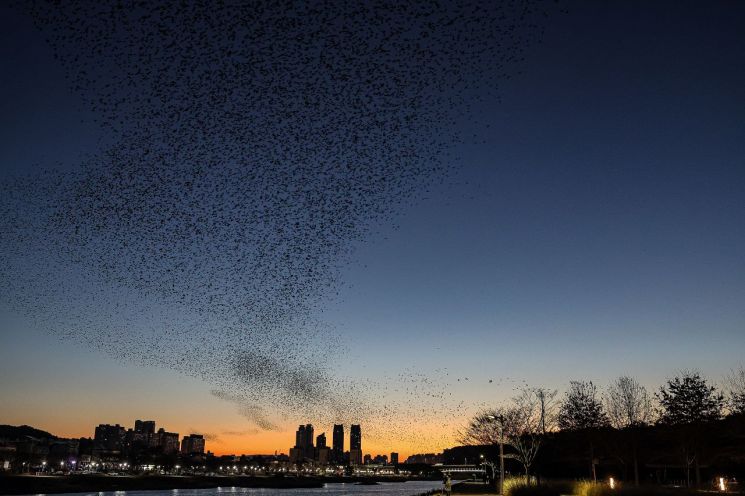
The Ulsan Metropolitan Government and the Ulsan Biodiversity Center conducted a total of 10 surveys on the number of Taehwagang rooks from November 10, 2024, to February 25, 2025.
The survey found that the maximum number of individuals was recorded on January 24, 2025, at 83,535, while the minimum was recorded at the start of the migration on November 10, 2024, at 44,737 individuals.
The average number of rooks during this period was calculated to be 62,483 individuals.
From January to February 2024, the Ulsan Metropolitan Government and the Center conducted the first-ever six surveys on the number of Taehwagang rooks.
The results showed a maximum of 74,810 individuals, a minimum of 47,220 individuals, and an average of 59,006 individuals.
To investigate the rooks that arrived in mid-October last year, the Ulsan Metropolitan Government and the Center formed a research team of seven members, including three researchers, two photographers, and two monitoring staff.
The research team divided the flocks emerging from the east side of Samho Bamboo Forest, located downstream, and those emerging toward the grass area of the Migratory Bird Park on the west side of the upstream bamboo forest. Every two weeks, during the morning hours when the birds left the bamboo forest to forage, photographers captured images of the birds departing every 10 seconds.
The number of individuals was then tallied using a program called "Counting from Photos," which counted the birds in each location and summed the results from the two sites.
According to the Center's calculations, the number of individuals was 44,737 on November 10, 2024, 57,305 on November 22, 56,893 on December 2, and 66,419 on December 14. On December 27, the number slightly decreased to 45,870 individuals.
On January 13, 2025, the number increased to 62,117 individuals, then surged to 83,535 on January 24. The numbers were 69,200 on February 7 and 73,488 on February 17.
On the final survey date, February 25, 2025, 65,262 individuals were recorded.
A researcher from the Ulsan Biodiversity Center stated, "There have been opinions that the number of rooks coming to Ulsan is gradually declining, but our survey found no change compared to early last year. We will continue not only annual surveys but also monitor monthly population changes to identify continuous trends and maintain a stable habitat base."
An official from the Ulsan Metropolitan Government said, "This rook survey used a different method from the one conducted by the National Institute of Biological Resources under the Ministry of Environment, so the population counts may differ. Through this survey, we found that a similar number of rooks visited the Taehwagang River as a roosting site compared to early last year. When the rooks arrive again in October, we will use the experience gained from this survey to prepare for an even more thorough investigation."
The National Institute of Biological Resources under the Ministry of Environment conducts simultaneous winter bird surveys once a month by having monitoring staff visually count the rooks at Taehwagang during their return to the roost. The Institute reported 89,320 individuals in 2022, 70,448 individuals in 2023, and 50,576 individuals in 2024.
© The Asia Business Daily(www.asiae.co.kr). All rights reserved.
![Clutching a Stolen Dior Bag, Saying "I Hate Being Poor but Real"... The Grotesque Con of a "Human Knockoff" [Slate]](https://cwcontent.asiae.co.kr/asiaresize/183/2026021902243444107_1771435474.jpg)















