Professor Choi Janghyun's Team Reveals Molecular Mechanism of miR-93 Aggravating MASLD
Vitamin B3 Suppresses miR-93 Expression... Published in Metab. Clin. Exp.
A genetic material that exacerbates metabolic dysfunction-associated steatotic liver disease (MASLD), which is known to affect 30% of the global population, has been newly identified.
Surprisingly, the most effective FDA-approved drug targeting this genetic material was found to be vitamin B3.
The research team led by Professor Choi Janghyun of the Department of Life Sciences at UNIST, together with Professor Yoon Hwayoung's team from the College of Pharmacy at Pusan National University and Professor Park Neunghwa's team from Ulsan University Hospital, has become the first in the world to identify that microRNA-93 (miR-93), which is expressed in the liver, is a genetic material that induces the onset and progression of MASLD.
 Research team, Professor Choi Janghyun (top left), Researcher Park Kieun (bottom left, first author), Dr. Lee Yohan (bottom center, first author). Provided by UNIST
miR-93 is a specialized RNA expressed in hepatocytes and functions to suppress the expression of other genes. In patients with fatty liver disease and animal models, levels of miR-93 were abnormally high. It was analyzed that miR-93 induces fat accumulation, inflammatory responses, and fibrosis in the liver through a molecular mechanism in which it suppresses the expression of the SIRT1 gene, which is involved in lipid metabolism within hepatocytes.
In fact, experimental mice in which the function to produce miR-93 was removed through gene editing showed a marked reduction in hepatic fat accumulation, with significant improvements in insulin sensitivity and liver function indicators. In contrast, mice with excessive expression of miR-93 exhibited worsened hepatic metabolic function.
Furthermore, when 150 FDA-approved drugs were screened, niacin, known as vitamin B3, was identified as the most effective substance in suppressing miR-93.
In experiments, mice administered niacin showed a significant decrease in hepatic miR-93 levels and a marked increase in SIRT1 gene activity. The activated SIRT1 was found to play a decisive role in normalizing impaired hepatic lipid metabolism by reactivating signaling pathways that promote fatty acid breakdown.
The research team explained, "This study has high clinical applicability as it precisely identified the molecular pathogenic mechanism of MASLD and demonstrated the possibility of regulating it with an already approved vitamin compound."
The researchers added, "Niacin is a drug with proven safety, already used as a treatment for hyperlipidemia, making it a strong candidate for application in miRNA-based combination therapy strategies."
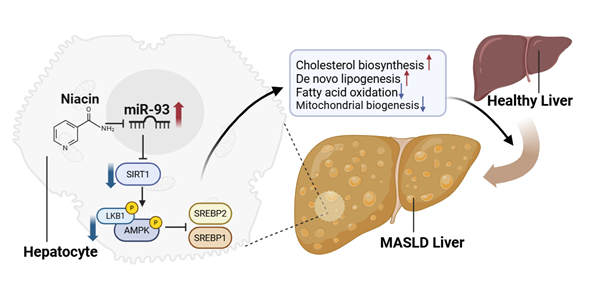 The pathogenic mechanism by which miR-93 induces metabolic dysfunction-associated steatotic liver disease (MASLD) and the therapeutic effects of niacin-based treatment.
This research was supported by the National Research Foundation of Korea, the Korea Drug Development Fund, and the Korea Research Institute of Bioscience and Biotechnology. The results were published online on April 12 in 'Metabolism: Clinical and Experimental,' the most prestigious journal in the field of biomedical sciences.
Dr. Lee Yohan and Researcher Park Kieun of UNIST, Professor Jung Junho of Ulsan University Hospital, and Researcher Lee Jinyoung of Pusan National University participated as co-first authors of this study.
© The Asia Business Daily(www.asiae.co.kr). All rights reserved.
![Clutching a Stolen Dior Bag, Saying "I Hate Being Poor but Real"... The Grotesque Con of a "Human Knockoff" [Slate]](https://cwcontent.asiae.co.kr/asiaresize/183/2026021902243444107_1771435474.jpg)
















