Media Facade Installed on the Exterior of the Korean Pavilion at the Osaka Expo
Joint Effort by Korean Companies Including LG Electronics
"An Opportunity to Showcase Advanced Display Technology"
On May 13, at the Yumesima Expo Site where the 2025 Osaka Kansai World Expo (Universal Exposition) is being held, visitors who walk northeast past the entrance will find the Korean Pavilion, which promotes Korean industry and culture. One side of the exterior wall of the pavilion is covered with a massive LED screen, creating a "media facade." This media facade measures 27 meters wide by 10 meters high, with a resolution of 3888 by 1440 pixels. Its sheer scale immediately overwhelms visitors as they approach the building. The videos displayed on the screen, depicting various visions of Korean cities, are visually stunning and easily capture the attention of onlookers. The final scene, where the words "KOREA" or "Republic of Korea" appear in a cityscape pattern, is powerful enough to give viewers goosebumps.
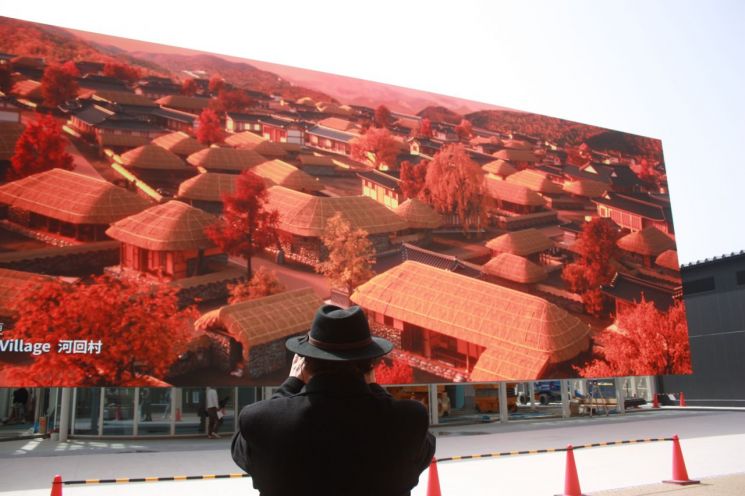 The media facade installed on the outer wall of the Korea Pavilion at the Yumesima Expo Site, where the 2025 Osaka-Kansai World Expo is being held. As videos of Hahoe Village and others appear on the media facade, a foreign journalist is taking photos. Photo by Yonhap News
The media facade at the Korean Pavilion is emerging as a highlight among visitors and experts at the Osaka Expo. On-site, people even say that it serves as the "face" of the Korean Pavilion. Thanks to the media facade, the Korean Pavilion attracted a total of 323,065 visitors from the opening of the Expo on April 13 until May 11, accounting for about 13.4% of all Expo attendees. Only two national pavilions?the Korean Pavilion and the United States Pavilion?feature a media facade, but the Korean Pavilion is widely regarded as having much clearer image quality than the American one.
The media facade at the Korean Pavilion was created through collaboration among Korean companies. LG Electronics, commissioned by the Korea Trade-Investment Promotion Agency (KOTRA), built the display structure by combining screens, and BasicTech handled the installation. The video content displayed on the screen was produced by EASYWITH, which drew attention by using its own generative artificial intelligence (AI) model to create the visuals. The AI model was trained on Korea's urbanization, industrialization, and technological advancement, and then used to generate sequence-based videos. As a result, the AI combined countless images and concepts related to Korea to independently design and present its vision of a future city. The installation of the large display began in December of last year and was completed in about five months.
An industry official commented that the media facade at the Korean Pavilion "is serving as an important opportunity to showcase our display technology to the world," adding that it is also expected to help strengthen Korea's presence in the global market. In the display industry, media facades are typically classified as part of the LED signage (outdoor electronic billboards) business, which is largely conducted in a business-to-business (B2B) format. Among these, media facades are called the "complete package" because they require advanced technology to deliver vivid image quality even on massive screens through precise and robust display engineering.
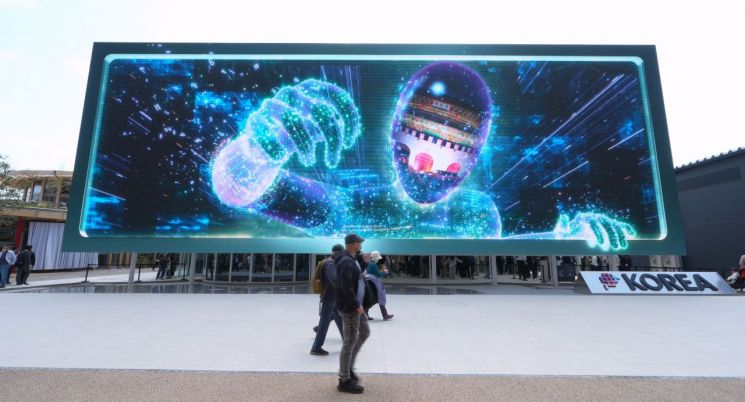 The media facade installed on the exterior wall of the Korean Pavilion at the Yumesima Expo Site, where the 2025 Osaka Kansai World Expo (Universal Exposition) is being held. Photo by Lee Jiwid
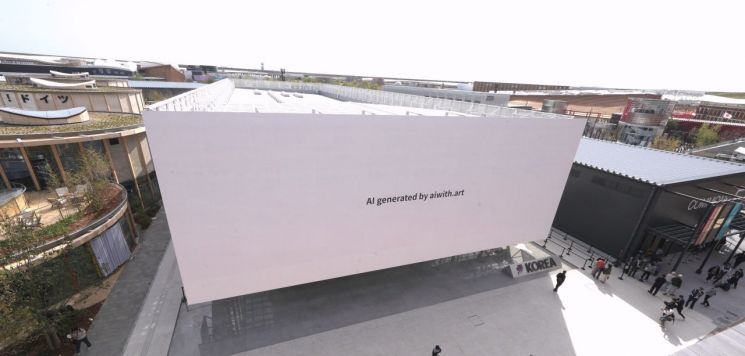 The media facade installed on the exterior wall of the Korean Pavilion at the Yumesima Expo Site, where the 2025 Osaka Kansai World Expo (Universal Exposition) is being held. Photo by Lee Jiwid
With LG Electronics and Samsung Electronics standing out in the global market, the Osaka Expo is being seen as a stage that clearly demonstrates their technological prowess. Both LG Electronics and Samsung Electronics are continuously targeting the signage market?including media facades?and investing in the development of related technologies. In February, at "ISE 2025," the largest display exhibition in Europe held in Barcelona, Spain, they unveiled a range of innovative products. Samsung Electronics introduced a super-large 115-inch 4K smart signage, while LG Electronics showcased high-brightness signage equipped with "anti-discoloration" technology, which minimizes color fading even after prolonged exposure to sunlight. According to global market research firm Mordor Intelligence, the digital signage market, estimated at $27.66 billion (about 39 trillion won) this year, is expected to grow to $41.41 billion (about 58 trillion won) by 2030.
© The Asia Business Daily(www.asiae.co.kr). All rights reserved.
![Clutching a Stolen Dior Bag, Saying "I Hate Being Poor but Real"... The Grotesque Con of a "Human Knockoff" [Slate]](https://cwcontent.asiae.co.kr/asiaresize/183/2026021902243444107_1771435474.jpg)

















