'Dirt spoon boy worker,' 'outsider,' 'general from the periphery.' The descriptors that follow Lee Jae Myung, the presidential candidate of the Democratic Party of Korea, have always been far removed from the mainstream.
Born in Andong, North Gyeongsang Province, Lee spent most of his impoverished teenage years working in factories. While working, his arm was caught in a machine, resulting in a permanent disability, and he suffered an industrial accident that left him with a diminished sense of smell due to severe exposure to chemicals. His family’s dire financial situation meant he could not even afford a proper school uniform. He completed both his middle and high school education by passing qualification exams.
According to one of his close associates, his "extremely poor" childhood became the driving force behind Lee's tenacity and competitive spirit as a politician. To fight off sleep, he would scatter thumbtacks on his desk and study relentlessly for the college entrance exam, eventually gaining admission to the law department at Chung-Ang University in 1982.
At one point, Lee considered a career as a judge or prosecutor. However, during his training, he attended a lecture by former President Roh Moo Hyun, who said, "A human rights lawyer can make a living without missing three meals a day." This inspired Lee to commit himself to a career as a human rights lawyer. Returning to Seongnam, known as the "city of workers," Lee opened his law office in 1989 and began his involvement in civil society by participating in the founding of the Seongnam Citizens' Coalition (now Seongnam Participation Solidarity) in 1994.
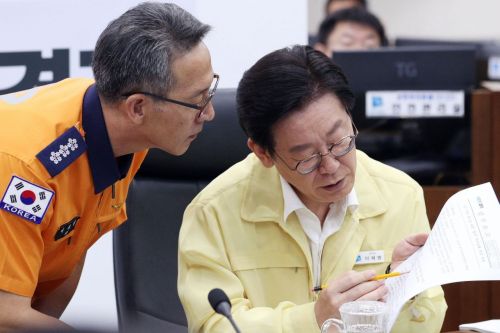 Democratic Party presidential candidate Jae Myung Lee, who was serving as the governor of Gyeonggi Province in 2018. Candidate Lee's Facebook
In 2004, he led a campaign to establish Seongnam Municipal Medical Center. Despite gathering support from 20,000 residents, the project was thwarted by opposition from the Seongnam City Council, which was then dominated by the Grand National Party. Lee has stated that this incident was the decisive factor that led him to enter politics. The following year, in 2005, he joined the Uri Party. After losing the Seongnam mayoral election in 2006, he finally began his full-fledged political career by winning the 2010 election for the 5th popularly elected mayor of Seongnam with 51.2% of the vote.
After his election, to pay off the debt accumulated under the previous administration, he declared a moratorium?the first by a local government?and repaid 457.2 billion won in debt within three years. Ultimately, he was re-elected as Seongnam mayor in 2014 with 55.1% of the vote, gaining attention for implementing three major free welfare policies: youth dividends, postpartum care, and free school uniforms, thereby opening a new paradigm in local politics.
After running in the 2017 presidential election, Lee became known as a national-level politician. In the 2018 local elections, he was elected as the 35th governor of Gyeonggi Province with 56.4% of the vote. From his time as Seongnam mayor to his tenure as governor, he played a key role in popularizing local currency. In this way, Lee established his reputation as an "effective administrator." After winning last April's general election, he took the helm of the Democratic Party as its leader and has since moved to the center of national politics.
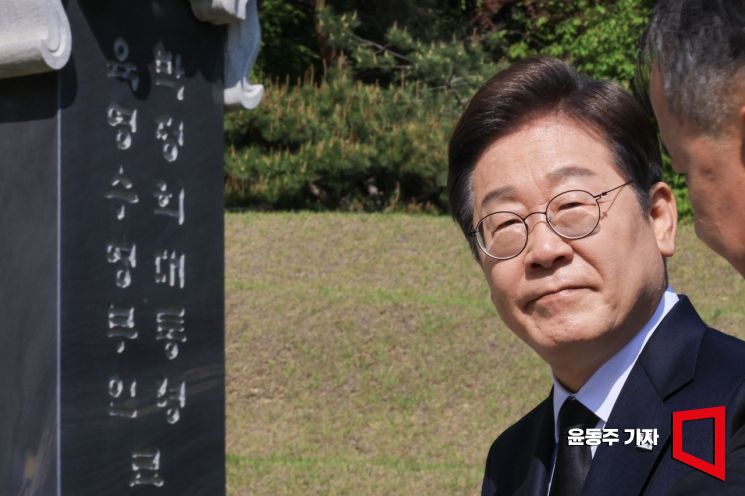 Lee Jae Myung, the presidential candidate of the Democratic Party of Korea, paid respects at the tomb of former President Park Chung Hee at the National Seoul Memorial Cemetery in Dongjak-gu, Seoul on the 28th of last month. Photo by Yoon Dong Joo
Although his defeat to former President Yoon Suk Yeol in the 20th presidential election remains a painful part of his past, he appears to be making a fresh start.
In this 21st presidential election, Lee is presenting pledges with a clear centrist and conservative tone, emphasizing growth and pragmatism, and actively targeting centrist voters. He is making efforts to broaden his appeal by reducing his progressive image and strengthening his pragmatic, centrist, and conservative stances. It is symbolic that Yoon Yeo Joon, the so-called "conservative strategist" and former Minister of Environment, has taken the role of Senior Chief Campaign Manager for the Democratic Party’s Central Election Committee.
The campaign committee has been organized as a "mammoth-sized" body that transcends factions and camps. The committee alone includes as many as 22 campaign chairs, making it exceptionally large. Kim Kyung Soo, the "pro-Moon Jae In successor" and former governor of South Gyeongsang Province who competed with Lee in the party primary, also serves as a chief campaign manager. Other chief campaign managers include former Minister of Justice Kang Kum Sil, former Commissioner of the Korea Disease Control and Prevention Agency Jeong Eun Kyung, former Prime Minister Kim Boo Kyum, and Kim Dong Myung, chairman of the Federation of Korean Trade Unions. The campaign has also brought in Lee In Ki, a former lawmaker from the Grand National Party (predecessor of the People Power Party) and former member of the Yoon Suk Yeol camp; Lee Seok Yeon, former head of the Office for Government Policy Coordination under the Lee Myung Bak administration; and Shin Jae Hyun, former Ambassador for Energy and Resources Cooperation and a conservative figure who served as a special ambassador under the Lee Myung Bak administration.
© The Asia Business Daily(www.asiae.co.kr). All rights reserved.
![Clutching a Stolen Dior Bag, Saying "I Hate Being Poor but Real"... The Grotesque Con of a "Human Knockoff" [Slate]](https://cwcontent.asiae.co.kr/asiaresize/183/2026021902243444107_1771435474.jpg)
















