The Incheon Social Service Institute announced on May 12 that it will conduct research on "Monitoring and Needs Assessment of the Incheon City Emergency Care Project" through the end of this year.
This research will review the overall emergency care project from its inception to the present. First, it will examine cases from other cities and provinces, analyze the characteristics of service users from last year, and conduct case studies. The study will also collect opinions from service providers, service institutions, and project managers in each district and county.
The research will identify key demands in each of the 10 districts and counties. A total of 6,000 people?600 from each region?will be surveyed on their awareness of emergency care services, their need for such services, and any additional services required. Based on these results, the institute plans to propose improvement measures.
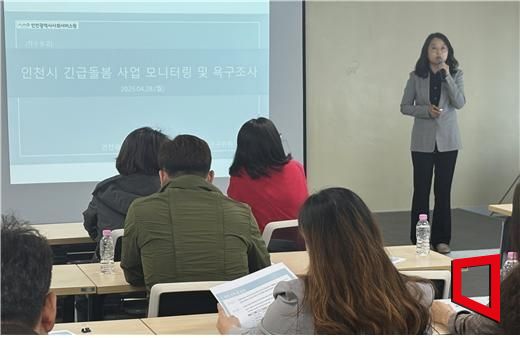 Incheon City Emergency Care Project Monitoring and Needs Assessment Research Launch Report Meeting. Incheon Social Service Institute
The emergency care system was introduced by the Ministry of Health and Welfare in 2021 during the COVID-19 pandemic. It is a system that provides temporary support for household chores, transportation, and care when a care gap occurs due to illness, injury, or the sudden absence of a primary caregiver. Last year, the income eligibility criteria were abolished and the number of service providers was expanded, establishing emergency care as a universal social service. In Incheon, emergency care services are currently provided by the Bupyeong, Ganghwa, and Michuhol Comprehensive Home Care Centers operated directly by the Incheon Social Service Institute, as well as 13 private facilities.
Last year, 198 Incheon citizens used emergency care services. Among them, 75 were in their 80s, 72 in their 70s, and 37 in their 60s, meaning that the majority of users were in their 60s to 80s. The most common reason for applying was sudden injury, with 146 cases. There were 20 cases of care gaps after applying for nursing grade, 18 cases due to the absence of a primary caregiver, and 9 cases due to frailty. By region, there were 50 users in Namdong-gu, 48 in Bupyeong-gu, 31 in Michuhol-gu, 26 in Gyeyang-gu, and 24 in Yeonsu-gu.
Seo Yoonjung, a research fellow at the Incheon Social Service Institute Policy Research Office, said, "The emergency care service plays a very important role in addressing care blind spots, as it is led by the public sector and provides universal services to meet the diverse care needs of citizens regardless of income level. Ahead of the introduction of the 'Act on Integrated Support for Local Care Including Medical and Nursing Care' next year, we will review the overall operation of emergency care services and analyze citizen demand to develop services tailored to the characteristics of each region."
© The Asia Business Daily(www.asiae.co.kr). All rights reserved.
![Clutching a Stolen Dior Bag, Saying "I Hate Being Poor but Real"... The Grotesque Con of a "Human Knockoff" [Slate]](https://cwcontent.asiae.co.kr/asiaresize/183/2026021902243444107_1771435474.jpg)















