Iran: "It Was Fruitful"
US: "Encouraged by Results... Looking Forward to Next Talks"
The United States and Iran have expressed a positive assessment of the fourth round of nuclear talks held in Oman and have indicated their willingness to continue negotiations. However, both sides remain at an impasse over the key issue of uranium enrichment.
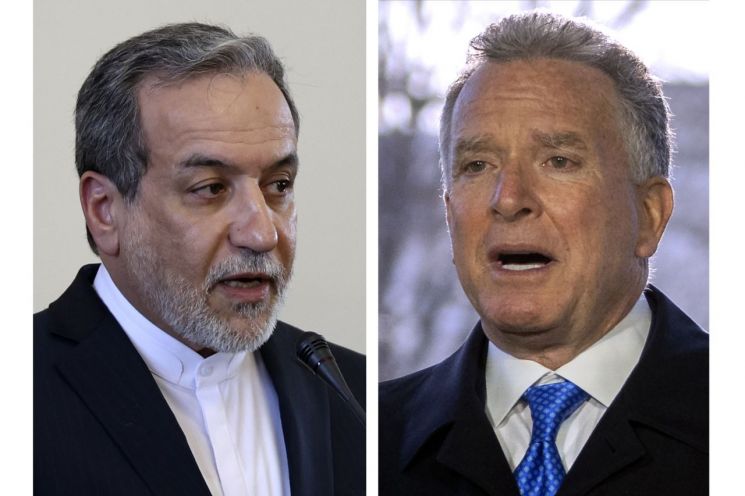 Abbas Araghchi, Iranian Foreign Minister (left), and Steve Witkoff, U.S. Special Envoy for the Middle East. Photo by AP
According to AP and other sources on May 11 (local time), Steve Witkoff, U.S. Special Envoy for the Middle East under President Donald Trump, and Abbas Araghchi, Iranian Foreign Minister, participated in the talks that day, mediated by Badr Albusaidi, Omani Foreign Minister.
As with the third round of nuclear talks held in Oman on April 26, technical experts also participated in the negotiations to provide advice on technical matters. Esmail Baghaei, spokesperson for the Iranian Foreign Ministry, described the talks as "difficult but fruitful." A U.S. official, speaking on condition of anonymity, said, "We have agreed to continue the discussions to address technical aspects," adding, "We are encouraged by today's results and look forward to the next round of talks in the near future."
After the meeting, Albusaidi, Omani Foreign Minister, posted on X (formerly Twitter) that "the talks addressed useful and creative ideas reflecting both sides' desire to reach an agreement." The schedule and location for the next round of negotiations are expected to be announced by Oman, the mediating country.
It was reported that the main issue in the high-level negotiations that day was the future of Iran's uranium enrichment program. After the talks, Minister Araghchi told Iranian state TV, "Enrichment is a right that must be maintained and is not subject to compromise," adding, "As in the past, we can consider limits on the scale, quantity, or concentration as confidence-building measures."
Iran has consistently emphasized that it will not compromise on its nuclear rights, including uranium enrichment. At the Fourth Arab-Iran Dialogue held in Doha, Qatar on May 9, Minister Araghchi stated, "If the goal of the (U.S.) talks is to deprive Iran of its nuclear rights, Iran makes it clear that it will not give up any rights." He added, "If the goal of the talks is to guarantee non-possession of nuclear weapons, then an agreement is possible."
The United States is demanding that Iran dismantle its uranium enrichment program. On May 8, Special Envoy Witkoff told U.S. online media outlet Breitbart, "There can never be a (uranium) enrichment program in Iran." He continued, "That is our red line," explaining, "This means that the three enrichment facilities in Iran?Natanz, Fordow, and Isfahan?must be dismantled."
During his first term, President Trump withdrew from the Iran nuclear agreement (JCPOA, Joint Comprehensive Plan of Action). After returning to office in January, President Trump sent a letter to Iran's Supreme Leader Ayatollah Seyyed Ali Khamenei in March, proposing nuclear negotiations with a two-month deadline. Since then, President Trump has escalated threats, stating that the use of force is not off the table if the nuclear issue is not resolved. The United States and Iran held three rounds of high-level nuclear talks between April 12 and April 26, and both sides have assessed that progress has been made.
© The Asia Business Daily(www.asiae.co.kr). All rights reserved.
![Clutching a Stolen Dior Bag, Saying "I Hate Being Poor but Real"... The Grotesque Con of a "Human Knockoff" [Slate]](https://cwcontent.asiae.co.kr/asiaresize/183/2026021902243444107_1771435474.jpg)
















