Hyundai Marine & Fire Insurance Traffic Climate and Environment Research Institute's Traffic Accident Analysis Over the Past Six Years
236 Child Victims in May... 2.1 Times Higher Than January and February (111 Cases)
Child traffic accidents have been found to occur frequently in May and June, which include Family Month. Many of these accidents happen when children suddenly run out into areas with limited visibility, such as parking lots or narrow alleyways, so extra caution is required.
On May 12, the Hyundai Marine & Fire Insurance Traffic Climate and Environment Research Institute released the results of a traffic accident analysis to provide child traffic safety information for Family Month and Children's Day in May. For this study, the institute analyzed about 170,000 pedestrian, bicycle, and personal mobility device (PM) accident cases reported to Hyundai Marine & Fire Insurance between 2019 and 2024.
When analyzing the number of traffic accident victims per 10,000 residents, excluding the elderly, the highest number of victims was found among children aged 7 to 12, the elementary school age group. The lowest number of victims was among adults in their 30s and 40s, the parents' generation. The number of victims among children aged 7 to 9 was 67.6, which is 1.6 times higher than the 43.3 victims among adults in their 30s.
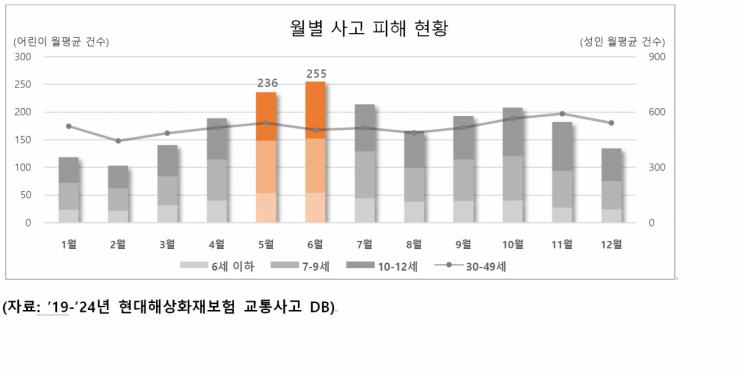
By period, child traffic accident victims were most frequent in May and June. The number of victims in May was 236, which is 2.1 times higher than in January and February (111 cases), and 1.3 times higher than the monthly average (178 cases). While accident victims among people in their 30s and 40s were evenly distributed throughout the year, child accidents were concentrated in the spring. This is because warmer weather during this period leads to increased outdoor activities among children.
Analyzing the distribution by time of day, adult traffic accidents were spread evenly throughout the working hours of the day. In contrast, over 60% of child traffic accidents occurred between 2 p.m. and 7 p.m. This is due to differences in activity times by age, as many child accidents occurred during after-school hours or playtime.
For children aged 6 and under, a high proportion of accidents occurred in parking lots. Of the cases involving minor injuries among children aged 6 and under, 19% occurred near parking lots, and 25% of serious injury cases happened in the same areas. This is a high level compared to about 10% for other age groups. This is because children aged 6 and under usually move with their parents on regular roads or sidewalks, but in areas near parking lots such as apartment complexes, supermarkets, or neighborhood alleys, they are often alone or walking ahead. When young children are alone, drivers often fail to notice them due to their small stature, leading to collisions. In particular, when vehicles are coming up from underground parking lots, drivers' visibility of small children is limited. Even in familiar places, if a child goes ahead or sits by the roadside, the risk of an accident increases, so parents need to be especially vigilant.
Children often run out onto roads within apartment complexes, narrow alleyways, or between parked cars. In fact, when comparing accidents involving pedestrians, bicycles, or kickboards that suddenly appeared by age group, the accident rate was higher among children than other age groups. For children aged 9 and under, more than 29% of all accident cases involved this type of sudden appearance.
Even when comparing the number of cases, elementary school children (aged 7-12) were involved in 2,368 cases of sudden appearance, compared to 940 cases among adults in their 30s and 858 cases among those in their 40s. Based on the frequency per year of age, the number of accident cases involving elementary school children was 4.4 times higher than that of adults in their 30s and 40s.
Children often suddenly run out from alleys, abruptly change direction to cross the road from sidewalks, or dash across narrow roads such as parking lot entrances without anticipating the presence of vehicles, focusing only on what is ahead. In such cases, drivers may not see the child in time and may not be able to slow down, leading to serious accidents. Even if the driver notices the child, it may be difficult to stop in time, resulting in a collision with the pedestrian, or the driver may swerve to avoid the child and end up colliding with another vehicle or structure.
A representative from the Hyundai Marine & Fire Insurance Traffic Climate and Environment Research Institute said, "When teaching children traffic accident prevention rules, it is important to provide concrete education on how to behave in real-life situations with their guardians, rather than simply telling them to 'be careful of cars'."
© The Asia Business Daily(www.asiae.co.kr). All rights reserved.
![Clutching a Stolen Dior Bag, Saying "I Hate Being Poor but Real"... The Grotesque Con of a "Human Knockoff" [Slate]](https://cwcontent.asiae.co.kr/asiaresize/183/2026021902243444107_1771435474.jpg)















