Recently, Provenance and Acquisition History Are Being Thoroughly Verified
Legal Text "Daemyeongnyul" Had Its Treasure Designation Revoked
The Buddhist scripture "Chojobon Daebanggwangbulhwaeomgyeong Jubon Volume 59," believed to have been printed in the 11th century, has failed to be designated as a Treasure. According to the National Heritage Administration on May 12, the Cultural Heritage Committee ultimately rejected the Treasure designation proposal during its meeting last month. The committee determined that the original source and acquisition details of the artifact were unclear.
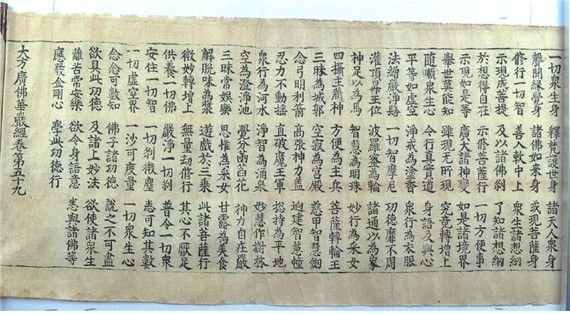
"Chojobon Daebanggwangbulhwaeomgyeong Jubon Volume 59" is part of an 80-volume set of the Avatamsaka Sutra, translated into Chinese by the Tang Dynasty monk Shichananta (652-710). When the National Heritage Administration announced its intention to designate the item as a Treasure in May of last year, it explained that "this is a printed copy of the Chojodaejanggyeong, produced after being carved in the 11th century and housed at Boin Temple on Mount Palgong, but destroyed by fire during the Mongol invasion in 1232." The administration described it as "the only known surviving copy" and evaluated it as having academic value, not only for its rarity but also from the perspectives of bibliography and Goryeo woodblock printing culture.
The Movable Cultural Heritage Subcommittee received documents from the owner regarding the original source and acquisition details on three separate occasions. However, as the supporting documents were insufficient, the committee requested additional materials and held an expert advisory meeting. After lengthy discussions, the committee concluded that the chronology of the submitted documents was inconsistent, and that objective materials such as contracts or remittance receipts proving the previous owner's purchase were lacking. As a result, the proposal was not accepted.
The National Heritage Administration has recently been meticulously verifying the provenance and acquisition history of cultural heritage items. In the case of the legal text "Daemyeongnyul," which was designated as a Treasure in 2016, the source provided by the applicant was found to be false, resulting in the first-ever cancellation of a designation in the history of the National Heritage Administration.
The National Heritage Administration plans to revise the enforcement regulations of the "Act on the Preservation and Utilization of Cultural Heritage" in the second half of the year. Previously, applicants for National Treasure or Treasure designation only needed to submit a handwritten statement. Going forward, they will be required to provide objective materials such as museum or library registration records, sales contracts, and remittance receipts.
© The Asia Business Daily(www.asiae.co.kr). All rights reserved.
![Clutching a Stolen Dior Bag, Saying "I Hate Being Poor but Real"... The Grotesque Con of a "Human Knockoff" [Slate]](https://cwcontent.asiae.co.kr/asiaresize/183/2026021902243444107_1771435474.jpg)
















