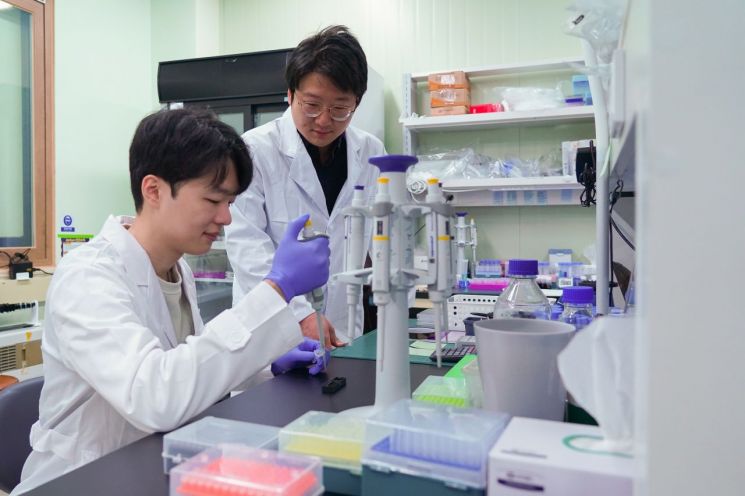
 (From left) Dr. Bobin Lee, Senior Researcher Kihyun Kim, GIST Institute of Advanced Optical Technologies.
Gwangju Institute of Science and Technology (GIST) announced on May 9 that a research team led by Senior Researcher Kihyun Kim at the GIST Institute of Advanced Optical Technologies has developed, for the first time in the world, a "black background-based rapid antigen kit" that can dramatically enhance the sensitivity of rapid antigen tests.
This research is an innovative approach that applies the principle of observing stars in the night sky to diagnostic kits. It overcomes the low sensitivity and false negative issues of existing kits and achieves performance levels close to those of PCR.
PCR (Polymerase Chain Reaction) is a technology that can rapidly and accurately amplify specific DNA, allowing for the exponential amplification and analysis of even small amounts of genetic information. With high sensitivity and accuracy, it enables the rapid detection of genes from small samples. However, it requires expensive equipment and specialized expertise, and the time and cost involved can be greater than other methods based on PCR itself.
Rapid antigen kits are widely used for COVID-19 and pregnancy testing. Their advantages include convenience and the ability to provide quick, on-site diagnostics, making them useful for early screening of high-risk groups for infectious diseases.
However, when the concentration of antigens is low, the signal appears faint, increasing the likelihood of false negatives, which has limited the accuracy of infection diagnosis.
In fact, during the COVID-19 pandemic, rapid antigen kits received emergency use authorization as a supplementary measure when PCR testing could not meet demand. However, they faced challenges in securing reliability in terms of diagnostic accuracy.
As a result, rapid antigen diagnostic technology has been primarily used for applications such as pregnancy testing, where precision is relatively less critical, and has been used only to a limited extent in infectious disease diagnostics, where high accuracy is essential.
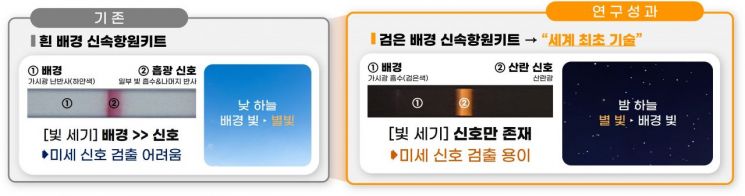
To overcome these limitations, the research team introduced a structural improvement by designing the background of the diagnostic kit in black. Conventional kits rely on visually observing the red absorption signal generated by gold nanoparticles against a white background. However, strong reflected and scattered light from the white background made it difficult to detect subtle signals.
Inspired by the natural phenomenon that stars are barely visible during the day but appear clearly at night, the team applied a black background to minimize unnecessary light reflection. As a result, the signal from gold nanoparticles became much more distinct, enabling the detection of even trace amounts of viruses.
Senior Researcher Kihyun Kim stated, "This study maintains the convenience of rapid antigen kits while dramatically improving sensitivity, making it possible to detect even trace amounts of viruses that were difficult to identify with conventional methods. This will be an important turning point for rapid antigen kits to achieve PCR-level accuracy in various clinical and public health fields, including infectious disease diagnostics."
© The Asia Business Daily(www.asiae.co.kr). All rights reserved.
![Clutching a Stolen Dior Bag, Saying "I Hate Being Poor but Real"... The Grotesque Con of a "Human Knockoff" [Slate]](https://cwcontent.asiae.co.kr/asiaresize/183/2026021902243444107_1771435474.jpg)
















