Over 40 Sites Under Underground Safety Evaluation
Inspections Extended Until End of June with Expert Cooperation
Rapid Implementation of Safety Measures and Support Plans Under Discussion
Public Anxiety Persists as Reports of Suspected Sinkholes Double
The Seoul Metropolitan Government is extending the safety inspection period around excavation sites. Since last month, inspections have been underway at 40 excavation sites, in cooperation with external experts and local district offices. The city also plans to accelerate the implementation of comprehensive measures to prevent sinkhole accidents.
According to the Seoul Metropolitan Government and other sources on May 9, the city has decided to extend safety inspections at excavation sites, originally scheduled to end next week, until the end of June.
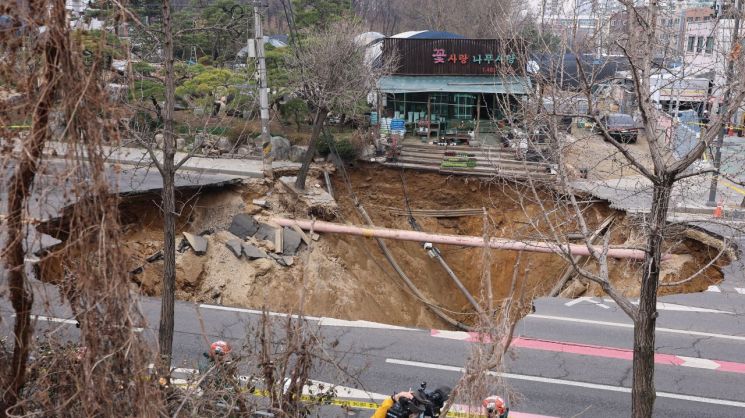 The scene of the large sinkhole that occurred on the road at Daemyeong Elementary School in Gangdong-gu last March. Photo by Yonhap News
This inspection was initiated in response to growing public anxiety and an increase in suspicious reports following a fatal sinkhole accident in Myeongil-dong last March. The city determined that on-site inspections were necessary because underground development projects that could potentially cause sinkholes are being carried out simultaneously across the city. As a result, since April 15, the Disaster and Safety Policy Division, the underground safety departments of district offices, and the architectural divisions of district offices have all begun inspections. The inspections are targeting 17 sites with excavations deeper than 20 meters, as well as 23 sites with excavations between 10 and 20 meters, all of which are subject to underground safety evaluations.
Although the inspection period has been extended, the number of targeted sites remains at 40. However, to minimize inconvenience at these sites, the city will strengthen cooperation with external experts and local district offices. Minor issues identified during inspections will be addressed immediately on-site, while serious issues will result in construction suspensions, corrective orders, or administrative actions.
The city is also accelerating the implementation of comprehensive measures for sinkhole prevention and management. Seoul is currently refining its "Underground Space Management Innovation Plan," which aims to prevent not only small-scale ground subsidence but also large-scale ground collapses that mainly occur around underground excavation sites. The city is also working to strengthen safety reviews for underground excavation projects and to establish institutional mechanisms for securing budgets for on-site measurements and risk detection. The number of ground-penetrating radar (GPR) vehicles will be increased from four to seven, expanding the inspection coverage to 60%. The city is also working to introduce a "ground subsidence monitoring network" capable of detecting up to 20 meters underground.
The replacement of aging sewage pipes, considered a key measure, will be significantly expanded. Seoul plans to double the annual budget from 200 billion won to 400 billion won, enabling the maintenance of 200 kilometers each year. In addition, the city will work to replace all 3,074 kilometers of water supply pipes that are more than 30 years old by 2040. A new department dedicated to ground subsidence, the "Underground Safety Division," will be established, expanding the organization to around 30 members?three times the current size. The city also plans to deploy a large number of private sector experts and to shorten the ground safety inspection cycle from once a year to once a month.
Recently, the city met with representatives from major underground excavation sites to discuss practical safety management measures. Construction companies involved in major underground excavation projects in Seoul?including the International Exchange Complex Road Improvement Project, the Dongbu Expressway Underground Construction Project, and the Yeongdong-daero Underground Space Complex Development Project?participated in the discussions. Improvement tasks proposed during the meeting included: strengthening GPR surveys at large excavation sites to once a month and disclosing the results; establishing a "review first, then construction" system for ground stability; building a real-time safety monitoring system using construction site CCTV; prioritizing the application of smart measurement technologies in ground-weak areas; and reflecting the costs of GPR surveys, visual inspections, and other ground safety measures in construction costs. Construction companies requested that appropriate construction costs and timelines reflecting the characteristics of urban areas be set, and that a consultative body be established between Seoul's expert groups and construction companies.
However, public anxiety remains high. After the large sinkhole accident in Myeongil-dong, reports of suspected ground subsidence surged to more than twice the normal level. According to the Seoul Metropolitan Government and other sources, from March 25 (the day after the Myeongil-dong accident) to April 22, a total of 1,450 reports related to sinkholes, potholes, and ground subsidence were filed?an average of 50 suspicious reports per day. The occurrence of casualties from a major sinkhole accident has heightened public anxiety, leading many to mistake even simple potholes (road depressions) for ground subsidence.
Some point out that the city's decision not to disclose the ground subsidence safety map (priority maintenance area map) has contributed to increased public anxiety. Last year, the city created a safety map assessing sinkhole risk in five levels, but decided not to disclose it, citing concerns that it could cause unnecessary misunderstanding and anxiety. Instead, the results of special GPR inspections and actions taken in response to citizen reports are disclosed on the "Seoul Safety Nuri" platform. Special GPR inspections are also being conducted at five railway construction sites in Seoul that require priority inspection for sinkhole prevention (covering 49.3 kilometers) and at 50 sites (covering 45 kilometers) selected by district offices. On Seoul Safety Nuri, the public can check the inspection period and section, the location and size of detected voids, and the results of actions taken.
© The Asia Business Daily(www.asiae.co.kr). All rights reserved.

















