Announcement of Three New Korean ARPA-H Projects for 2025
Aiming to Address Health Security, Intractable Diseases, and Essential Medical Service Challenges
The government will provide 17.5 billion won annually for five years to each of three high-cost, high-difficulty research and development (R&D) projects, for a total of 52.5 billion won, in order to address major national challenges in the healthcare sector, such as infectious disease pandemics and essential medical service crises.
On May 9, the Ministry of Health and Welfare and the Korea Health Industry Development Institute announced the first new projects for the 2025 "Korean ARPA-H (Advanced Research Projects Agency for Health) Project" and issued a call for R&D proposals to implement them.
The Korean ARPA-H Project is a government initiative that invests in mission-oriented R&D that is high-cost, high-difficulty, but has significant ripple effects, in order to solve national challenges in the healthcare sector. The government has set five urgent missions: establishing health security, overcoming intractable diseases, securing cutting-edge biohealth technologies, improving welfare and care, and innovating essential medical services. From 2024 to 2032, the government plans to support the project with a total budget of 1.1628 trillion won. Last year, the project planned a total of 10 research projects, including the development of ultra-long-term vaccine stockpiling technology, the development of innovative space medicine technologies, and the development of multimodal sarcopenia treatment technologies, and selected 25 R&D projects to implement.
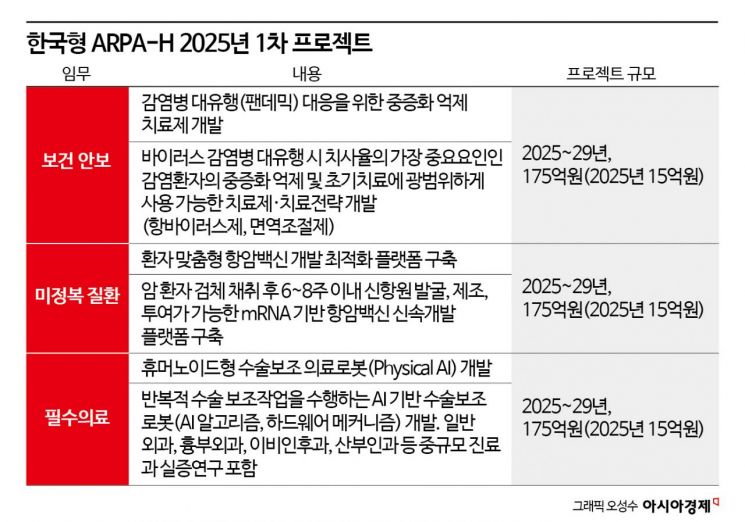
This year's new projects include the development of therapeutics to suppress severe cases in response to infectious disease pandemics, the establishment of an optimized platform for developing patient-specific cancer vaccines, and the development of humanoid surgical assistant medical robots.
First, under the mission of establishing health security, the project to develop therapeutics to suppress severe cases in response to infectious disease pandemics will be promoted. The goal is to develop therapeutics and treatment strategies that can be widely used for early treatment and to suppress the progression to severe illness in high-risk patients, such as those with underlying conditions, in response to pandemics that recur every few years.
Under the mission of overcoming intractable diseases, the project to establish an optimized platform for developing patient-specific cancer vaccines will be promoted. The project will integrate detailed technologies such as neoantigen analysis and discovery, immunogenicity testing, and the manufacturing of personalized messenger ribonucleic acid (mRNA) vaccines to respond to various mutations in cancer patients for treatment and recurrence prevention. The goal is to establish a rapid mRNA-based vaccine development platform that can discover neoantigens and manufacture and administer vaccines in a short period after collecting samples from cancer patients.
Under the mission of innovating essential medical services, the project to develop humanoid surgical assistant medical robots will be promoted to address essential medical issues such as shortages of medical personnel. The goal is to develop a physical AI-based surgical assistant robot that combines artificial intelligence (AI) algorithms and hardware to perform repetitive surgical assistance tasks, thereby supporting doctors during surgery and creating a more efficient surgical environment.
Jung Eunyoung, Director-General of Health Industry Policy at the Ministry of Health and Welfare, stated, "If successful, these new projects for 2025 will be challenging initiatives that can dramatically improve public health by securing therapeutics for infectious diseases, overcoming cancer, and addressing shortages of essential medical personnel." She added, "We hope that by bringing together Korea's healthcare research capabilities, we can create a real breakthrough for public health and medical innovation."
© The Asia Business Daily(www.asiae.co.kr). All rights reserved.

















