Over 300 Representatives from Government, Business, and Academia Attend
"Government Support Needed to Stimulate Private Innovation and Investment"
"Measures Required to Secure Electricity, Data, and Talent"
"Korean-Style LLMs Should Be Supported by a 'One Team' Effort from Public and Private Sectors"
Key figures representing the government, business, and academia gathered and agreed that supporting manufacturing AI technology is essential for Korea to establish itself as a global powerhouse in artificial intelligence (AI).
The "Korea AI Policy Forum," hosted by the Korea Chamber of Commerce and Industry in collaboration with the Korean Association for Artificial Intelligence and the Korean Association for AI Law, was held on May 9 at Lotte Hotel Seoul. The event was attended by Choi Taewon, Chairman of the Korea Chamber of Commerce and Industry, Yoo Sangim, Minister of Science and ICT, Ahn Deokgeun, Minister of Trade, Industry and Energy, Lee Jihyung, President of the Korean Association for Artificial Intelligence, and Choi Kyungjin, President of the Korean Association for AI Law, among other key figures from the government, business, and academia. The keynote speech and panel discussion were chaired by Yeom Jaeho, President of Taejae University and Vice Chair of the National AI Committee. The session chairs included Kwon Seokjun, Professor at Sungkyunkwan University, and Jung Song, Director of the KAIST AI Institute and Dean of the KAIST Graduate School of AI.
From the government, Kim Kyungman, Director at the Ministry of Science and ICT, Kang Gamchan, Director at the Ministry of Industry, and Shin Sangryul, Director of Policy Planning at the National AI Committee, participated as panelists. From the business sector, Kim Jihyun, Executive Vice President at SK Management and Economics Research Institute, Kim Youngok, CAIO (Chief AI Officer) at HD Hyundai AI Center, Yoon Sungho, CEO of Makinarocks, and Kim Byunghak, Performance Leader at Kakao Kanana, took part. From academia, Kim Minki, Dean of KAIST Graduate School of Business, Lee Jongseok, Professor at KAIST, and Han Soonkoo, Professor at Yonsei University, joined as panelists. In total, around 300 business leaders, experts, and government officials attended the forum.
In his opening remarks, Choi Taewon, Chairman of the Korea Chamber of Commerce and Industry and SK Group, stated, "Korea needs a new strategy to create a structure where we can excel in the AI field and pioneer the future," adding, "Without the help of AI, the very economic model that the nation has relied on will collapse."
Yoo Sangim, Minister of Science and ICT, said, "Korea is recognized as a country with strong capabilities, possessing hardware manufacturing expertise from memory to AI semiconductors, and having the third largest number of proprietary AI models in the world. I am confident that if we leverage our unique strengths, we can create new opportunities." He continued, "We will support the expansion of AI into all sectors of the economy and society, including manufacturing and healthcare, based on AI computing infrastructure and our proprietary AI models, to drive innovation." He added, "If private sector innovation and investment are activated with government support, AI can lead Korea to a new leap forward."
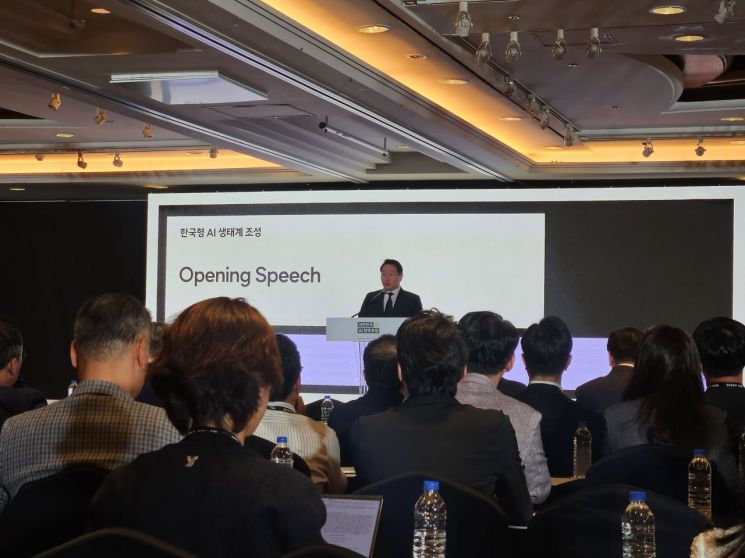 Choi Taewon, Chairman of the Korea Chamber of Commerce and Industry and SK Group, is delivering the opening address at the "Korea AI Policy Forum" held on the 9th at Lotte Hotel Seoul. Photo by Park Juni
Ahn Deokgeun, Minister of Trade, Industry and Energy, emphasized, "The use of AI in manufacturing is a prerequisite for becoming an AI powerhouse," and stated, "For Korea to become one of the top three AI nations, we must become number one in industrial AI and manufacturing AI." He added, "Our understanding of manufacturing sites and our abundant industrial data differentiate us from other countries, so we must actively pursue an 'industrial AI strategy' that leverages the strengths of our companies based on these assets."
In his welcoming remarks, Lee Jihyung, President of the Korean Association for Artificial Intelligence, said, "No matter how advanced our technology is, it cannot truly become ours unless we establish a national strategy that encompasses not only technology but also regulation, society, and culture." He pledged, "We will do our utmost to connect academic expertise to policy so that Korea can leap forward as a global AI powerhouse." Choi Kyungjin, President of the Korean Association for AI Law, also stated, "For Korea to become one of the world's top three AI nations, we must achieve breakthroughs not only in securing world-class talent but also in R&D, infrastructure, data, and systems?outpacing the United States and China in all aspects of society." He stressed, "Not only businesses and the government but also the public must participate to accelerate the AI transformation (AX)."
In his keynote address, Yeom Jaeho, President of Taejae University, explained, "The AI ecosystem must be realized according to market principles so that AI infrastructure, AI models, and AI services develop sequentially, and the resulting increase in AI demand leads to further investment in AI infrastructure, creating a virtuous cycle." He continued, "To ensure the smooth circulation of the AI ecosystem, the government should take the lead in securing resources such as data, talent, and infrastructure, and focus on solving challenges that cannot be addressed by the private sector alone." He also emphasized, "Companies should actively respond to the national AI strategies and policies established by the government and continue healthy competition to strengthen overall AI capabilities. If the public and private sectors cooperate as 'one team,' we can build a Korean-style AI ecosystem."
In the three subsequent panel discussions, AI experts from business, government, and academia engaged in lively debates. The first panel discussion addressed the roles that companies and the government must play to overcome the weaknesses of the AI ecosystem, which lags behind global trends. Kim Minki, Dean of KAIST Graduate School of Business, suggested, "To develop Korea's AI ecosystem, it is urgent to expand essential strategic assets such as AI computing infrastructure and to secure supply measures for key inputs like electricity, data, and talent." He added, "Government financial investment should drive demand for infrastructure and support the competitiveness of key inputs, thereby serving as a catalyst for private investment."
The second panel discussion focused on ways to promote the development and utilization of manufacturing AI. Kwon Seokjun, the session chair, stated, "Manufacturing AI should not only enhance productivity but also serve as a core strategy for upgrading Korea's major industries. In particular, linking industry, AI, and energy could become a crucial strategic breakthrough for revitalizing local economies and driving national growth." He emphasized the need for comprehensive support through collaboration between the government and industry, including the operation of customized data centers, creating demand for AIX (UNIX operating system) through AI vouchers, and mega sandboxes.
Lee Jongseok, Professor at KAIST, explained, "The main reasons for hesitation in adopting AI at manufacturing sites are resistance due to accountability in case of malfunction and uncertainty about economic viability." He added, "There is a need for support in developing interpretable, manufacturing-specialized AI and reliability assurance technologies, such as building pilot factories for AI autonomous manufacturing simulation, as well as policies to promote the adoption and spread of manufacturing AI through the creation of manufacturing AI special zones and voucher systems."
The final panel discussion addressed the necessity and strategies to enhance the competitiveness of a Korean-style LLM (Large Language Model). Jung Song, the session chair, stated, "LLMs are a critical factor that determines the completeness of each country's AI ecosystem, driving innovative changes across various industries and serving as a core technology that will shape Korea's future digital competitiveness." He argued, "To build LLMs that combine the capabilities of universities and companies, the government needs to provide long-term and stable policy support for key elements such as infrastructure, data, and talent."
Han Soonkoo, Professor at Yonsei University, stressed, "Considering the network effect and national security aspects of LLMs, K-LLM is absolutely necessary for the Korean economy." He emphasized, "With a sense of urgency about the global competitive environment, domestic companies, universities, and the government must join forces as 'one team.'"
© The Asia Business Daily(www.asiae.co.kr). All rights reserved.
![Clutching a Stolen Dior Bag, Saying "I Hate Being Poor but Real"... The Grotesque Con of a "Human Knockoff" [Slate]](https://cwcontent.asiae.co.kr/asiaresize/183/2026021902243444107_1771435474.jpg)















