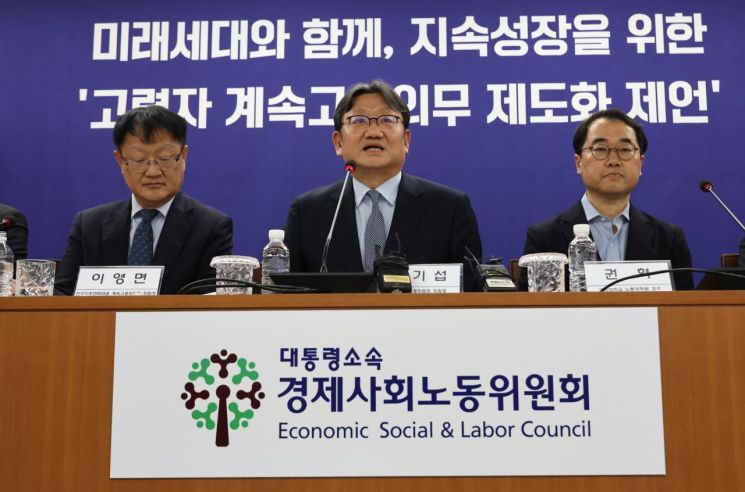
 On the 8th, Kwon Kisub, chairman of the Economic, Social and Labor Council (ESLC) under the President in Jongno-gu, Seoul, is speaking at the briefing on "Public Interest Committee Proposals for Institutionalizing the Mandatory Continued Employment of Elderly Workers." Photo by Yonhap News
On May 8, the Economic, Social and Labor Council (ESLC) under the President announced public interest committee proposals to institutionalize the mandatory continued employment of elderly workers. In response, the business community immediately voiced opposition, citing concerns such as youth employment.
The Korea Employers Federation expressed strong regret regarding the proposals announced on this day, stating, "The key issue of wage system reform is missing." The federation pointed out, "During the discussions in the Continued Employment Committee, the business community repeatedly emphasized the need to ease the procedures for amending work rules, which is the minimum effective measure for wage system reform. However, this was not reflected at all."
The federation further criticized, "The proposals do not grant companies the right to select which employees to rehire, but instead obligate them to rehire, in principle, all elderly workers who wish to continue working." It interpreted, "Especially for regular employees of large companies with labor unions, aside from some differences in compensation, this is essentially no different from extending the retirement age."
The Korea Chamber of Commerce and Industry also expressed concerns in a statement issued by Lee Jongmyung, head of the Industrial Innovation Division, saying, "It would be desirable to ensure that labor and management can adopt various forms of employment extension through autonomous agreements." The chamber warned, "The ESLC proposals do not guarantee the autonomous choice of labor and management, which is effectively the same as extending the retirement age. This is likely to increase rigidity in companies and cause conflicts over jobs with the younger generation."
The Federation of Korean Industries, in a statement by Lee Sangho, head of the Economic and Industrial Division, pointed out, "If the practical benefits of mandatory continued employment are concentrated among certain groups, such as large corporations and regular employees, labor market polarization may intensify, requiring in-depth discussion from a long-term perspective." The federation added, "To build a sustainable employment ecosystem for the elderly, it is desirable to have autonomous continued employment methods that consider various conditions in the industrial field." It emphasized, "Fundamental institutional foundations, such as reasonable wage system reform and increased employment flexibility, must be established first to achieve this."
The public interest committee proposals announced by the ESLC on this day include maintaining the current statutory retirement age of 60, while obligating employers to continue employing workers who wish to work beyond retirement until the age of 65. For workplaces where labor and management have not agreed to extend the retirement age, employers will be required to continue employing elderly workers.
© The Asia Business Daily(www.asiae.co.kr). All rights reserved.
![Clutching a Stolen Dior Bag, Saying "I Hate Being Poor but Real"... The Grotesque Con of a "Human Knockoff" [Slate]](https://cwcontent.asiae.co.kr/asiaresize/183/2026021902243444107_1771435474.jpg)















