Birth Dates Changed in Recent Vatican Yearbook
Voting Rights Granted Only to Cardinals Under 80
As the conclave (the secret meeting of the College of Cardinals to elect a new pope) entered its second day, allegations have emerged that some African cardinals falsified their ages in order to secure voting rights.
According to the German daily Merkur and the religious magazine Kirche-und-Leben on May 8 (local time), the cardinals implicated in these allegations are Cardinal Philippe Ou?draogo of Burkina Faso and Cardinal John Njue of Kenya. Voting rights in the papal election are granted only to cardinals under the age of 80 as of the day before the papal seat becomes vacant. However, there are suspicions that these cardinals changed their dates of birth in advance of the death of Pope Francis in order to meet this requirement.
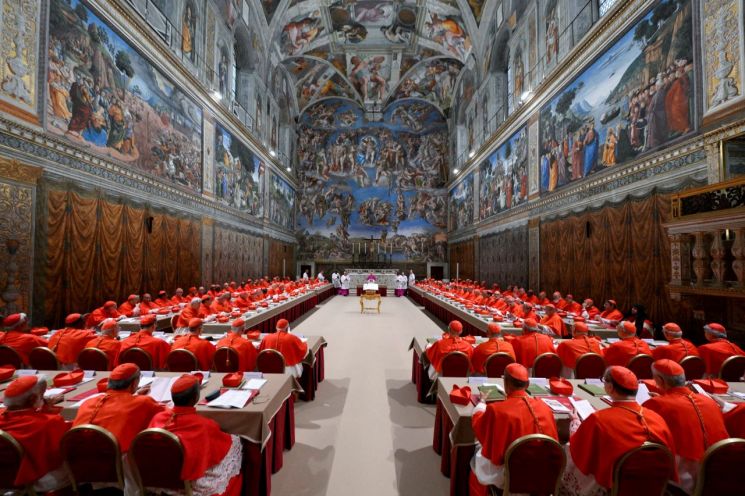 On the 7th (local time), cardinals from around the world gathered to pray at the Sistine Chapel ahead of the papal election. Photo by Reuters
Last year’s Vatican yearbook listed Cardinal Ou?draogo’s date of birth as January 25, 1945, but in the 2025 edition, it was changed to December 31, 1945. Cardinal Njue, who was previously known to have been born in 1944, suddenly became listed as being born on January 1, 1946. As a result of these changes, both cardinals narrowly retained their voting rights, being 79 years old as of April 20, 2025, the day before Pope Francis passed away.
In a media interview, Cardinal Ou?draogo explained, "There was neither a school nor a hospital in the village where I was born. I was born at home, and there was no record of my birth date." He stated that he chose January 25, 1945, as his date of birth when he was ordained as a priest in 1973, but did not explain why he recently changed it to a later date. Vatican spokesperson Matteo Bruni said, "It is possible that identification documents arrived at the Vatican." Although Cardinal Ou?draogo was appointed by Pope Francis in 2014, he is considered a conservative figure who opposes homosexuality and divorce.
Cardinal Ou?draogo also commented, "In Africa, birthdays have no meaning and have little impact on social life." There is also an opinion that in Burkina Faso, if the exact date of birth is unknown, the government typically assigns December 31 as the official date. Regarding this, Merkur noted, "Only God knows what the truth is."
Cardinal Njue did not participate in this vote. The media reported that he was absent due to health issues. However, he himself stated, "It is definitely not because of health problems," and claimed, "I did not receive an invitation from the Vatican." In contrast, the Vatican responded, "No invitation is required for the conclave," and insisted that "Cardinal Njue’s absence is due to health reasons, not age."
Meanwhile, the conclave to elect the next pope began on the afternoon of May 7 at the Vatican. There are a total of 135 cardinals worldwide with voting rights, but two cardinals?Cardinal Njue and Cardinal Antonio Ca?izares Llovera of Spain?did not participate. The conclave continues until a cardinal receives the support of at least two-thirds of the 133 cardinal electors, which is a minimum of 89 votes, to be elected pope. When a pope is elected, white smoke is released; if not, black smoke appears. On the first day, there was one round of voting, but from the second day onward, there are four rounds of voting each day, increasing the likelihood of electing a new pope.
© The Asia Business Daily(www.asiae.co.kr). All rights reserved.

















