Economic, Social and Labor Council's Public Interest Members Announce Proposal
Mandatory Continuous Employment Suggested as a Transitional Measure
"Continuous Employment Opportunities and Appropriate Wages Must Be Guaranteed"
Phased Implementation Needed After Grace Period Until 2027
The Economic, Social and Labor Council, a presidential advisory body for social dialogue, has proposed that, rather than immediately implementing a statutory retirement age extension, mandatory continuous employment for older workers should be introduced as a transitional measure. The public interest members' proposal presents various types of continuous employment, such as entering into new employment contracts for workplaces where the retirement age is not extended. For large corporations and public institutions, where there could be conflicts with youth employment, the proposal includes the option of transferring older workers to affiliated companies. The period of mandatory continuous employment would be gradually extended so that it reaches age 65 by 2033.
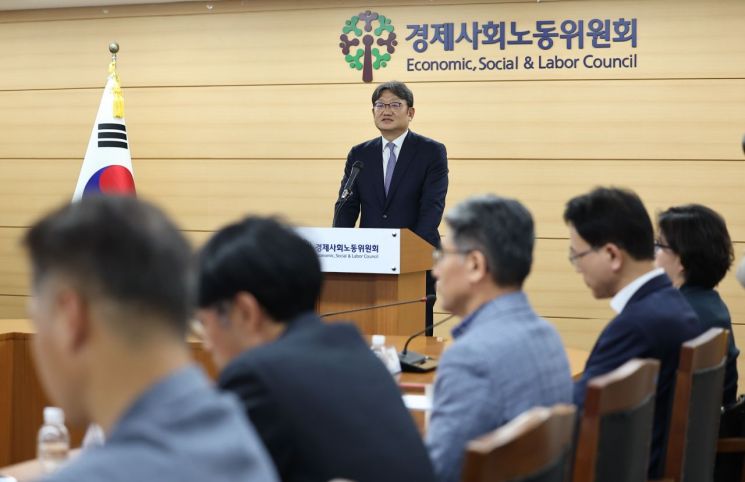
"Urgent Need to Quickly Overhaul Continuous Employment...We Must Face the Reality in Korea"
The Continuous Employment Committee for Responding to Demographic Changes, a subcommittee of the Economic, Social and Labor Council, announced on May 8 the 'Public Interest Members' Proposal on Institutionalizing Mandatory Continuous Employment for Older Workers.' On this day, Lee Youngmyeon, chair of the Continuous Employment Committee, presented for the first time a public interest members' proposal regarding solutions for continuous employment that have been discussed so far.
Chair Lee stated, "Since the implementation of the statutory retirement age of 60 in 2016, Korea has not been adequately prepared for continuous employment of older workers after age 60," and added, "With the recent reform of the National Pension system, there is an urgent need to quickly overhaul the continuous employment system for older workers." He continued, "While it would be ideal to align the statutory retirement age with the pension eligibility age, we must face the reality of Korea's seniority-based wage system and the dual structure of the labor market."
He also said, "Given the severe employment situation for the younger generation, we must heed warnings that extending the statutory retirement age could limit hiring opportunities for young people, as well as job opportunities at large corporations and in the public sector." He emphasized, "The public interest members are making recommendations for a mandatory continuous employment system for older workers as a transitional measure until the conditions for extending the statutory retirement age are fully in place."
Chair Lee stated, "If labor and management at individual workplaces autonomously agree to extend the retirement age by negotiating wages or working hours, this should be fully respected." He added, "The mandatory continuous employment obligation is assigned to employers at workplaces where there is no autonomous agreement between labor and management to extend the retirement age, or where such agreement has not been reached." He explained, "The fulfillment of the mandatory continuous employment obligation will be achieved through the signing of new employment contracts."
The key components of the mandatory continuous employment system are: ▲ universal guarantee of continuous employment opportunities, ▲ guarantee of appropriate wages corresponding to productivity, and ▲ guarantee of 'choice' regarding working hours and job roles in continuous employment. In principle, all employees who wish to work after age 60 should be given the opportunity for continuous employment. However, exceptions may be made if the employee's health deteriorates to the point that they cannot perform their duties, or if the business is downsized or closed.
The detailed types of the mandatory continuous employment system include: ▲ Stage 1: Job-retention type continuous employment, ▲ Stage 2: Voluntary selection type continuous employment, and ▲ special provisions for continuous employment at large corporations and public institutions. The job-retention type allows employees to continue working in their existing roles and with the same working hours if they wish, but wages should be set at an appropriate level considering productivity. The voluntary selection type allows for adjustments to job roles and working hours for reasonable reasons such as the older worker's health or safety.
For jobs at large corporations and public institutions, which are favored by young people, a special type of continuous employment will allow older workers to be transferred to affiliated companies. However, Chair Lee explained that such measures should be transitional, limited in scope and duration, and only allowed temporarily in consideration of youth employment conditions.
Chair Lee stated, "Employers should consider the possibility of applying the following order when fulfilling the mandatory continuous employment obligation: Stage 1 job-retention type, Stage 2 voluntary selection type, and special provisions for large corporations and public institutions." He added, "Employers may also apply a combination of these methods depending on the job category, role, or job group within the workplace."
Regarding the timing of implementation, he said, "Considering the National Pension eligibility age and the time needed for preparation, a phased approach by year is necessary." He suggested, "Assuming the legislation is passed this year, a two-year grace period should be provided until 2027, then from 2028 to 2031, the mandatory continuous employment period should be extended by one year every two years, and from 2032 onward, it should be extended by one year annually."
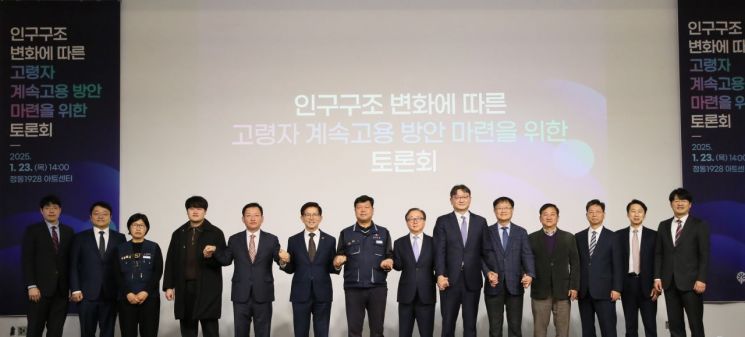 A public debate on continuous employment held last January with participation from labor, management, and government representatives. Economic Social Labor Council
National Responsibility Needed to Ensure Effectiveness of Mandatory Continuous Employment
The Continuous Employment Committee presented four principles for designing the mandatory continuous employment system: ▲ it must not deepen the dual structure of the labor market, ▲ it must be compatible with youth employment, ▲ it must consider the sustainability of the labor market, and ▲ it must be operated with active participation from both labor and management. Chair Lee stated, "The system should be designed so that the benefits of mandatory continuous employment do not concentrate only on certain employees working in large corporations or the public sector."
As for the national responsibilities to ensure the effectiveness of the mandatory continuous employment system, he said, "Communication procedures should be institutionalized so that the opinions of employees, including young people, are properly reflected during labor-management consultations or agreements." He also stated, "To promote the spread of continuous employment and the transition to age-friendly workplaces, the government should provide guidelines and consulting support for job redesign and wage system reform." He further pointed out, "It is also necessary to revise training programs for older workers."
Chair Lee emphasized, "We must expedite improvements to employment safety nets, such as retirement pension systems and employment insurance, in preparation for an aging labor market." He also proposed, "Statistics related to older worker employment and wage systems should be improved, and a (tentatively named) Older Workers Continuous Employment Committee should be established within the Economic, Social and Labor Council to monitor the implementation of mandatory continuous employment for older workers and its impact on the labor market." He added, "An active incentive system should be established to support the fulfillment of the mandatory continuous employment obligation, including tax benefits and compensation for wage reductions."
Chair Lee stressed, "The public interest members have worked to create a plan that balances guaranteeing continuous employment opportunities for older workers with the cost burdens on companies, while also reflecting the realities of the labor market and the needs of future generations." He continued, "We can no longer delay reforming the continuous employment system," and expressed hope that "these recommendations will lead to swift legislative discussions and quickly resolve the uncertainties surrounding employment for older workers."
"Considering Rapid Legislative Conditions After the Launch of the New Administration"
The Economic, Social and Labor Council launched the Continuous Employment Committee for Responding to Demographic Changes on June 27 last year through a tripartite agreement among labor, management, and government, and has held a total of 40 meetings over the past 11 months to prepare this public interest members' proposal. A total of 10 people, including representatives of labor, management, government, and public interest members, participated in 10 plenary meetings, 3 secretariat meetings, and 27 public interest meetings.
Although the plenary meetings with labor and management have been suspended since December last year, all public interest members of the Continuous Employment Committee continued public interest-focused discussions, recognizing the seriousness and urgency of the issue. During the process, the committee listened to a wide range of field opinions, including those from young people, small and medium-sized business representatives, and cases of retirement age extension and reemployment. In January, a public debate was also held with the participation of labor, management, and government.
Kwon Kisub, chair of the Economic, Social and Labor Council, said, "There are still differences between labor and management regarding continuous employment for older workers, and it is difficult to expect an early return to social dialogue between labor and management." He added, "As chair of the council, I regret that I could not achieve a tripartite agreement."
However, "In order to minimize conflicts and uncertainties surrounding the continuous employment system for older workers, and considering the conditions for rapid legislation after the launch of the new administration, the public interest members have decided to announce their recommendations today," he said. "We hope that today's recommendations will not only expand job opportunities for older workers but also lay the foundation for a vibrant labor market where both younger and older generations can coexist."
© The Asia Business Daily(www.asiae.co.kr). All rights reserved.
![Clutching a Stolen Dior Bag, Saying "I Hate Being Poor but Real"... The Grotesque Con of a "Human Knockoff" [Slate]](https://cwcontent.asiae.co.kr/asiaresize/183/2026021902243444107_1771435474.jpg)

















