Korea Railroad Corporation (KORAIL) is launching a demonstration project that includes the production and test operation of hydrogen trains.
On May 8, KORAIL announced that it held a kickoff briefing for the "Research and Development Project for the Demonstration of Eco-friendly Hydrogen Electric Multiple Units" at its Daejeon headquarters.
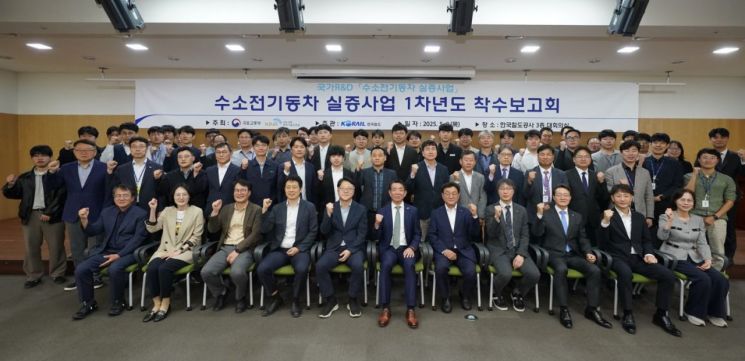 Participants at the kickoff briefing for the "Eco-friendly Hydrogen Electric Vehicle Demonstration Project" held on the 8th at the Daejeon headquarters are taking a commemorative photo. Photo by Korea Railroad Corporation
About 60 participants attended the kickoff briefing, including Han Moonhee, President of KORAIL, as well as officials from the Ministry of Land, Infrastructure and Transport, the National Railroad Authority, and professors from Korea National University of Transportation, among other related organizations.
The demonstration project will be carried out under the supervision of the Ministry of Land, Infrastructure and Transport and the Korea Agency for Infrastructure Technology Advancement (KAIA), with participation from industry, academia, and research institutes.
KORAIL will oversee the entire project. In addition, six organizations?including the National Railroad Authority, Korea National University of Transportation, and Woojin Industrial Systems?will share responsibilities for different areas such as vehicle production and design, performance verification, establishment of hydrogen charging and inspection facilities, and revision of related regulations.
The goal of the demonstration project is to establish the technological and institutional foundation for the commercialization of hydrogen electric multiple units by 2028. A total research budget of 32.1 billion KRW (20 billion KRW from the government and 12.1 billion KRW from public and private sectors) will be invested in the project.
Hydrogen trains use hydrogen as a power source and do not require a separate electricity supply, allowing them to operate on non-electrified lines without overhead wires. They also have more than twice the energy efficiency of diesel trains and are environmentally friendly, as they produce no carbon emissions.
The maximum operating speed of hydrogen trains is 150 km/h, and they can travel more than 600 km on a single charge. KORAIL expects that, once hydrogen trains are introduced in the field, they will be able to replace existing diesel locomotives (two-car formations) on lines such as the Gyoeui Line and Gyeongwon Line.
KORAIL will also establish hydrogen charging facilities that can serve both hydrogen trains and hydrogen buses. The final site for the hydrogen charging facilities will be selected by the end of this year, taking into account support plans from local governments.
Park Chaeok, Director of the KORAIL Railroad Research Institute, stated, "KORAIL will lead the development of eco-friendly hydrogen electric multiple units in cooperation with domestic railway-related organizations, ensuring there are no concerns about exhaust or noise. We expect that, once hydrogen electric multiple units are developed and deployed in the field, they will replace aging trains on non-electrified sections and help railways take a leap forward as an environmentally friendly mode of transportation."
© The Asia Business Daily(www.asiae.co.kr). All rights reserved.
![Clutching a Stolen Dior Bag, Saying "I Hate Being Poor but Real"... The Grotesque Con of a "Human Knockoff" [Slate]](https://cwcontent.asiae.co.kr/asiaresize/183/2026021902243444107_1771435474.jpg)















