Potential Growth Rate Outlook and Policy Implications Released on May 8
A state-run research institute has projected that South Korea's potential growth rate in the 2040s will hover around 0%. The Korea Development Institute (KDI) forecast that, as the country faces rapid population aging, even negative growth could occur in the latter half of the 2040s.
On May 8, KDI released an issue analysis report titled "Potential Growth Rate Outlook and Policy Implications." Kim Gyucheol, Director of Economic Trends at KDI, stated, "This year, the potential growth rate is projected to be in the high 1% range, and it is expected to fall to the low 1% range by 2030." He added, "The potential growth rate will continue to decline, and especially in the 2040s, it is expected to grow at around 0%."
KDI identified the slowdown in total factor productivity due to a shrinking working-age population as the key factor behind this structural growth deceleration. Kim explained, "Around 2030, the contribution of labor input is expected to turn negative." As time passes, the economic contribution of labor input is decreasing, and the pace of capital input growth is also slowing, resulting in a weakening of the overall growth foundation.
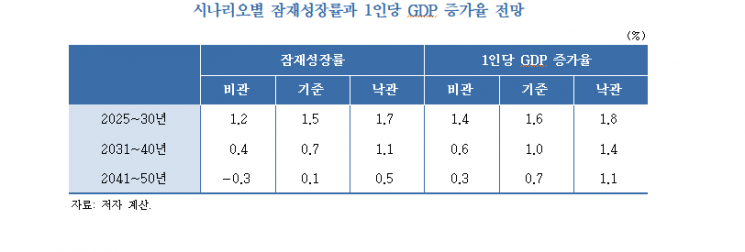
Accordingly, KDI presented three scenarios for future total factor productivity growth rates. The baseline scenario assumes a total factor productivity growth rate converging to the recent 10-year (2015-2024) average of 0.6%. The optimistic scenario assumes a rebound to 0.9% due to advances in artificial intelligence (AI) technology and structural reforms. The pessimistic scenario assumes a decline to 0.3%, based on continued trade conflicts and delayed economic structural reforms.
According to the analysis, under the baseline scenario, growth is expected to be in the low 1% range in 2030, with a slight negative growth projected in the latter half of the 2040s. Specifically, growth rates of 1.5% for 2025-2030, 0.7% for 2031-2040, and 0.1% for 2041-2050 were forecast. In the pessimistic scenario, where economic structural reforms are expected to be delayed, the onset of negative growth is projected to occur in the early 2040s.
However, under the optimistic scenario premised on technological advancement, modest growth is considered possible even in 2050. Growth of 1.7% is projected for 2025-2030, 1.1% for 2031-2040, and 0.5% for 2041-2050. If prices and exchange rates are fixed at 2024 levels, per capita GDP is projected to reach $53,000 in the optimistic scenario, $48,000 in the baseline scenario, and around $44,000 in the pessimistic scenario.
KDI commented, "In all scenarios, both the potential growth rate and per capita GDP growth rate will decline, but there will be a significant gap in growth rates depending on the pace of total factor productivity growth." The institute emphasized the need to focus efforts on improving total factor productivity through economic structural reforms. Therefore, it recommended creating conditions that allow highly productive, innovative companies to pioneer new markets by easing entry barriers and improving regulations that restrict competition.
KDI also suggested that relaxing seniority-based wage systems and excessive protections for regular workers would enable more efficient reallocation of human resources. In addition, it stressed the need to mitigate the decline in the labor force due to demographic changes by utilizing female, elderly, and foreign workers.
Alongside these recommendations, KDI issued a warning regarding fiscal policy management. The institute noted that a declining potential growth rate could lower the real neutral interest rate and constrain the scope of monetary policy, making it necessary to realign policy frameworks to address both high and low inflation risks in a balanced manner. Regarding fiscal policy, KDI cautioned, "Care must be taken to prevent the chronicization of fiscal deficits caused by repeated economic stimulus measures."
© The Asia Business Daily(www.asiae.co.kr). All rights reserved.
![Clutching a Stolen Dior Bag, Saying "I Hate Being Poor but Real"... The Grotesque Con of a "Human Knockoff" [Slate]](https://cwcontent.asiae.co.kr/asiaresize/183/2026021902243444107_1771435474.jpg)















