"Replaced with Simplified Regulations,"
but Pressure on China May Increase
Experts: "Focus on Country-by-Country Negotiations
and Develop Effective Response Strategies"
The administration of former U.S. President Donald Trump has announced that it will withdraw the artificial intelligence (AI) semiconductor export control policy implemented by the previous Joe Biden administration just before its enforcement and replace it with simplified regulations. Although the new framework is simpler in form, there are concerns that increased pressure on China could also impact the domestic memory industry. Experts believe that it is important to closely monitor the new regulatory approach and country-by-country negotiations in order to develop effective response strategies.
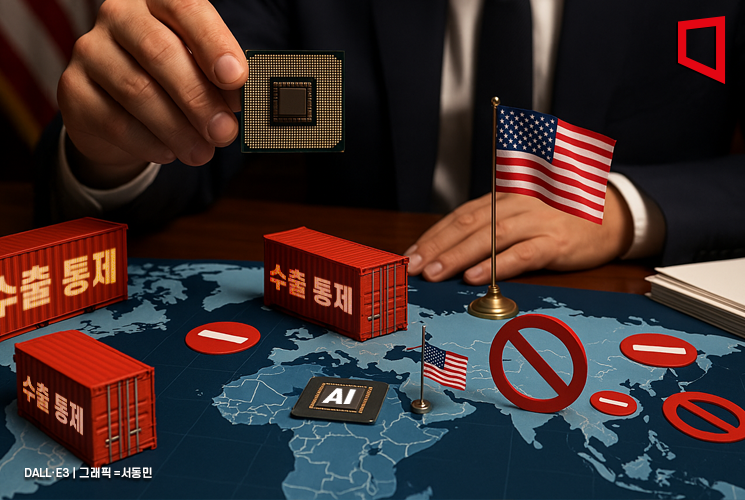
On May 7 (local time), the Trump administration announced its intention to scrap the existing country-tiered export control system, known as the 'AI Proliferation Framework,' and replace it with simplified regulations. The 'AI Proliferation Framework' was scheduled to take effect on May 15. The U.S. Department of Commerce's Bureau of Industry and Security (BIS) stated, "The Biden administration's AI policy is excessively complex and bureaucratic and would hinder American innovation," adding, "We will replace it with much simpler regulations to promote U.S. innovation and secure AI superiority."
This means that the previous system, which differentiated AI semiconductor export controls by allies, general countries, and countries of concern, will be replaced by a new and simpler approach. However, the specific details have not been disclosed.
The domestic semiconductor industry has stated that it is still difficult to determine whether the new measures will be favorable or unfavorable. In the market, there is a perception that the withdrawal of the complex country-by-country export control system can be interpreted as regulatory easing. Since President Trump announced these measures ahead of his visit to Saudi Arabia, it appears that export controls on some Middle Eastern countries will be relaxed, while regulations targeting China will actually be strengthened. Analysts say that short-term optimism is being reflected first, rather than uncertainty stemming from selective application.
Kim Junghoe, Vice Chairman of the Korea Semiconductor Industry Association, commented, "It is difficult to see this decision as immediately intensifying semiconductor regulations under the new approach." Shin Wonkyu, an invited research fellow at the Korea Economic Research Institute, interpreted the move as "eliminating the system of classifying counterparties into tiers and simplifying it," and analyzed, "It seems designed so that products manufactured in China and exported to the U.S. will be subject to sanctions, which would ultimately activate China's own semiconductor industry ecosystem rather than that of the U.S."
There are concerns that domestic companies manufacturing semiconductors in China and exporting them to the U.S. could be affected, but experts predict the impact will be limited. Han Areum, Senior Research Fellow at the Korea International Trade Association, said, "In the case of HBM, most of our companies' shipments go to Taiwan rather than China," adding, "The U.S. is shifting its stance to implement measures that will block country-specific rerouting of exports to China." She emphasized, "Ultimately, there is a possibility that there will be country-by-country pressure regarding how strictly China rerouted exports are controlled."
There was also mention of the possibility that the Trump administration's 'simplified export controls' could be linked to tariff policy. Vice Chairman Kim explained, "This can be interpreted as meaning that activating the U.S. industry can be sufficiently achieved through tariff policy rather than subsidies." Shin also commented, "While the Biden administration exempted tariffs for allied countries, the Trump administration's approach seems to be to start with allies surrounding China," adding, "Even if tariffs are lowered in other sectors, there is a possibility that high tariffs will be maintained for semiconductors and other advanced technologies."
Following news of the Trump administration's policy, Nvidia's share price closed up 3.1% on the U.S. stock market that day. Major semiconductor companies such as TSMC, Broadcom, Qualcomm, and AMD also saw their share prices rise across the board. The Philadelphia Semiconductor Index also closed up by 1.76%. As of 10:22 a.m. on the same day, SK hynix was trading at 194,200 won, up 3,400 won (1.78%) from the previous trading day. At the same time, Samsung Electronics was trading at 54,900 won, up 300 won (0.55%).
© The Asia Business Daily(www.asiae.co.kr). All rights reserved.
![Clutching a Stolen Dior Bag, Saying "I Hate Being Poor but Real"... The Grotesque Con of a "Human Knockoff" [Slate]](https://cwcontent.asiae.co.kr/asiaresize/183/2026021902243444107_1771435474.jpg)











