US Fed Holds Rates Steady for Third Consecutive Meeting Despite Trump Pressure
Maintains Annual Rate at 4.25-4.5%... "Uncertainty Has Grown"
Powell Dismisses Preemptive Rate Cut... Warns of Stagflation
Says "Trump Pressure Not Considered" in Monetary Policy Decisions
Expectations for First-Half Rate Cut Fall... Rate Cut Anticipated in July
Amid rising concerns over "tariff-induced stagflation" (rising prices during an economic downturn), the US Federal Reserve (Fed) has kept its benchmark interest rate unchanged for the third consecutive time, as widely expected. Despite pressure from President Donald Trump to cut rates, Fed Chair Jerome Powell repeatedly stated that both inflation and unemployment risks have intensified due to uncertainty in trade policy, and emphasized a "wait and see" approach until the impact of tariffs on the economy becomes clearer. Some on Wall Street interpreted this as a 'warning' to the Trump administration, which has been aggressively imposing tariffs, while investors have quickly lowered their expectations for a rate cut in the first half of the year and are now speculating about the possibility of a rate cut resuming in July.
US Fed Holds Rates Steady for Third Time Despite Trump Pressure... "Economic Uncertainty Has Grown"
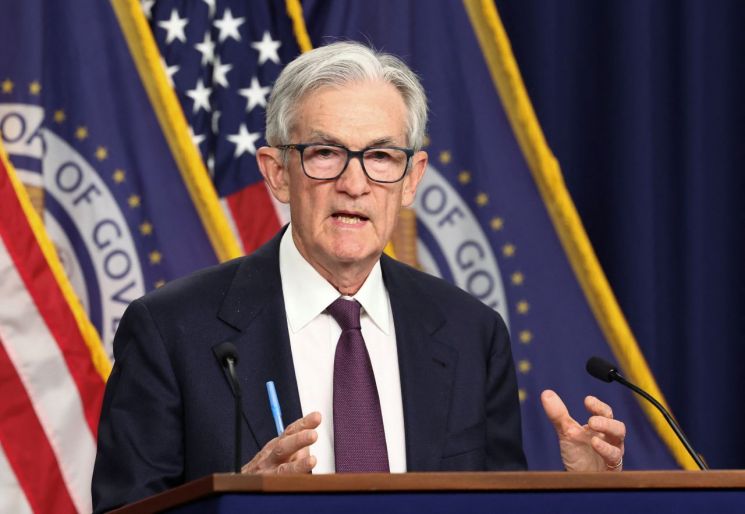
On May 7 (local time), the Fed announced in a unanimously agreed policy statement released after its regular Federal Open Market Committee (FOMC) meeting that it would keep the federal funds rate unchanged at 4.25-4.5% per annum. After beginning rate cuts in September last year and lowering the rate by a total of 1 percentage point from 5.25-5.5%, this marks the third consecutive pause following similar decisions in January and March of this year. As a result, the interest rate gap with South Korea remains at 1.75 percentage points at the upper end.
The main reason for this rate freeze is uncertainty stemming from trade policy. The ongoing confusion caused by aggressive tariff policies and the difficulty in predicting their economic impact led the Fed to conclude that it is better to wait until the policy direction and its effects become clearer. The key theme in both the FOMC policy statement and Chair Powell's press conference was "uncertainty."
In its statement, the Fed said, "Uncertainty about the economic outlook has increased," and added, "The Committee is paying attention to risks on both sides of its dual mandate (price stability and full employment)." The statement also included new language warning that "risks of rising unemployment and inflation have both increased," highlighting the possibility of stagflation due to tariff policies. Notably, with the US economy contracting by 0.3% in the first quarter of this year?the first negative growth in three years, attributed to a surge in imports before tariffs took effect?the statement newly noted that "fluctuations in net exports affected the data," indicating that the Fed sees tariffs as having a real economic impact.
Chair Powell, speaking at a press conference immediately after the FOMC, said, "Given the scope and scale of the tariffs, if these increases persist, there is a high likelihood of rising inflation, slowing economic growth, and higher unemployment." He added, "My gut feeling is that uncertainty about the future economic path has become extremely high. There is no need to rush (a rate cut)." He continued, "Until we see more data, we cannot know the right response, so we are not in a position to act preemptively," and "The cost of waiting for additional information is also quite low. We will wait and see."
The market is concerned that President Trump's aggressive tariff drive could lead to higher prices, slower consumption, and an economic downturn. It is difficult to predict whether the aftershocks of tariff policy will have a more severe impact on inflation or on economic slowdown. For the Fed, which is tasked with achieving both price stability and full employment, this presents a dilemma of having to pursue two conflicting goals simultaneously. This is why the Fed has chosen to keep rates on hold and maintain a wait-and-see approach.
Additionally, Chair Powell responded to President Trump's pressure for rate cuts by stating, "It has no influence at all on monetary policy," and "We act in the interests of the American people. The only things we consider are economic indicators, forecasts, and the balance of risks."
Financial Markets Remain Relatively Calm... Wall Street Lowers Expectations for First-Half Rate Cut
Following the Fed's decision to hold rates steady, financial markets reacted relatively calmly. The New York stock market initially fell immediately after the FOMC statement, which included new warnings about inflation and unemployment, but rebounded late in the session on Chair Powell's reassurance that "the US economy remains robust" and news that the Trump administration would ease export controls on artificial intelligence (AI) semiconductors. On the New York Stock Exchange (NYSE) that day, the Dow Jones Industrial Average rose 0.7% from the previous trading day, while the S&P 500 and Nasdaq indices gained 0.43% and 0.27%, respectively.
However, investors interpreted the FOMC statement and Chair Powell's message, which highlighted concerns about stagflation, as somewhat hawkish (favoring monetary tightening), and lowered their expectations for a rate cut in the first half of the year. According to the Chicago Mercantile Exchange (CME) FedWatch, the probability that the Fed will cut rates by 0.25 percentage points in June fell from 30.5% the previous day to 19.9% on this day. The probability of holding rates steady in June and resuming a rate cut in July is currently reflected at 58.5%. Greg McBride, chief financial analyst at Bankrate, commented, "With inflation already high and expected to rise further, the Fed would need to see significant signs of weakness in the labor market before resuming rate cuts."
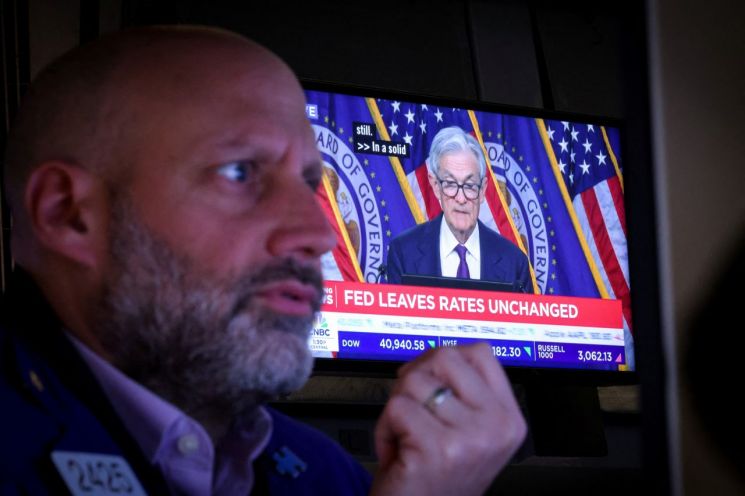
Wall Street investment banks (IBs) such as JP Morgan and Daiwa Securities analyzed that this FOMC meeting highlighted concerns about stagflation due to tariff policy, and that the Fed's monetary policy now faces major challenges.
David Kelly, chief global strategist at JP Morgan Asset Management, described the FOMC statement as "somewhat hawkish" and said, "This announcement from the Fed is a kind of warning signal to the Trump administration, with the subtext being, 'Your policies are leading to higher inflation and unemployment.'" He added, "Frankly, both sides of our (the Fed's) dual mandate are at risk, and since we cannot be confident about which direction to take, we are not going to rush into a rate cut."
Daiwa Securities commented, "The additional language in this policy statement underscores the difficulties the Fed faces regarding the potential for policy changes in the coming months," and "It suggests that concerns about stagflation are being discussed more seriously."
© The Asia Business Daily(www.asiae.co.kr). All rights reserved.













