Purchased North Korean Banknotes as Souvenirs from a Trip to China
Police: "On-site Inspection Found No National Security Concerns"
In Jeju, a post selling North Korean banknotes was uploaded on the secondhand goods trading app "Danggeun," prompting the police to investigate for potential national security concerns. According to Newsis on May 8, a sales post titled "North Korean banknotes" was posted on Danggeun on May 4. The post was uploaded by a user who had verified their location in Jeju City. The items for sale were old North Korean banknotes featuring Kim Il-sung, specifically the 5,000-won and 2,000-won notes. The asking price was 15,000 won. The seller explained, "These are banknotes I exchanged with an actual North Korean person at a Chinese airport."
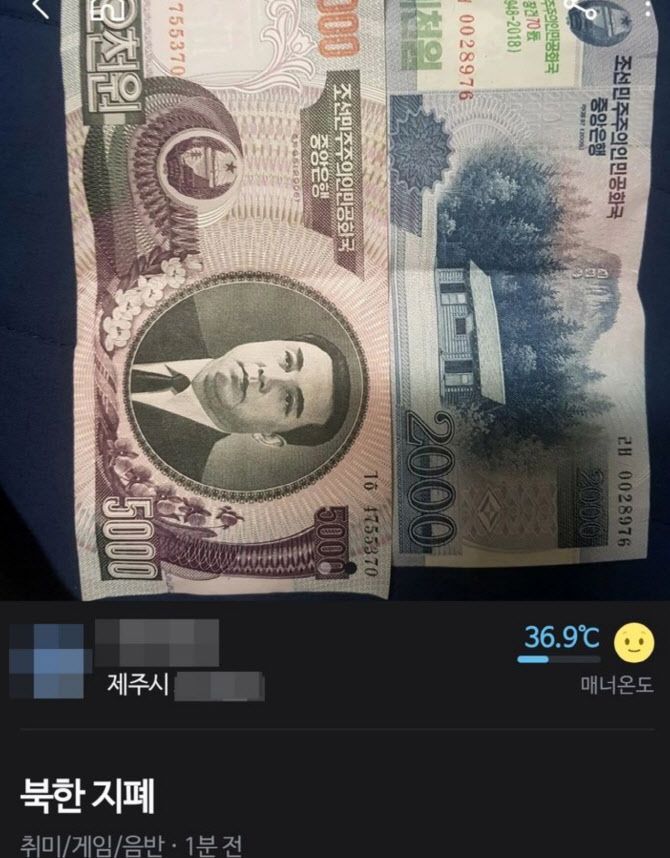 In Jeju, a post selling North Korean banknotes was uploaded on the secondhand goods trading app "Danggeun," prompting the police to investigate for potential national security concerns. According to Newsis on the 8th, a sales post titled "North Korean banknotes" was posted on Danggeun on the 4th. Secondhand goods trading app Danggeun
After obtaining this information, the Jeju Provincial Police Agency began to verify the facts, including conducting an on-site investigation, on May 6. The investigation concluded that there were no indications of national security concerns. It was found that the seller had purchased the North Korean banknotes as souvenirs during a trip to China. The post has since been deleted. The investigation confirmed that the seller was not suspected of any national security violations. It is understood that this user bought the North Korean banknotes as souvenirs during a trip to China and then posted them for sale.
However, selling North Korean banknotes may violate the Inter-Korean Exchange and Cooperation Act, so caution is advised. In addition, while buying and selling foreign currency on secondhand trading platforms like Danggeun is not illegal in itself, transactions exceeding a certain amount must be reported to the Bank of Korea under the Foreign Exchange Transactions Act. Therefore, indiscriminate trading could result in legal violations. An official from the Jeju Provincial Police Agency stated, "Buying and selling foreign currencies such as dollars or euros on secondhand trading apps may violate the Foreign Exchange Transactions Act and other regulations, so caution is required. If you come into contact with North Koreans in foreign countries such as China to exchange, distribute, or sell North Korean currency, you may be subject to punishment. Please be careful."
Meanwhile, the currency of most countries typically features symbolic figures. However, except for Chairman Kim Il-sung, North Korean banknotes only use images rather than real-life individuals. For example, instead of actual workers, farmers, or intellectuals, the notes depict representations of these professions or the general masses. This shows that currency design in North Korea is also used as a tool for regime propaganda. Since liberation, North Korea has carried out a total of five currency reforms. During the first currency reform in 1947, the 1-won, 5-won, 10-won, and 100-won notes were distinguished only by their face value and ink color, and the designs featured the same two figures: a farmer and a worker.
© The Asia Business Daily(www.asiae.co.kr). All rights reserved.
![Clutching a Stolen Dior Bag, Saying "I Hate Being Poor but Real"... The Grotesque Con of a "Human Knockoff" [Slate]](https://cwcontent.asiae.co.kr/asiaresize/183/2026021902243444107_1771435474.jpg)
















