180 Billion Won to Be Invested Over Four Years Through Ministry of Industry Project
Jeonnam Province Expects to Strengthen Competitiveness in Future Vehicle Industry
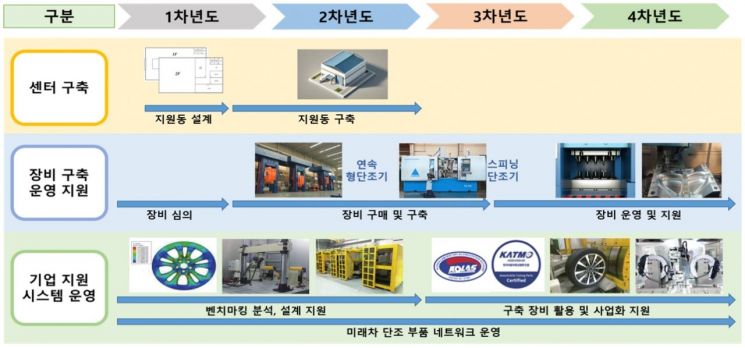 Plan for Establishing a Prototype Production Base for Low-Carbon Future Vehicle Parts at Gangjin Seongjeon Complex. Provided by Jeonnam Province
Infrastructure for prototype production of low-carbon future vehicle parts will be established in the area of Gangjin Seongjeon Industrial Complex in Jeonnam Province.
According to Jeonnam Province on May 8, the Korea Automotive Technology Institute, located at the Premium Automotive Research Center in Yeongam, was selected for the "Establishment of a Prototype Production Base for Low-Carbon Future Vehicle Parts" project, which is part of the Ministry of Trade, Industry and Energy's 2025 new automotive infrastructure initiative.
The Korea Automotive Technology Institute will serve as the lead research and development institution. Over the next four years, until 2028, a total of 18 billion won (7.7 billion won from the national government and 10.3 billion won from local governments) will be invested to build a continuous die forging machine, a spinning forging machine, a support facility for prototype production, and to provide support for companies in the Gangjin Seongjeon Industrial Complex area.
Forging is a mechanical process that shapes metal by hammering or applying pressure. When a material is placed between flat tools and hammered while changing its position, it is called open-die forging. When a material is placed between dies shaped in a specific form and hammered, it is called closed-die forging.
The main objective of the project is to promote the prototype production and technological development of high-efficiency parts, aiming to improve fuel efficiency and reduce carbon emissions in line with the government's expansion of eco-friendly vehicles.
At the national level, efforts are being made to meet the growing demand for eco-friendly vehicles and achieve carbon reduction targets. In line with this trend, demand for high-durability and lightweight parts is rapidly increasing, and domestic finished vehicle manufacturers are actively pursuing technological innovation and parts development in response.
The core of the project is to accelerate process automation and the development of lightweight and high-strength products by introducing continuous die forging equipment. Through this, the productivity of forging parts companies will be improved and their entry into the global market will be promoted.
In the automotive wheel sector, production volume is expected to increase by 55% compared to casting, and the average unit price of forged parts is expected to decrease by 68%. Annual sales are projected to reach 70 billion won, and more than 160 new jobs are expected to be created.
In addition, by establishing a prototype production base for future vehicle parts to support the transition of the forging industry, technical support from industry-academia-research consultative bodies will be provided, and efforts will be made to attract upstream and downstream industry companies.
With the establishment of a foundation for domestic companies to produce low-carbon future vehicle parts that are currently dependent on imports, the competitiveness of Jeonnam's future vehicle industry is expected to be strengthened.
An official from Jeonnam Province stated, "We will strengthen technological capabilities for low-carbon future vehicle parts and lay the foundation for enhancing the global competitiveness of the automotive industry, thereby innovating automotive parts technology and promoting collaboration."
© The Asia Business Daily(www.asiae.co.kr). All rights reserved.
![Clutching a Stolen Dior Bag, Saying "I Hate Being Poor but Real"... The Grotesque Con of a "Human Knockoff" [Slate]](https://cwcontent.asiae.co.kr/asiaresize/183/2026021902243444107_1771435474.jpg)















