A wearable optical blood pressure monitor capable of detecting hypertension even during physical activity has been developed. Conventional cuff-based blood pressure measurement methods cause discomfort by compressing the arm and require about 10 minutes of stabilization before measurement. Although smartwatch-based blood pressure measurement technologies have been developed to address these issues, their accuracy decreases in cases of hypertension or during exercise, and they also have limitations in continuously measuring blood pressure. In contrast, the wearable optical blood pressure monitor offers the advantage of enabling continuous blood pressure measurement not only while the user is at rest but also during activities such as climbing stairs.
On May 8, KAIST announced that the research team led by Professor Kihoon Jung in the Department of Bio and Brain Engineering has succeeded in developing a wearable blood pressure sensor that can be used for continuous blood pressure monitoring during exercise, utilizing hyperspectral PPG (Photoplethysmography) technology.
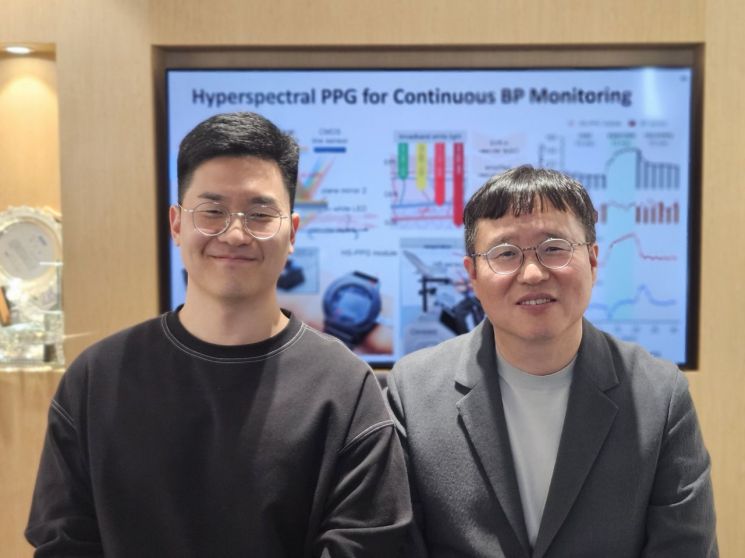 Jungwoo Park, Postdoctoral Researcher in the Department of Bio and Brain Engineering at KAIST (left), Kihoon Jung, Professor (right). Provided by KAIST
Previously, it was common for smartwatches to use PPG sensors with three wavelengths for blood pressure measurement technology, but this approach suffered from low accuracy during hypertension and exercise, as well as the inability to perform continuous measurements.
To address these limitations, the research team devised a method using a hyperspectral PPG module that includes a high-resolution, ultra-thin microspectrometer capable of analyzing light wavelengths. This module simultaneously measures PPG signals of various wavelengths and calculates continuous and precise time differences, enabling stable estimation of blood pressure.
The wearable hyperspectral PPG sensor developed by the research team not only allows for continuous monitoring of blood pressure but also measures physiological parameters such as heart rate and respiration rate simultaneously, making it possible to analyze blood pressure changes before and after exercise in detail.
This research is significant in that it enables continuous tracking of blood pressure changes during exercise, allowing for the detection of exercise-induced hypertension.
The research team demonstrated a reliability index of 0.95 for blood pressure estimation during the recovery phase after exercise, which is higher than the 0.75 achieved by other detection methods. The reliability index ranges from a minimum of -1 to a maximum of 1, with values closer to 1 indicating that predictions closely match actual values, thus proving high reliability.
Professor Kihoon Jung stated, "Hyperspectral PPG technology has the potential to be widely used in the field of personalized digital healthcare in the future."
This research was supported by the Korea Health Industry Development Institute's Korea ARPA-H project and the National Research Foundation of Korea's Global Mid-Career Researcher Program. The results, led by Jungwoo Park, a postdoctoral researcher in the Department of Bio and Brain Engineering at KAIST, were published in the international journal 'Advanced Science' on April 25.
© The Asia Business Daily(www.asiae.co.kr). All rights reserved.
![Clutching a Stolen Dior Bag, Saying "I Hate Being Poor but Real"... The Grotesque Con of a "Human Knockoff" [Slate]](https://cwcontent.asiae.co.kr/asiaresize/183/2026021902243444107_1771435474.jpg)















