Infrastructure for Space Environment and Performance Testing... Capable of Evaluating Electric Propulsion and Space Equipment Performance
Securing a Space Research Platform, Aiming to Become the Center of Domestic Space Electric Propulsion Research
Busan National University has established the country's largest "large-scale vacuum test facility for space environment simulation" and is embarking on full-scale space development research.
Busan National University (President Choi Jaewon) announced on May 8 that at the end of April, it successfully completed the installation of a large vacuum test facility, "SPACE-1 (Space Propulsion and Application Chamber for Environmental testing-1)," in the university's 8th Engineering Building and passed the Site Acceptance Test (SAT).
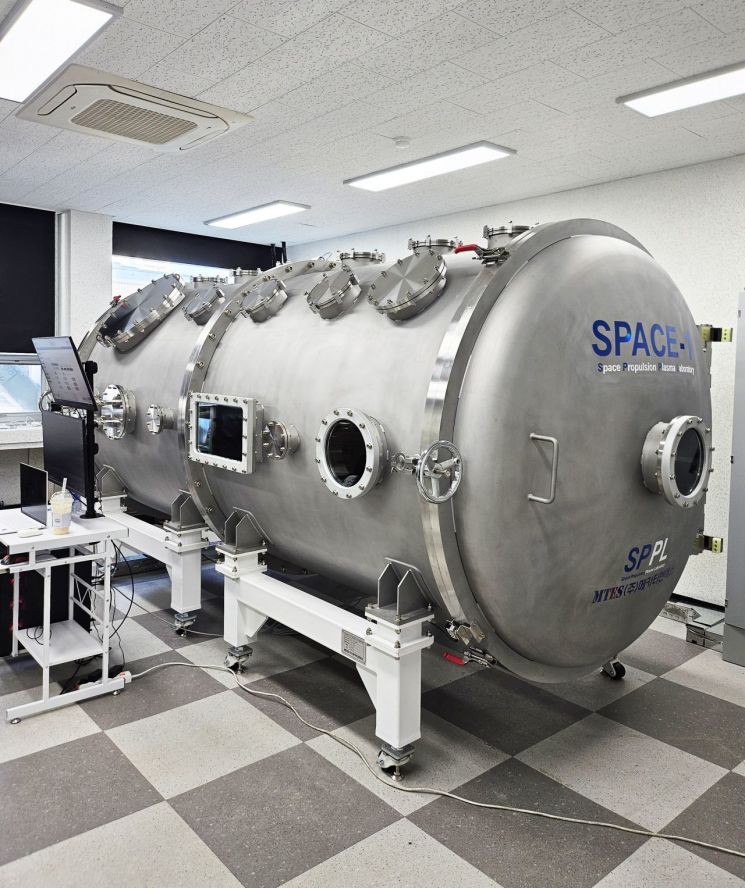
This facility was established under the leadership of Professor Kim Horak from the Department of Aerospace Engineering, who heads the Space Propulsion Plasma Laboratory. Approximately 300 million KRW was invested through the Ministry of Science and ICT's Young Researcher Infrastructure Construction Project.
The chamber, with a diameter of 1.7 meters and a length of 3.5 meters, is an unusually large-scale vacuum test infrastructure for a university research institution in Korea. It enables testing of electric propulsion systems with a capacity of up to 5 kW or more, as well as high-vacuum environment tests for satellite components, space semiconductors, and materials. The chamber maintains a vacuum level below a base pressure of 10-7 Torr and is designed to precisely evaluate the performance of various equipment, including Hall thrusters, ion thrusters, and pulsed plasma thrusters.
Professor Kim Horak stated, "This facility is more than just a test device; it will become a core foundation for the self-reliance of domestic electric propulsion technology and the development of next-generation space propulsion systems." He added, "We plan to gradually expand our research from small satellite propulsion modules to next-generation technologies for deep space exploration."
The facility is also equipped with optical sensors and probe devices to measure plasma characteristics generated during testing. There are plans to further enhance the vacuum conditions by installing additional high-vacuum pumps and graphite plates in the future.
Busan National University aims to utilize this facility to carry out government-supported projects and, through collaboration with domestic and international research institutes and companies, to establish itself as a "national hub for space propulsion system testing and performance evaluation."
© The Asia Business Daily(www.asiae.co.kr). All rights reserved.

















