The customs authorities are taking decisive action to block drug smuggling via maritime routes. Recently, the weight of maritime drug seizures has grown so large that it now accounts for more than half of all drug smuggling seizures. In response, the authorities have announced plans to significantly strengthen maritime enforcement networks to prevent Korea from being exploited as a major maritime drug smuggling route.
According to the Korea Customs Service on May 8, a total of 20 cases of drug smuggling using ships and maritime cargo were detected from 2021 through April of this year. The total weight of the seized drugs reached 3 tons. This figure represents 0.5% of all drug smuggling cases detected by the Korea Customs Service during the same period, but 53.6% of the total weight. While the number of cases is small, more than half of the total weight of seized drugs was intercepted at sea.
By period, notable cases include the seizure of 402.8 kg of methamphetamine in maritime cargo from Mexico at Busan Port in 2021, and 400 kg of cocaine in maritime cargo from Peru. In 2024, 28.4 kg of cocaine was found in the lower section of a ship from Canada at Ulsan Onsan Port, and 33.2 kg of cocaine was seized in maritime cargo from the United States at Busan Port.
This year, in April, 2 tons of cocaine (with a street value of 1 trillion won) were seized inside a ship from Mexico that docked at Gangneung Okgye Port. The amount of cocaine seized at that time was enough for 67 million people to use simultaneously, making it the largest single drug smuggling case ever detected in Korea.
Given that maritime drug smuggling cases can involve weights in the ton range per incident, the Korea Customs Service plans to further strengthen enforcement to ensure that not a single case goes undetected.
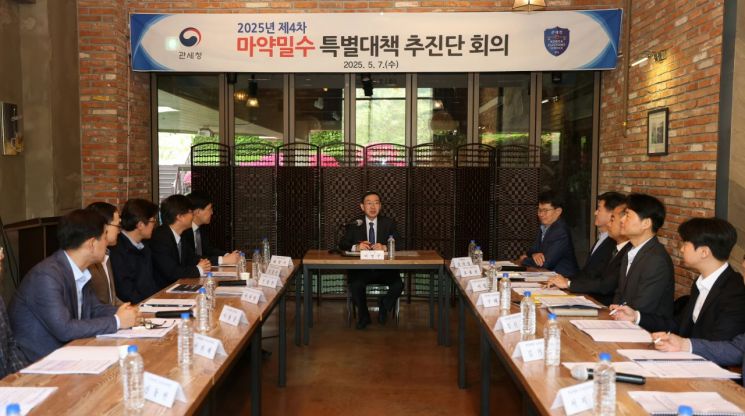 Lee Myunggu, Vice Commissioner of the Korea Customs Service, is presiding over the "4th Special Task Force Meeting on Drug Smuggling Countermeasures for 2025" at Donghae Customs on the 7th. Photo by Korea Customs Service
The previous day, the Korea Customs Service held the "4th Special Task Force Meeting on Drug Smuggling Countermeasures for 2025" to focus on discussing countermeasures against drug smuggling using ships and maritime cargo.
The meeting, presided over by Lee Myunggu, Vice Commissioner of the Korea Customs Service, primarily addressed plans to strengthen selective and intensive inspections of ships that have either departed from or transited through high-risk countries.
Based on the meeting's outcomes, the Korea Customs Service plans to expand maritime drug enforcement infrastructure by introducing advanced inspection equipment such as remotely operated underwater video devices (ROVs) for searching ship hulls, and GPS detectors capable of tracking GPS signals attached to drugs. The agency will also deploy additional drug detection dogs at major port customs offices.
In addition, special maritime cargo drug inspection teams will be formed and operated at major port customs offices, including Busan, Incheon, and Pyeongtaek, to ensure thorough inspections of cargo from high-risk countries. A new type of container scanner equipped with a backscatter function, which is effective in detecting hidden drugs, will be introduced sequentially starting at Busan Port. The backscatter function allows the visualization of scattered X-rays after colliding with the inspection target, making it easier to detect low-density organic substances such as drugs.
Furthermore, the Korea Customs Service plans to strengthen cooperation with customs authorities in major drug-originating countries in Southeast Asia and Central and South America to actively gather information on maritime drug smuggling risks.
Lee Myunggu, Vice Commissioner of the Korea Customs Service, stated, "If large quantities of drugs enter the country via maritime routes, it will cause irreparable harm to our society and citizens. The Korea Customs Service will do everything possible to ensure that not a single attempt at maritime drug smuggling succeeds."
© The Asia Business Daily(www.asiae.co.kr). All rights reserved.
![Clutching a Stolen Dior Bag, Saying "I Hate Being Poor but Real"... The Grotesque Con of a "Human Knockoff" [Slate]](https://cwcontent.asiae.co.kr/asiaresize/183/2026021902243444107_1771435474.jpg)
















