Benchmark Rate Held at 4.25-4.5% Per Annum
"Rising Unemployment and Inflation Risks"
Cautious Stance Amid Tariff-Induced Inflation Concerns
The United States Federal Reserve (Fed) has kept its benchmark interest rate unchanged for the third consecutive time, as widely expected. Although President Donald Trump repeatedly pressured for a rate cut, the Fed appears to have maintained a wait-and-see stance, intending to observe the impact of tariffs on the economy amid growing uncertainty caused by trade policy.
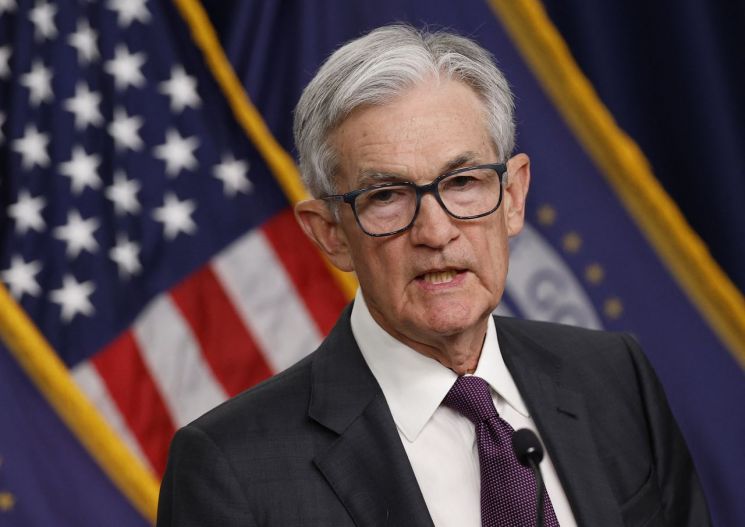
On May 7 (local time), after its regular Federal Open Market Committee (FOMC) meeting, the Fed announced in its policy statement that it had decided to hold the federal funds rate steady at 4.25% to 4.5% per annum.
After initiating a rate cut in September of last year and lowering the rate by a total of 1 percentage point from 5.25%?5.5%, this marks the third consecutive hold following similar decisions in January and March of this year. As a result, the interest rate gap with South Korea remains at 1.75 percentage points at the upper end.
In its policy statement, the Fed said, "Uncertainty about the economic outlook has increased further," and added, "The Committee is paying attention to both sides of its dual mandate (price stability and full employment)." The Fed also stated, "We judge that the risks of rising unemployment and inflation have increased," expressing concern about the possibility of stagflation, where tariffs drive up prices while slowing economic growth.
Prior to this FOMC meeting, the market had been certain that the benchmark rate would be held steady. As the Trump administration's trade policies heightened expectations of stagflation, the prevailing view was that the Fed would respond only after assessing the impact on the real economy. In particular, with inflation expected to rise due to tariff policies, there was concern that a premature rate cut could fuel inflation, leading monetary authorities to maintain a cautious stance for the time being. While there are considerable concerns about a tariff-induced economic downturn, robust employment indicators have led some analysts to believe that the Fed has the flexibility to maintain a prudent monetary policy stance.
The Fed explained, "The Committee's assessment will take into account a wide range of information, including labor market conditions, inflation pressures and inflation expectations, as well as financial and international developments."
This rate hold comes amid pressure from the Trump administration to lower rates. President Trump has called Chair Jerome Powell a "loser" and has repeatedly pushed for rate cuts. At one point, Trump even publicly raised the possibility of dismissing Powell, subjecting him to intense criticism. Treasury Secretary Scott Besant also pointed out that the yield on the two-year U.S. Treasury note, which is sensitive to monetary policy, is much lower than the benchmark rate, describing this as a signal that the Fed should lower rates and urging Chair Powell to do so.
© The Asia Business Daily(www.asiae.co.kr). All rights reserved.
![Clutching a Stolen Dior Bag, Saying "I Hate Being Poor but Real"... The Grotesque Con of a "Human Knockoff" [Slate]](https://cwcontent.asiae.co.kr/asiaresize/183/2026021902243444107_1771435474.jpg)
















