The First Major Blackout in a Renewable-Dependent Europe
Last Year, Spain's Share of Renewables Rose to 57%
"Most of the Power Grid Was Built Decades Ago"
High Volatility of Renewables Causes Frequency Instability
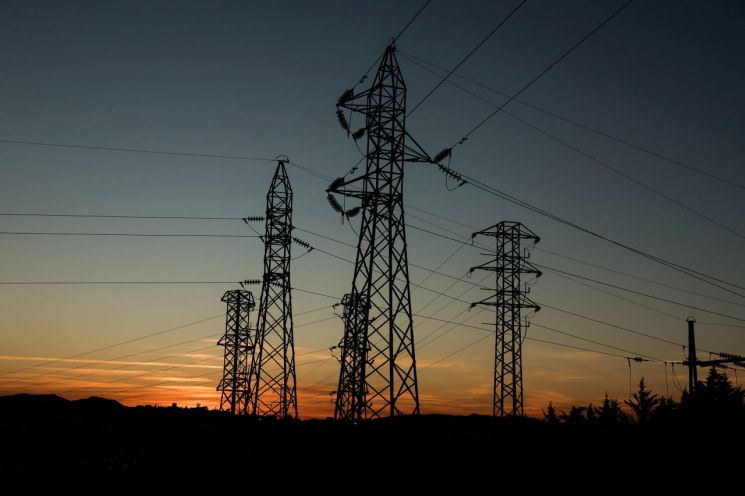 On April 28, when the blackout occurred, a power transmission line is visible against the evening sunset in the outskirts of Ronda, Spain. Photo by Reuters Yonhap News
On April 16, the Spanish power company Red Electrica declared on the social media platform X that it had "produced enough renewable energy to meet demand." However, less than two weeks later, on April 28, a massive blackout occurred in Spain, resulting in damages amounting to hundreds of millions of euros. While power authorities are investigating the exact cause of the incident, experts believe that insufficient investment in the power grid, compared to the expansion of renewable energy, is likely to have triggered the blackout.
On May 7, Bloomberg News reported, "Over the past five years, Spain's solar power capacity has increased more than fivefold, but most of the power grid infrastructure was built and installed decades ago," adding, "The nationwide blackout in Spain has exposed the vulnerabilities of the power grid."
This large-scale blackout in Spain has drawn global attention as it is the first such incident to occur in a European country that relies heavily on renewable energy. According to Statista, the share of renewables in Spain's electricity mix rose from 31% in 2011 to 57% last year. Thanks to this rapid increase, Spain has established itself as a leading country for renewable energy in Europe.
According to data released by Red Electrica in December last year, wind power accounted for the largest share of the overall energy mix at 23%, while solar power ranked third at 17%. Nuclear power held the second-highest share at 19%, and coal accounted for only 1.1%. Spain plans to expand solar power by an additional 70% by the end of the 2020s. Spain's energy roadmap, approved by the European Union (EU), includes the gradual decommissioning of all nuclear power plants between 2027 and 2035.
It has been noted that Spain has neglected investment in the power grid compared to its focus on renewables. Bloomberg News pointed out, "Over the past five years, Spain invested, on average, only 30 cents in the power grid for every dollar spent on renewable energy," adding, "This contrasts with most European countries, which invest 70 cents in the grid for every dollar spent on renewables."
Energy experts emphasize that as renewable energy expands, investments in both the power grid and energy storage systems (ESS) must also increase rapidly. This is because renewables are highly volatile depending on weather conditions, which puts a strain on the grid. European countries, including Spain, have imposed caps on grid investment out of concern that excessive spending could be passed on to electricity rates. The Spanish government is currently considering whether to raise this cap.
According to local media reports, at around 12:30 p.m. on the 28th, the day of the blackout, wind power generation surged rapidly. At the same time, an overload signal was received at a nuclear power plant, leading to the automatic insertion of control rods and the shutdown of the reactor. For some reason, solar power output also plummeted from 18 GW to 8 GW within a few seconds. As the output from renewables fluctuated sharply, the grid frequency, which is normally maintained at 50 hertz (Hz), dropped suddenly, resulting in the blackout.
As a result, there is growing speculation that the high volatility of renewables caused frequency instability in the power system, leading to the blackout. Traditional power grids?such as those based on thermal, nuclear, and hydroelectric power?are based on alternating current (AC) generated by rotating turbines, which maintains a stable frequency. In contrast, renewables like solar and wind generate direct current (DC), which must be converted to AC.
Bloomberg News explained, "Frequency is the 'heartbeat' of the power grid and is traditionally stabilized by the inertia provided by thermal, nuclear, and hydroelectric power plants," adding, "On the afternoon of the 28th, Spain relied almost entirely on electricity from solar panels, with very little contribution from these traditional sources."
Pratiksha Ramdas, an analyst at energy consulting firm Rystad Energy, told The New York Times (NYT), "The more renewables are supplied to the grid, the more sensitive the grid becomes to disturbances." Traditional generation sources such as gas turbines and nuclear power can help mitigate the intermittent fluctuations of solar and wind, but they were not operating at the time of the blackout.
Immediately after the blackout, possible causes such as extreme weather, cyberattacks, and human error were discussed. Of particular note was the possibility of a blackout caused by induced atmospheric vibration. Induced atmospheric vibration refers to abnormal operation of power lines caused by sudden temperature changes or localized weather phenomena.
However, Professor Jianzhong Wu of Cardiff University expressed skepticism about this possibility in an interview with the Science Media Centre, stating, "The weather in the affected area was good at the time of the blackout."
Spanish authorities have refuted claims that renewables were to blame for the blackout. Spain's Minister for the Ecological Transition, Sara Aagesen, said, "On the afternoon of the 28th, solar accounted for 55%, wind for 10%, nuclear for 10%, and hydro for 10% of the energy mix. In the past, the system has operated perfectly under similar conditions," adding, "It is inappropriate to place the blame on renewables."
Following the blackouts in Spain and Portugal, there have been calls for improvements to the so-called "energy island" issue. Located on the Iberian Peninsula, Spain and Portugal are geographically separated from other European countries, maintaining independent power grids.
Spain's power system is connected to Portugal, Andorra, Morocco, and France, but the interconnection capacity is only 3 GW, or 3% of total capacity. The European Union aims to increase this to 15% by 2030. Spain is currently building an interconnection with France, which, when completed in 2027, will raise the grid's interconnection capacity to 5 GW.
Meanwhile, Spain's CaixaBank estimated that the blackout last month caused losses of 400 million euros (about 635 billion won) to the Spanish economy. This amount corresponds to 0.1% of the country's quarterly GDP.
© The Asia Business Daily(www.asiae.co.kr). All rights reserved.

















