On May 7, the Ministry of Land, Infrastructure and Transport announced that it has launched the "Hydrogen Electric Train Demonstration Research and Development (R&D) Project," aiming to commercialize hydrogen trains by 2028. The project will establish hydrogen infrastructure on existing railways and operate hydrogen trains on a trial basis. Hydrogen trains offer numerous advantages, including higher energy efficiency and lower emissions of harmful substances compared to conventional diesel trains, and major countries have either already commercialized or are preparing for their adoption.
A total of 32.1 billion won will be invested in this project by 2027. Korea Railroad Corporation (KORAIL) will serve as the lead organization. Previously, core technologies for hydrogen electric trains were developed through national R&D, and the main goal of this project is to demonstrate these technologies in the field and accelerate commercialization. In this process, the institutional framework will also be established.
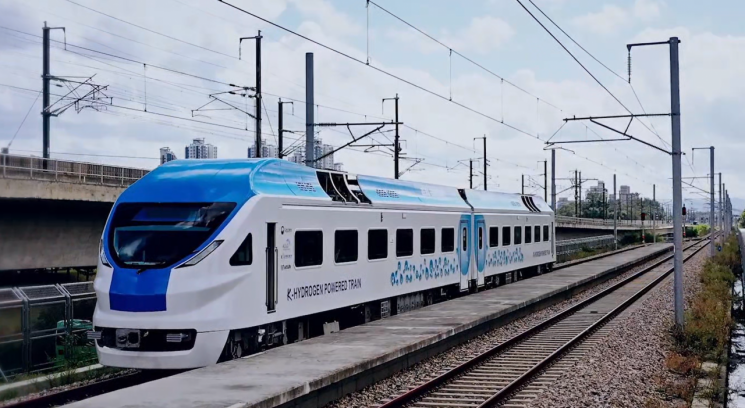
By 2027, a single two-car hydrogen electric train set for medium- and short-distance (commuter) use will be produced, featuring an output of 1.2 MW, a maximum operating speed of 150 km/h (design speed of 165 km/h), and a range of over 600 km per charge. After safety verification, including type approval, the train will be operated on a demonstration line on a trial basis.
In addition, hydrogen refueling stations and vehicle inspection facilities will be built on currently operating non-electrified lines. By operating the hydrogen electric train alongside these facilities, the project will verify the performance and suitability of the operational infrastructure, and establish technical standards and operational management regulations.
Hydrogen trains generate electricity by supplying hydrogen stored in onboard tanks to a fuel cell, which then powers an electric motor to provide propulsion. As they do not require external power supply, the Ministry explained that hydrogen trains can improve rail accessibility even in non-electrified areas where electrification is difficult. The government expects that hydrogen trains will be more than twice as energy efficient as diesel trains, and since they emit no carbon, replacing aging diesel trains with hydrogen trains could significantly reduce both economic and environmental costs.
On May 8, the Ministry of Land, Infrastructure and Transport plans to hold a project launch briefing with Korea Railroad Corporation, Korea Railroad Research Institute, and other implementing organizations. Jung Ikyeong, Director of Railway Safety Policy at the Ministry, stated, "By commercializing our hydrogen trains early, we will secure a leading position in the global market and establish a new growth engine for the future railway industry." He added, "The activation of related upstream and downstream industries, such as core components and infrastructure for hydrogen trains, will also contribute to the expansion of the hydrogen mobility industrial ecosystem."
© The Asia Business Daily(www.asiae.co.kr). All rights reserved.

















