Relocation of Gwangju Civil-Military Airport and Construction of Southwestern Gateway Airport
Exemption from Preliminary Feasibility Study for Gwangju-Daegu Dalbit Railway Project
Highlighting the Need for Advancements in Science, Culture, and Labor Market Reform
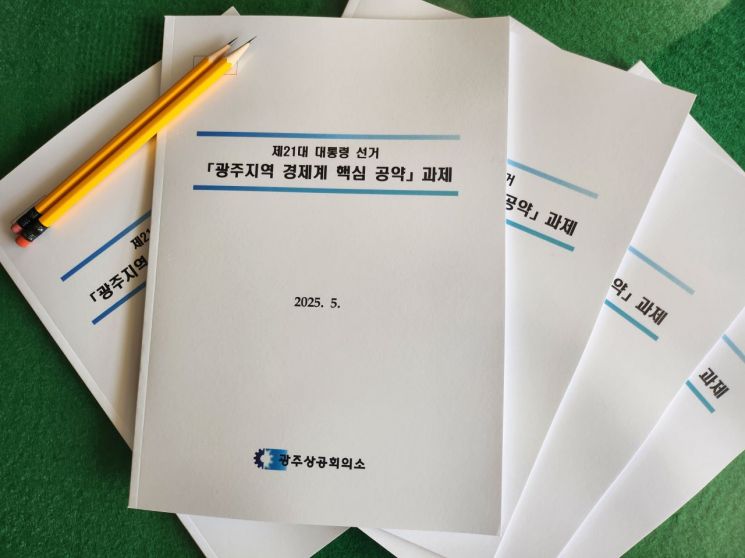 The 21st Presidential Election, Key Economic Policy Agenda for the Gwangju Region. Provided by Gwangju Chamber of Commerce and Industry
The Gwangju Chamber of Commerce and Industry announced on May 7 that it has identified 16 key policy pledges reflecting the voices of the local business community ahead of the 21st presidential election. The chamber plans to deliver these pledges to the campaign teams of major party candidates, including the Democratic Party of Korea and the People Power Party.
These policy proposals were developed by collecting opinions from local industry sites and the business sector, with a focus on tasks aimed at balanced national development and strengthening industrial competitiveness. Notably, the agenda covers a wide range of mid- to long-term core tasks for the sustainable development of both Gwangju and South Jeolla Province, going beyond immediate local economic issues.
First, the Gwangju Chamber emphasized that the prompt relocation of the Gwangju civil-military airport and the construction of a gateway airport in the southwestern region are essential tasks that would benefit both the region and the military. The chamber called for the revision of the Special Act on the Relocation of Military Airports and for the relocation to be led by the central government.
Another major task included is the establishment of a super-regional energy economic community in the southwest. This initiative aims to link the power grid, hydrogen, renewable energy, and energy-specialized industrial complexes across Gwangju, South Jeolla, and North Jeolla Provinces, enhancing both national energy security and industrial competitiveness. The chamber expects significant synergy effects through super-regional cooperation.
The chamber also pointed out delays in the follow-up procedures for exempting the preliminary feasibility study for the Gwangju-Daegu Dalbit Railway project and called for firm financial and policy implementation to ensure early construction within the next presidential term. Other key proposals for balanced national development and strengthening local innovation capabilities include: ▲the second phase of relocating public institutions to local areas ▲stable financial support for Korea Institute of Energy Technology (KENTECH) ▲promotion of exemption from the preliminary feasibility study for the second phase of the Gwangju AI ecosystem project, 'AX Demonstration City.'
In the area of science and technology infrastructure, the chamber argued that Gwangju, as a hub for AI and materials industries, is the optimal location for large-scale basic science research facilities. In the cultural sector, the need to attract three major national cultural institutions?the Gwangju branch of the National Museum of Modern and Contemporary Art, the National Assembly Gwangju Library, and the Gwangju branch of the National Museum of Korean Contemporary History?through balanced regional allocation was also emphasized.
To address the climate crisis and rural depopulation, the chamber proposed expanding the adoption of agrivoltaics and amending the Farmland Act. Agrivoltaics, which combines agriculture and power generation, is evaluated as a representative convergence policy that can increase farm household income and contribute to the national goal of expanding renewable energy.
In terms of labor market system reform, the chamber raised the need for: ▲shifting the Serious Accidents Punishment Act to a prevention-oriented approach and amending the law ▲improving the employment permit system for foreign workers ▲operating the 52-hour workweek system more flexibly. The chamber particularly pointed out that the current work hour regulations, which are uniformly applied regardless of site conditions, significantly restrict the productivity of small and medium-sized enterprises, and called for legal amendments to allow flexible adjustments based on labor-management agreements.
Additionally, the Gwangju Chamber stated, "Provisions that effectively restrict claims for damages against illegal acts undermine the principle of the rule of law and pose a serious threat to the competitiveness of our industrial sites," and requested that the so-called Yellow Envelope Act be handled with caution.
In the area of taxation, the chamber proposed a structural overhaul to enhance business continuity and investment incentives, including: ▲easing requirements and raising limits for business succession deductions ▲lowering inheritance tax rates and adjusting tax bases ▲reducing corporate tax rates to the OECD average level.
Chairman Han Sangwon stated, "These policy proposals are not simply local grievances, but realistic policy tasks to support the sustainable growth of Gwangju and South Jeolla Province. We hope that each party and presidential candidate will actively accept the proposals of the local business community and reflect them in their policies."
Meanwhile, on May 3, the Gwangju Chamber held a meeting with Democratic Party of Korea National Talent Committee Chairman Jung Sung-ho, National Assembly member Min Hyungbae, and others, to convey the local business community's opinions on these policy proposals.
© The Asia Business Daily(www.asiae.co.kr). All rights reserved.
![Clutching a Stolen Dior Bag, Saying "I Hate Being Poor but Real"... The Grotesque Con of a "Human Knockoff" [Slate]](https://cwcontent.asiae.co.kr/asiaresize/183/2026021902243444107_1771435474.jpg)















