UNDP Releases Human Development Report
South Korea's Score Improves, but Ranking Falls
Iceland Tops the List for Highest Quality of Life
In the Human Development Index (HDI) rankings, which assess the quality of life in each country and are published by the United Nations Development Programme (UNDP), South Korea ranked 20th in the world, dropping one spot from the previous year. Although the actual score improved, the ranking fell. The life expectancy of South Koreans was 84.3 years, which was among the highest among all top HDI countries, second only to Hong Kong (85.5 years).
According to the "2025 Human Development Report" released by the UNDP on May 6 (local time), South Korea's HDI was recorded at 0.937 as of 2023, ranking 20th among 193 countries and regions surveyed. This represents an improvement in the score compared to the previous year (0.928, 19th place), but a decline in ranking. The HDI is calculated based on four objective indicators: life expectancy, expected years of schooling, mean years of schooling, and per capita Gross National Income (GNI).
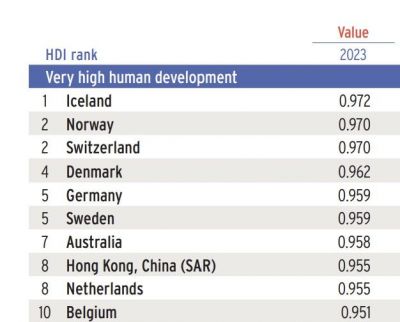 List of Top 10 Countries by Human Development Index (HDI). United Nations Development Programme (UNDP) "2025 Human Development Report"
South Korea's HDI was only 0.738 in 1990, but has steadily risen since then, placing in the top group of countries in recent years, including ranking 12th in both 2010 and 2012. As of 2023, South Korea's life expectancy was 84.33 years, with expected years of schooling and mean years of schooling at 16.62 years and 12.72 years, respectively. Per capita GNI, based on purchasing power parity (PPP), was estimated at $49,726.
Globally, the HDI stood at 0.756, almost unchanged from the previous year's 0.752. Iceland ranked first in the HDI rankings. As of 2023, Iceland recorded a Human Development Index of 0.972. Although its life expectancy was 1.64 years shorter than that of South Korea, its expected years of schooling and mean years of schooling were 2.23 years and 1.19 years longer, respectively, and its per capita GNI was $69,117.
This was followed by Norway (0.970), Switzerland (0.970), Denmark (0.962), Germany (0.959), Sweden (0.959), Australia (0.958), Hong Kong (0.955), the Netherlands (0.955), and Belgium (0.951). Japan ranked 23rd with a score of 0.925, up one spot from the previous year. China ranked 78th with a score of 0.797, down three spots from 75th the previous year.
The country ranked lowest, at 193rd, was South Sudan (0.388), which continues to experience civil war among warlords. Somalia (0.404), the Central African Republic (0.414), and Chad (0.416) also remained at the bottom, as they did last year. North Korea was not ranked in this report due to insufficient available information.
The UNDP stated that, except for 2020 and 2021 when COVID-19 swept the globe, the pace of improvement in human quality of life has been at its lowest in 35 years since 1990, noting that "unexpectedly weak progress has emerged instead of sustained recovery." The report also pointed out that inequality between wealthy developed countries and poorer nations has deepened, and urged that "as traditional development pathways come under pressure, decisive action is needed to break out of a prolonged stagnation in quality of life improvement."
Meanwhile, this report also included the results of a global survey on the impact of artificial intelligence (AI) on human life. About half of respondents said that the work they do could be automated by AI. However, 6 out of 10 respondents believed that new jobs would be created and employment would increase, while only 13% predicted that jobs would decrease, according to the UNDP.
© The Asia Business Daily(www.asiae.co.kr). All rights reserved.
![Clutching a Stolen Dior Bag, Saying "I Hate Being Poor but Real"... The Grotesque Con of a "Human Knockoff" [Slate]](https://cwcontent.asiae.co.kr/asiaresize/183/2026021902243444107_1771435474.jpg)















