KOSPI Starts Higher, KOSDAQ Downward Trend
Short-term Recovery to 2,600 Expected
No Need to Worry About 'Sell in May' This Year
Won-Dollar Exchange Rate Expected to Stabilize Downward
The KOSPI started on an upward trend after the holiday break. The market believes that a short-term recovery to the 2600 level is possible. Although there is a saying, "Sell in May," some analysts argue that a positive outlook is warranted for May this year.
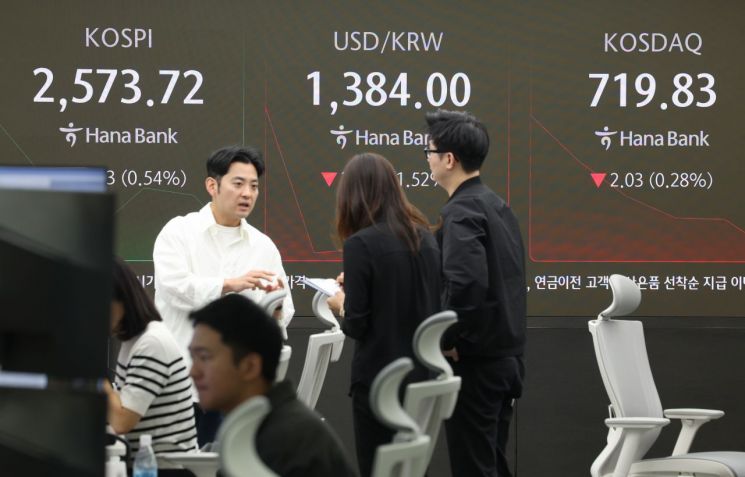
As of 9:30 a.m. on May 7, the KOSPI was trading at 2,568.80, up 9.01 points (0.35%) from the previous session. The KOSDAQ was down 5.12 points (0.71%) at 716.74.
During the holiday, U.S. stock markets posted strong gains over the weekend on the back of solid economic indicators, but the upward momentum was tempered this week due to issues such as trade negotiations. Han Ji-young, a researcher at Kiwoom Securities, said, "During the three trading days when the domestic market was closed, U.S. stock markets showed strength at first but weakened later. The easing of recession fears due to strong U.S. April employment data and a robust ISM Services PMI, as well as steady capital expenditure (CAPEX) demand among AI stocks within the Magnificent 7 (M7), provided upward momentum. However, downward factors?such as news of President Donald Trump imposing tariffs on film and pharmaceutical products, friction in negotiations with Canada, continued negative impact from Apple's weak earnings, and Palantir's share price decline due to valuation concerns despite its earnings surprise?gradually gained the upper hand, leading to overall market weakness," he analyzed.
In particular, the market is expected to focus on the impact of the appreciation of the Korean won (decline in the exchange rate) observed during the holiday period. The value of the Korean won surged in tandem with a sharp rise in the value of the Taiwan dollar. In the New York non-deliverable forward (NDF) market, the won-dollar exchange rate continued to fall during the holiday, dropping to the 1,360 won range during intraday trading on May 5. On this day, the won-dollar exchange rate opened at 1,380.0 won in the Seoul foreign exchange market, down 25.3 won.
Lee Kyung-min, a researcher at Daishin Securities, explained, "The sharp rise in the value of the Taiwan dollar was mainly due to concerns that there could be upward pressure on the currency in U.S.-Taiwan trade negotiations amid easing U.S.-China tensions. As the value of the Taiwan dollar soared, Taiwanese financial institutions and companies with large holdings of U.S. assets increased their demand for currency hedging, further strengthening the Taiwan dollar." He added, "In this process, Korea, which has benefited from a current account surplus with the United States similar to Taiwan, could not escape concerns about becoming a target for Trump. In particular, Korea has an economic structure similar to Taiwan and a relatively large foreign exchange market. As a result, the Korean won stood out as an indirect hedging asset, and the sharp rise in the Taiwan dollar was accompanied by a widening decline in the won-dollar exchange rate."
The prevailing outlook is that the won-dollar exchange rate will stabilize downward. Lee said, "As the won-dollar exchange rate quickly moves to a lower level, there is a possibility that domestic companies and institutions may rush to sell dollars, so the possibility of a further decline in the exchange rate should be kept open. However, given that a weak dollar trend is likely to persist in the first half of the year, the downward stabilization of the won-dollar exchange rate remains valid. Also, considering that a wait-and-see stance may emerge ahead of the release of the May FOMC results in the early morning of May 8 in the United States, the won-dollar exchange rate may adjust its pace in the short term rather than continuing a sharp downward trend immediately. Thereafter, the won-dollar exchange rate is expected to continue its downward stabilization toward the mid-1,300 won range."
There are forecasts that the "Sell in May" strategy will not work in the stock market this May. Kim Jong-min, a researcher at Samsung Securities, said, "Market volatility has not yet subsided, and investors are closely monitoring the direction of U.S. tariff policies. In addition, concerns about the 'Sell in May' strategy, in which investors sell stocks and leave the market in May, are also present. However, it is highly likely that this strategy will not apply to the Korean stock market this year. In past periods of decline in May, foreign investors were the main sellers, but given the current exchange rate environment and KOSPI valuation, the possibility of further foreign selling is limited." He added, "Rather than foreign investors, institutional buying is clearly increasing, which is a different situation from previous 'Sell in May' phases."
There are expectations that the KOSPI could break through the 2,600 level in the short term. Kim said, "The KOSPI surpassed the 2,550 level before the holiday, and it appears possible to break through the 2,600 level in the short term. However, uncertainties over U.S.-China trade negotiations, controversies arising from the results of trade negotiations with major countries, and the process of confirming economic indicators reflecting Trump's tariff policies should be taken into account for short-term fluctuations. This will serve as a process to relieve short-term overheating and absorb supply, providing another buying opportunity." He added, "Solid exports from Korea, upward revisions to earnings forecasts led by the semiconductor sector, and a shift to net buying by foreign investors due to appreciation pressure on the won are expected to further boost the KOSPI's rebound momentum, so we maintain our outlook for the KOSPI to break through the 2,700 level in the second quarter."
© The Asia Business Daily(www.asiae.co.kr). All rights reserved.

















