A recent study found that more than 7.6 million tons of greenhouse gases were emitted due to the wildfires that began in Uiseong last March and subsequently spread to Gyeongnam, Gyeongbuk, and Ulsan (hereafter referred to as the Uiseong wildfires). This amount is equivalent to the greenhouse gas emissions produced by 71.75 million mid-sized cars making a round trip between Seoul and Busan (800 km).
The National Institute of Forest Science announced on May 7 that, based on the provisional wildfire-affected area of 104,000 hectares for the Uiseong wildfires, a recalculation of greenhouse gas emissions estimated that 7.64 million tons (CO2eq) of greenhouse gases were released.
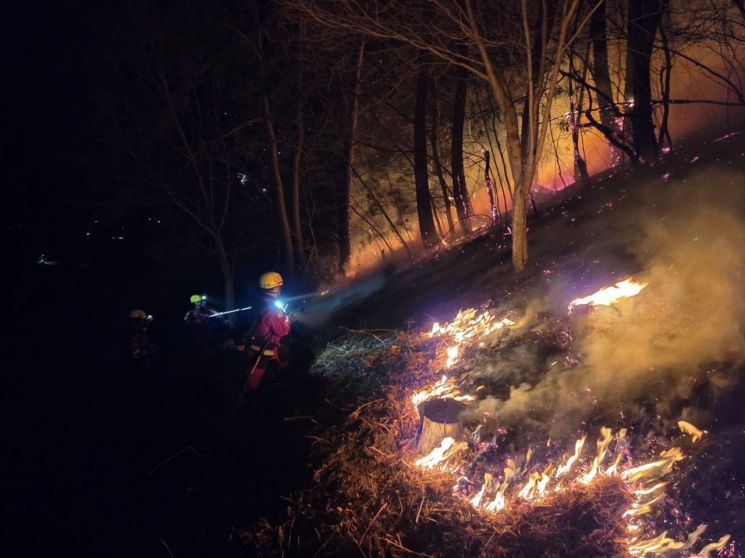 Firefighters are conducting nighttime wildfire suppression activities at the wildfire site in Sancheong, Gyeongnam, last March. Provided by Korea Forest Service
According to the recalculated figures, the greenhouse gas emissions from the wildfires amounted to 6.776 million tons of carbon dioxide (CO2), 568,000 tons of methane (CH4), and 298,000 tons of nitrous oxide (N2O), all expressed in carbon dioxide equivalent (CO2eq). The CO2 equivalent is a standardized metric that accounts for the different contributions of each greenhouse gas to global warming, with CH4 multiplied by 28 and N2O by 265 for conversion.
The recalculated greenhouse gas emissions were based on the wildfire-affected area recently confirmed by the Central Disaster and Safety Countermeasures Headquarters. This differs from the emissions figures previously announced by the forest authorities on April 8, which were based on the wildfire impact zone.
The wildfire impact zone is a reference used for developing wildfire suppression strategies and is not the same as the actual damaged area confirmed through on-site investigation after the fire has been extinguished.
Additionally, the recalculated emissions are estimates based on the currently confirmed wildfire-affected area and may change in accordance with the official statistics that will be published following further damage assessments, according to the National Institute of Forest Science.
Kim Raehyun, head of the Forest Carbon Research Center at the National Institute of Forest Science, stated, "Wildfires not only release carbon that has been stored for centuries in an instant, but also weaken the forest's absorption capacity. Since wildfires can turn forests from carbon sinks into carbon sources, it is important to refrain from burning near forests and to make efforts to prevent wildfires."
© The Asia Business Daily(www.asiae.co.kr). All rights reserved.
![Clutching a Stolen Dior Bag, Saying "I Hate Being Poor but Real"... The Grotesque Con of a "Human Knockoff" [Slate]](https://cwcontent.asiae.co.kr/asiaresize/183/2026021902243444107_1771435474.jpg)















